Timely delivery: Ribonucleoside 3'-phosphates as pro-moieties for an orally administered drug
Aug 06, 2012
Timely delivery: Ribonucleoside 3'-phosphates as pro-moieties for an orally administered drug

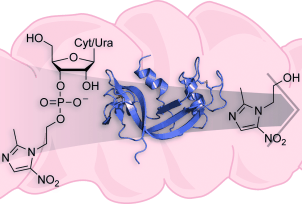
(Phys.org) -- Many drug candidates fail because of low solubility or poor pharmacokinetic behavior. Ron Raines and colleagues at the University of Wisconsin–Madison (USA) have devised a new prodrug strategy to overcome these limitations. Their approach takes advantage of the capacity of an enzyme prevalent in human serum–pancreatic-type ribonuclease—to catalyze the cleavage of a drug conjugated to a ribonucleoside 3'-phosphate; the results of their work are reported in ChemMedChem.

They demonstrated efficacy by using metronidazole, a sparingly soluble antibiotic that is often administered orally. In the absence of ribonuclease, metronidazole conjugates are stable and inactive. Physiological levels of enzyme render the conjugate toxic to Bacteroides fragilis, a common penicillin-resistant bacillus that is responsible for anaerobic infections. Alterations to the ribonucleoside enable modulation of key attributes, such as the rate of drug delivery.

This study paves the way for further research into the activation and timed release of drugs of varying aqueous .

Explore further: Cell research: enzyme questions important principle of evolution

More information: Ronald T. Raines, Ribonucleoside 3'-Phosphates as Pro-Moieties for an Orally Administered Drug, ChemMedChem 2012, 7, No. 8, dx.doi.org/10.1002/cmdc.201200243

add to favorites email to friend print save as pdf

Related Stories

Researchers make neurological disease breakthrough

Oct 07, 2011

(Medical Xpress) -- Results of a study by a group of University of Notre Dame researchers represent a promising step on the road to developing new drugs for a variety of neurological diseases.

Research team gives drug dropouts a second chance

May 07, 2012

(Phys.org) -- A cross-disciplinary team of researchers at the University of Maryland has designed a molecular container that can hold drug molecules and increase their solubility, in one case up to nearly ...

Recommended for you

Scientists develop advanced biological computer

16 hours ago

(Phys.org) —Using only biomolecules (such as DNA and enzymes), scientists at the Technion-Israel Institute of Technology have developed and constructed an advanced biological transducer, a computing machine capable of manipulating ...

Research aims to fix long-held, inaccurate insect model

17 hours ago

(Phys.org) —In humans, a polymer called melanin determines skin, eye and hair color—the darker the skin, the more melanin in a person's body. For insects, melanin is a major aspect of their immune defense ...

Molecular modelling to help create better, safer drugs

17 hours ago

(Phys.org) —How our bodies break down the common drugs ibuprofen, diclofenac and warfarin is the subject of a new study from the University of Bristol, published in the Journal of the American Chemical So ...

User comments : 0

More news stories

Scientists develop advanced biological computer

(Phys.org) —Using only biomolecules (such as DNA and enzymes), scientists at the Technion-Israel Institute of Technology have developed and constructed an advanced biological transducer, a computing machine capable of manipulating ...

Galaxies fed by funnels of fuel

(Phys.org) —Computer simulations of galaxies growing over billions of years have revealed a likely scenario for how they feed: a cosmic version of swirly straws.