California's temporary workers face increased likelihood of poverty, says new study
(Phys.org)—California's temporary workers are twice as likely as other employees in the Golden State to live in poverty, receive food stamps and be on Medicaid, according to a new report from UC Berkeley's Center for Labor Research and Education.
Temporary workers are found in blue-collar positions such as landscaping, housekeeping or data entry jobs, but also in white-collar worlds such as nursing, accounting and computer programming. These threats of diminished circumstances and eroded wages apply to nearly a quarter-million California workers in the temporary help industry, and another 37,000 people working for employee leasing/employment services firms.
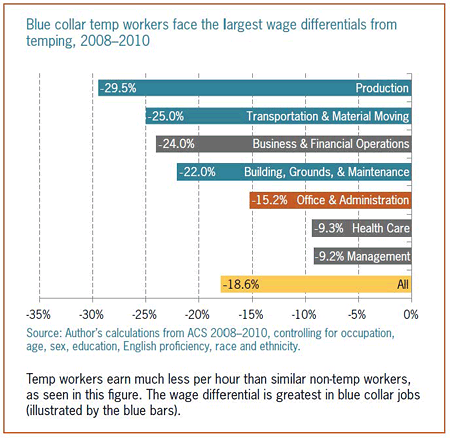
The report, based on data from 2010, notes that workers hired through staffing agencies earn an average of 18 percent less per hour than workers with the same characteristics in the same occupations. They also are less likely to receive health insurance benefits.
"These lowered wages mean that contingent workers rely more on the state safety net," said author Miranda Dietz, a research data analyst for the Center for Labor Research and Education, in the report.
These workers' problems should be of concern to everyone, said Dietz, because the reliance of temp workers on state aid exacerbates already serious state budget problems, and negatively affects wages for similar, non-temporary jobs while undermining existing provisions protecting workers.
Suggested solutions generally range from raising the minimum wage and providing medical leave to these workers, but the report notes additional ideas. They include increasing enforcement of employment regulations that protect workers, expanding employment liability for regulation enforcement to include not just the staffing agencies but also the companies that use temporary workers, and assigning responsibility to enforce worker protections to the entity best able to deter safety violations.
"California is not alone in its struggle with the problems of contingent and temporary work," wrote Dietz. "But…we must consider what is needed to provide both a vibrant economy and decent conditions for those who create it."
Starting with pay, the outlook for these workers is dimmer than for others, according to Dietz. She estimated that, in 2010, the median hourly wages were $13.72 for temporary workers and $19.72 for other California workers. Once a worker's age, race, gender and levels of education and English proficiency are taken into account, temporary workers still make about 18 percent less an hour than their non-temporary counterparts, with an even bigger gap for blue-collar temp workers in fields such as transportation and production.
In addition to earning poor pay and few, if any, benefits, Dietz said these workers are more susceptible to wage and hour violations, along with workplace illness and injury. This may be because, according to Dietz, many temporary workers may not complain about violations for fear of not being invited back to work by the staffing agency or the company using the agency. Even if workers do speak up, Dietz said that proving that the company using the staffing agency has engaged in either retaliation against a worker or violations of worker rights is difficult.
If staffing agencies alone are held accountable for violations, Dietz noted, small staffing firms may go out of business, never paying workers what they are owed and insulating the company that hired the staffing agency from obligations to the temporary workers.
Provided by University of California - Berkeley


