New technique controls graphite to graphene transition
Jul 02, 2012
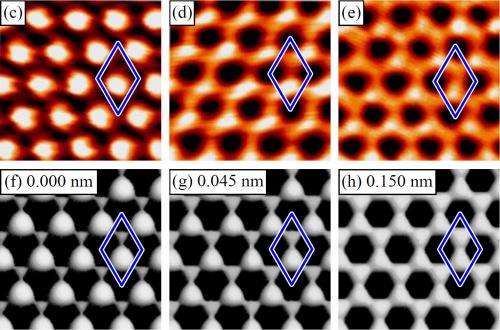
The top three images of graphite are from the experiment and the lower three images were produced through theoretical calculations. The images from left to right show more displacement of the top layer of graphite and its transition to graphene.

(Phys.org) -- University of Arkansas physicists have found a way to systematically study and control the transition of graphite, the “lead” found in pencils, to graphene, one of the strongest, lightest and most conductive materials known, an important step in the process of learning to use this material in modern day technology.

Peng Xu, Paul Thibado, Yurong Yang, Laurent Bellaiche and their colleagues report their findings in the journal Carbon.

at the University of Manchester first isolated graphene, a one atom thick sheet of carbon atoms, by using Scotch tape to lift only the top layer off of the other layers of graphite. Electrons moving through graphite have mass and encounter resistance, but electrons moving through graphene are massless and encounter almost no resistance, which makes graphene an excellent candidate material for future energy needs and for quantum computing for enormous calculations while using little energy.

However, graphene is a new material only discovered in 2004, and many things remain unknown about its properties.

“The transition from graphite to graphene can be random,” said Xu. “Our idea was to control this.”

The researchers used a new technique called electrostatic manipulation scanning tunneling microscopy to “lift” the top layer of graphite, creating graphene. Scientists have traditionally used scanning tunneling microscopy on a stationary surface, but this new technique uses a moving surface to move between graphite and graphene.

“Not only can we make it happen, but we can control the process,” Xu said.

Using this technique, the researchers can tell how much force it takes to create graphene and how much distance exists between graphene and the as well as to track the total energy of the process.

How the electron acquires its mass is a fundamental topic and is related to particle physicists’ hunt for the Higgs boson, a long-hypothesized elementary particle that has predicted properties, such as a lack of spin and electric charge, but that does not have a predicted value for mass. Being able to move electrons between a massive and massless state allows scientists to study this duality and how it works. The level of control the scientists have over the process will allow them to figure out possible ways to use for advancing this understanding.

Explore further: Hybrid material as gold-leaf substitute

Related Stories

Graphite + water = the future of energy storage

Jul 15, 2011

A combination of two ordinary materials – graphite and water – could produce energy storage systems that perform on par with lithium ion batteries, but recharge in a matter of seconds and have an ...

Seeing an atomic thickness

May 19, 2011

Scientists from NPL, in collaboration with Linkoping University, Sweden, have shown that regions of graphene of different thickness can be easily identified in ambient conditions using Electrostatic Force ...

Strong bonds between rare-earth metals and graphene

Sep 28, 2011

(PhysOrg.com) -- Transistors and information storage devices are getting smaller and smaller. But, to go as small as the nanoscale, scientists must understand how just a few atoms of metals behave when deposited ...

Recommended for you

Hybrid material as gold-leaf substitute

14 hours ago

(Phys.org) —A team of researchers headed by Professor Raffaele Mezzenga has created a hybrid material out of gold and milk proteins that looks like a wafer-thin gold leaf. Thanks to its properties, it could ...

Antioxidant with a long shelf life

Jun 17, 2013

(Phys.org) —Scientists from ETH Zurich have developed a nanomaterial that protects other molecules from oxidation. Unlike many such active substances in the past, the ETH-Zurich researchers' antioxidant ...

Fast pollutant degradation by nanosheets

Jun 17, 2013

(Phys.org) —Waste from textile and paint industries often contains organic dyes such as methylene blue as pollutants. Photocatalysis is an efficient means of reducing such pollution, and molybdenum trioxide ...

Unzipped nanotubes unlock potential for batteries

Jun 13, 2013

(Phys.org) —Researchers at Rice University have come up with a new way to boost the efficiency of the ubiquitous lithium ion (LI) battery by employing ribbons of graphene that start as carbon nanotubes.

Nanoparticle opens the door to clean-energy alternatives

Jun 13, 2013

(Phys.org) —Cheaper clean-energy technologies could be made possible thanks to a new discovery. Research team members led by Raymond Schaak, a professor of chemistry at Penn State University, have found ...

User comments : 1

Adjust slider to filter visible comments by rank

Display comments: newest first

antialias_physorg
not rated yet Jul 02, 2012
How the electron acquires its mass is a fundamental topic and is related to particle physicists hunt for the Higgs boson, a long-hypothesized elementary particle that has predicted properties, such as a lack of spin and electric charge, but that does not have a predicted value for mass. Being able to move electrons between a massive and massless state allows scientists to study this duality and how it works.

Aren't we confusing 'mass' and 'effective mass' here?

More news stories

3D printing tiny batteries

(Phys.org) —3D printing can now be used to print lithium-ion microbatteries the size of a grain of sand. The printed microbatteries could supply electricity to tiny devices in fields from medicine to communications, ...

Future looks bright for carbon nanotube solar cells

(Phys.org) —In an approach that could challenge silicon as the predominant photovoltaic cell material, University of Wisconsin-Madison materials engineers have developed an inexpensive solar cell that exploits ...

Hybrid material as gold-leaf substitute

(Phys.org) —A team of researchers headed by Professor Raffaele Mezzenga has created a hybrid material out of gold and milk proteins that looks like a wafer-thin gold leaf. Thanks to its properties, it could ...

World's most powerful microscope ready for research

(Phys.org) —The world's most powerful microscope, which resides in a specially constructed room at the University of Victoria, has now been fully assembled and tested, and has a lineup of scientists and businesses eager ...

Origins of 'The Hoff' crab revealed (w/ Video)

The history of a new type of crab, nicknamed 'The Hoff' because of its hairy chest, which lives around hydrothermal vents deep beneath the Southern Ocean and Indian Ocean, has been revealed for the first ...