Team of students and faculty designs product to increase childhood immunization rates in developing countries
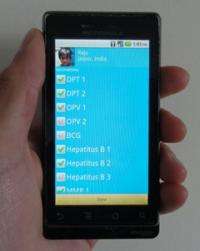
A multidisciplinary team of students and faculty members has been recognized with an international design award for their development of a smart phone application that makes it easier for children in developing countries to receive life-saving vaccinations.
The application, called IMMUNE, was chosen among entries from 17 countries to receive the Design for All Foundation’s top award at the organization’s annual meeting in Barcelona.
The Design for All Foundation is an international organization that promotes participation in the construction of society by all people regardless of age, gender, capabilities, or cultural background. This includes equal opportunities to participate in economic, social, cultural, and recreational activities with as much independence as possible.
“We realized more than 30 million children in India lack proper immunizations, either because vaccines are unavailable or because healthcare services are poorly provided or inaccessible,” said Akshay Sharma of Blacksburg, Va., assistant professor of industrial design in the School of Architecture + Design in the College of Architecture and Urban Studies.
Sharma, a native of India, said one of the largest medical problems in developing countries was the lack of a standardized system to keep vaccination records easily accessible for healthcare workers, which is partially responsible for low rates of vaccinations.
“I have been worried about the fabric of our society with almost four billion people living below the poverty line,” he said. “They survive on less than $2 a day and will never make up a viable consumer base."
The idea for the project was influenced by an ethnographic study Sharma conducted in an impoverished area of his hometown in Jaipur, Rajasthan, India, in the summer of 2010. Sharma says he learned that parents in these areas felt that an ornament blessed by a deity was better protection against disease than proper vaccinations.
Along with Aditya Johari of Roanoke, Va., assistant professor of engineering education in the College of Engineering who is also from India, Sharma formed a team of faculty members and students to create a method by which vaccines can be delivered efficiently and one in which vaccination records are easy-to-use, inexpensive, and scalable.
Other members of the team were
• Susan Wyche of Blacksburg, Va., assistant professor at Michigan State University and Fellow at Virginia Tech’s Center for Human-Computer Interaction;
• Peter Beegle of Hudson, Ohio, a junior majoring in industrial design in the College of Architecture and Urban Studies; and
• Jonathan Ballands of Kingwood, Texas, a junior majoring in computer science in the College of Engineering.
“The shared passion for social impact and the different backgrounds made it easy to form an interdisciplinary collaborative team,” Sharma said. “Each team member brought a different area of expertise to the group, which created an effective platform for working on complex issues.”
The IMMUNE design replaces tedious paper-based records with Android-based smart phones. It works by placing a Quick Response (QR) code on an object that is durable and easy-to-produce, such as a wooden toy. When a child arrives for a vaccination, the healthcare worker simply scans the QR code with a smart phone and pulls up the child’s records, including a picture of the child and shots received in previous visits. Records can be searched by QR code, the patient’s name, or identification number.
“The rapid growth in cell phone coverage in India provided an excellent opportunity for a system that uses an existing infrastructure to accomplish a complex task such as vaccination records,” Sharma said. “It is estimated by 2014, virtually all of the Indian population will have access to a cell phone.”
The IMMUNE project was developed as part of Sharma’s Designing for Empowerment, an interdisciplinary program involving students and faculty from several Virginia Tech departments working with their counterparts in India and Kenya. The initiative, first created as a five-week experimental course, explores the role of design as a catalyst for empowerment of some of the poorest sections of society. To date, the program has engaged in projects related to financial literacy, healthcare, communication technologies, and prosthetics for the underprivileged.
“These projects have given me the direction I needed in life,” Sharma said. “That is to combine my passions for design and human empowerment for the greater good of society.”
The interdisciplinary nature of the Design for Empowerment program leverages the varied strengths of faculty members and students to come together to create a strong design that is relevant to today’s society. For Ballands, this concept was both as asset and a challenge.
“I had to think like a computer scientist and an industrial designer at the same time,” he said. “Sometimes the best thing to do as an industrial designer is the hardest thing to do as a computer scientist and vice versa.”
Beegle said the experience helped him apply what he had learned in the classroom. “The most challenging part of the project was that I was the only designer on the team, so I had to make a lot of big decisions,” he said. “But it was also rewarding to see how far I can push myself and see what I can create."
Sharma agreed. “When you are in this situation, it feels like everything is possible,” he said. “Somebody in the design team always has the right answer.”
IMMUNE will be tested as a pilot project in Rajasthan. Based on results, the group says they hope to make it available for large-scale deployment.
Provided by Virginia Tech


