SuperSTEM research reveals that graphene re-knits its holes
Jul 20, 2012 By Wendy Ellison
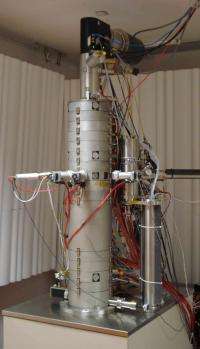
SuperSTEM2, there are only six of these exceptionally sensitive instruments worldwide. Credit: SuperSTEM Consortium

(Phys.org) -- Scientists at The University of Manchester and the SuperSTEM facility at STFC’s Daresbury Laboratory have discovered that the ‘miracle material’, graphene, undergoes a self repairing process to mend holes. This research, published in Nano Letters, could hold the key in the quest to realise graphene's huge potential for use in fields from electronics to medicine.

Graphene, which is made of sheets of carbon just one atom thick, is a promising material for a wide range of future applications due, for instance, to its exceptional electronic properties.

The team, which included Professor Kostya Novoselov, who shared a Nobel Prize in Physics in 2010 for exploiting the remarkable properties of graphene, was originally looking to gain a deeper understanding into how metals interact with graphene, essential if it is to be integrated into practical electronic devices in the future.

The researchers were using a powerful electron microscope at the SuperSTEM Laboratory at Daresbury, which allows scientists to study the properties of materials one atom at a time. They recently demonstrated that metals can initiate the formation of holes in the graphene sheet, which could be hugely detrimental to the properties of any graphene-based device.

Surprise results then showed that some of the that had been created during this process were actually mending themselves spontaneously using nearby loose carbon atoms to re-knit the graphene structure.

Dr. Quentin Ramasse, Scientific Director at SuperSTEM said: "This was a very exciting and unexpected result. The fact that graphene can heal itself under the right conditions may be the difference between a working device and a proof of concept without any real application. We may now have a way of not only drilling through in a controlled fashion to sculpt it at the atomic level, but also to grow it back in new shapes. This adds a lot of flexibility to our nanotechnology toolbox and could pave the way to future technological applications".

Explore further: New research shows that graphene is able to seal holes in itself automatically

More information: View the full paper online here.

Related Stories

Graphene's 'Big Mac' creates next generation of chips

Oct 09, 2011

The world's thinnest, strongest and most conductive material, discovered in 2004 at the University of Manchester by Professor Andre Geim and Professor Kostya Novoselov, has the potential to revolutionize material ...

Graphene's piezoelectric promise

Jan 05, 2012

Engineers predict that graphene can be coaxed into acting piezoelectric, merely by punching triangular holes into the material.

Seeing an atomic thickness

May 19, 2011

Scientists from NPL, in collaboration with Linkoping University, Sweden, have shown that regions of graphene of different thickness can be easily identified in ambient conditions using Electrostatic Force ...

Recommended for you

Kinks and curves at the nanoscale

May 19, 2013

One of the basic principles of nanotechnology is that when you make things extremely small—one nanometer is about five atoms wide, 100,000 times smaller than the diameter of a human hair—they are going ...

Snake's ultra-black spots may aid high-tech quest

May 16, 2013

Scientists have identified nanostructures in the ultra-black skin markings of an African viper which they said Thursday could inspire the quest to create the ultimate light-absorbing material.

User comments : 0

More news stories

Advance in nanotech gene sequencing technique

(Phys.org) —The allure of personalized medicine has made new, more efficient ways of sequencing genes a top research priority. One promising technique involves reading DNA bases using changes in electrical ...

Engineers' nanoantennas improve infrared sensing

(Phys.org) —A team of University of Pennsylvania engineers has used a pattern of nanoantennas to develop a new way of turning infrared light into mechanical action, opening the door to more sensitive infrared ...

New immune system discovered

(Medical Xpress)—A research team, led by Jeremy Barr, a biology post-doctoral fellow, unveils a new immune system that protects humans and animals from infection.

Practice makes perfect? Not so much

Turns out, that old "practice makes perfect" adage may be overblown. New research led by Michigan State University's Zach Hambrick finds that a copious amount of practice is not enough to explain why people ...