July 25, 2012 feature
New hybrid material simplifies organic transistor design
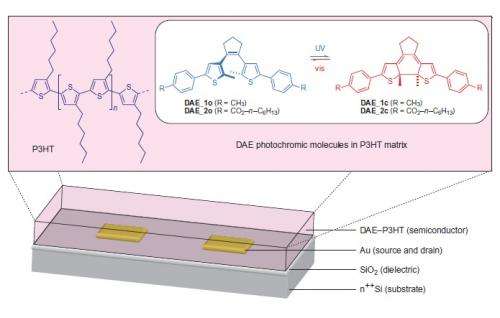
(Phys.org) -- Organic transistors serve as a key component of new flexible, low-cost electronics. Since the organic materials that make up these transistors are what give the transistors their ability to switch and amplify signals, scientists spend a great deal of effort searching for organic materials with highly tunable electronic properties. In some cases, this research involves blending multiple materials together.
In one of the most recent studies in this area, researchers have blended two molecular components together to fabricate a hybrid material whose electronic properties can be switched between two energy states when illuminated by light of different wavelengths. When incorporated into an organic transistor, the hybrid material enables the transistor to be switched both electrically and optically.
The researchers, led by Norbert Koch and Stefan Hecht of the Humboldt University of Berlin in Germany, and Paolo Samori from the University of Strasbourg in France, have published their study in an advanced online issue of Nature Chemistry.
One part of the hybrid material is an electroactive organic semiconducting polymer, while the other component is a type of diarylethene molecule that the researchers designed and synthesized, which has optically tunable electronic states.
To test the resulting hybrid semiconducting material, the researchers incorporated it into an organic thin-film transistor. When alternately illuminating the transistor with a light of two different wavelengths for five seconds at a time, the researchers could reversibly photo-modulate the transistor’s state. They measured the transistor’s response time to a 3-nanosecond-pulse laser light at just a few microseconds, which is technologically relevant for applications.
The new material provides the new transistor an advantage over other organic transistors in that it eliminates the need for fabricating and inserting an additional layer of photochromic molecules apart from the semiconducting layer.
The researchers predict that the new semiconducting thin film, with its molecules that have electrically and optically tunable states, could lead to a variety of semiconducting systems. In the future, they plan to work on tailoring the blend’s properties for different applications.
More information: Emanuele Orgiu, et al. “Optically switchable transistor via energy-level phototuning in a bicomponent organic semiconductor.” Nature Chemistry. DOI: 10.1038/NCHEM.1384
Journal information: Nature Chemistry
Copyright 2012 Phys.org
All rights reserved. This material may not be published, broadcast, rewritten or redistributed in whole or part without the express written permission of PhysOrg.com.


