What 10,000 fruit flies have to tell us about differences between the sexes

What do you get when you dissect 10 000 fruit-fly larvae? A team of researchers led by the European Molecular Biology Laboratory in the UK and the Max Planck Institute of Immunobiology and Epigenetics (MPI) in Germany has discovered a way in which cells can adjust the activity of many different genes at once. Their findings, published in the journal Science, overturn commonly held views and reveal an important mechanism behind gender differences.
Asifa Akhtar's laboratory, previously at EMBL now at MPI, studies precisely how flies regulate an important set of genes. Females have two X chromosomes while males have only one, so the genes on the female X chromosomes somehow need to be kept from producing twice as many proteins as those on the male X chromosome. Male fruit flies get around this by making their X chromosome's genes work double time: an epigenetic enzyme doubles the output of thousands of different genes. But just how much that doubled output is can vary tremendously from one gene to the next.
"Imagine that you have thousands of half-filled glasses of all different sizes and shapes," explains Nick Luscombe, who led the work at EMBL-EBI. "Now imagine that you have to fill them all up to the top at the same time. This is an incredibly complex mechanism."
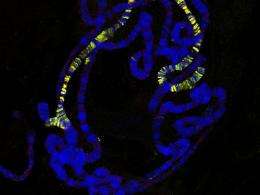
To see how genes are expressed, scientists try to pinpoint signals that show when a gene increases its output. In most studies of this kind, this output is increased by a factor of between 10 and 100 when a gene is being expressed. In this study, the signal involved is miniscule: an increase of only a factor of two.
Observing such a faint signal is a major challenge. But thanks to the painstaking fly-larvae dissection efforts of graduate student Thomas Conrad, combined with the detailed analytical efforts of Florence Cavalli and Juanma Vaquerizas, the team gathered enough material to measure this output and compare males and females directly.
The scientists found twice as many DNA-transcribing (reading) proteins – known as polymerases – attached to the male X chromosome as to the female version. This means that the difference between males and females is rooted in the beginning of the transcription process, when the polymerase first binds to the DNA. This goes against the commonly held view that the regulation mechanism is kicked off during transcription.
"A factor of two appears miniscule, so it is not easy to measure accurately," says Akhtar. "We were really doing a bulk analysis of several hundred genes, and that required a lot of careful bioinformatics analysis. Our group would run experiments, Nick's would analyse the data, and then we would decide on new experiments together to be sure that what we were seeing was real."
Discovering the machinery that doubles the expression of male X-chromosome genes could well have implications that go far beyond the humble fly. Speaking more technically, Luscombe says: "This is the first direct, clear mechanism that links a histone modification and the activity of a polymerase across thousands of genes".
Looking into future directions, Akhtar says: "We now need to look more deeply into what makes this kind of mass regulation possible, and how it fits in with other means cells may have to fine-tune their use of genetic information."
More information: Conrad, T., Cavalli, F.M.G., Vaquerizas, J.M., Luscombe, N.M., Akhtar, A. (2012) Drosophila dosage compensation involves enhanced Pol II recruitment to male X-linked promoters. Science; published online 19 July. DOI: 10.1126/science.1221428
Journal information: Science
Provided by European Molecular Biology Laboratory


