Simple new way to clean traces of impurities from drug ingredients
Jun 20, 2012
Simple new way to clean traces of impurities from drug ingredients

Scientists are reporting development of a simple new procedure for removing almost 98 percent of an important impurity that can contaminate prescription drugs and potentially increase the risk for adverse health effects in patients. Their report appears in ACS' journal Organic Process Research & Development.

Ecevit Yilmaz and colleagues note that contamination of medications with so-called "genotoxic" impurities (GTIs) have resulted in several major recent drug recalls. GTIs may be ingredients used to make drugs, or they may be formed during production of drugs, and can remain in the final product in minute amounts. The presence of one GTI in the anti-viral medication Viracept distributed in the European Union forced a recall in 2007. With GTIs an ongoing serious concern for the pharmaceutical industry, the scientists sought a better way to remove an important GTI called acrolein.

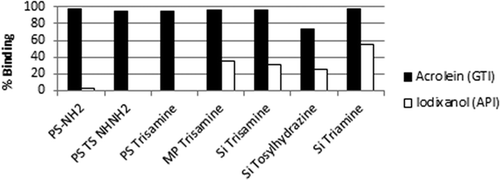
They describe development of a way to remove acrolein by using engineered particles based on silica and polystyrene. Mixing the particles in a solution contaminated with acrolein for 20 minutes resulted in removal of nearly 98 percent of the GTI without any substantial removal of the active pharmaceutical ingredient. They note that while the separation materials are readily available, there may be the need for more research on the method before using it to clean up pharmaceuticals on a commercial basis.

Explore further: Protein study suggests drug side effects are inevitable

More information: “Removal of Acrolein from Active Pharmaceutical Ingredients Using Aldehyde Scavengers” Org. Process Res. Dev., 2012, 16 (6), pp 1225–1229. DOI: 10.1021/op3000459

Abstract
A variety of chemical compounds, intermediates, and reagents are used during the process of synthesizing active pharmaceutical ingredients (APIs). Some of these chemicals, intermediates, and reagents, as well as byproducts of synthetic processes, can have toxic properties and be present as impurities at low levels in the API or final drug formulation. If present at high concentrations, the toxic impurities could cause adverse health effects in humans. This paper describes a simple and rapid approach for selective removal of acrolein from APIs using iodixanol as a model API. Several scavengers were tested, and the resins which showed highest binding efficiency and selectivity were chosen for further evaluations. The kinetics of acrolein scavenging in the presence of the API iodixanol and the scavenging capacity of resins were demonstrated in this paper. The most complete scavenging is obtained with PS-NH2 which removes 97.8% of acrolein without any substantial removal of the API during 20 min of reaction time.

add to favorites email to friend print save as pdf

Related Stories

Reducing gene-damaging impurities in medicines

Sep 29, 2010

Drug manufacturers have been adjusting to strict new government standards that limit the amount of potentially harmful impurities in medicine, according to the cover story of the current issue of Chemical & Engineering News ...

Getting more anti-cancer medicine into the blood

Jan 26, 2011

Scientists are reporting successful application of the technology used in home devices to clean jewelry, dentures, and other items to make anticancer drugs like tamoxifen and paclitaxel dissolve more easily in body fluids, ...

Recommended for you

Protein study suggests drug side effects are inevitable

May 20, 2013

A new study of both computer-created and natural proteins suggests that the number of unique pockets – sites where small molecule pharmaceutical compounds can bind to proteins – is surprisingly small, meaning drug side ...

Attacking MRSA with metals from antibacterial clays

May 17, 2013

In the race to protect society from infectious microbes, the bugs are outrunning us. The need for new therapeutic agents is acute, given the emergence of novel pathogens as well as old foes bearing heightened antibiotic resistance.

Keeping fruit, vegetables and cut flowers fresh longer

May 15, 2013

New technology offers the promise of reducing billions of dollars of losses that occur each year from the silent, invisible killer of fruits, vegetables and cut flowers—a gas whose effects are familiar to everyone who has ...

Why don't beetles freeze in the winter?

May 14, 2013

For 37 years, Queen's University Biochemistry professor Peter Davies has been unraveling the mystery of why some organisms including insects and fish don't freeze in the winter. His research into insect antifreeze protein ...

User comments : 0

More news stories

New method for producing clean hydrogen

Duke University engineers have developed a novel method for producing clean hydrogen, which could prove essential to weaning society off of fossil fuels and their environmental implications.

Protein study suggests drug side effects are inevitable

A new study of both computer-created and natural proteins suggests that the number of unique pockets – sites where small molecule pharmaceutical compounds can bind to proteins – is surprisingly small, meaning drug side ...

Beautiful 'flowers' self-assemble in a beaker

By simply manipulating chemical gradients in a beaker of fluid, materials scientists at Harvard have found that they can control the growth behavior of crystals to create precisely tailored structures—such ...

Attacking MRSA with metals from antibacterial clays

In the race to protect society from infectious microbes, the bugs are outrunning us. The need for new therapeutic agents is acute, given the emergence of novel pathogens as well as old foes bearing heightened antibiotic resistance.