Nanoparticles found in moon glass bubbles explain weird lunar soil behaviour
Jun 12, 2012
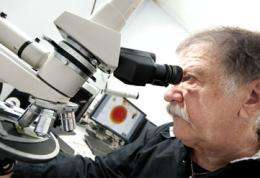
Dr Marek Zbik

(Phys.org) -- A stunning discovery by Queensland University of Technology soil scientist Marek Zbik of nanoparticles inside bubbles of glass in lunar soil could solve the mystery of why the moon's surface topsoil has many unusual properties.

Dr Zbik, from Queensland University of Technology's Science and Engineering Faculty, said scientists had long observed the strange behaviour of but had not taken much notice of the nano and submicron particles found in the soil and their source was unknown.

Dr Zbik took the lunar to Taiwan where he could study the glass bubbles without breaking them using a new technique for studying nano materials call synchrotron-based nano tomography to look at the particles. Nano tomography is a transmission X-ray microscope which enables 3D images of nanoparticles to be made.

This video is not supported by your browser at this time.
View a 3D image from inside the lunar bubble using transmission X-Ray microscopy. You can see what is inside the lunar bubble with 3D glasses.

"We were really surprised at what we found," Dr Zbik said.

"Instead of gas or vapour inside the bubbles, which we would expect to find in such bubbles on Earth, the lunar glass bubbles were filled with a highly porous network of alien-looking glassy particles that span the bubbles' interior.

"It appears that the nanoparticles are formed inside bubbles of molten rocks when meteorites hit the lunar . Then they are released when the glass bubbles are pulverised by the consequent bombardment of meteorites on the moon's surface.

"This continuous pulverising of rocks on the and constant mixing develop a type of soil which is unknown on Earth."

Dr Zbik said nanoparticles behaved according to the laws of quantum physics which were completely different from so called 'normal' physics' laws. Because of this, materials containing nanoparticles behave strangely according to our current understanding.

"Nanoparticles are so tiny, it is their size and not what they are made of that accounts for their exceptional properties.

"We don't understand a lot about quantum physics yet but it could be that these nanoparticles, when liberated from their glass bubble, mix with the other soil constituents and give lunar soil its unusual properties.

"Lunar soil is electro-statically charged so it hovers above the surface; it is extremely chemically active; and it has low thermal conductivity eg it can be 160 degrees above the surface but -40 degrees two metres below the surface.

"It is also very sticky and brittle such that its particles wear the surface off metal and glass."

Dr Zbik said the moon had no atmosphere to cushion the impact of meteorites like Earth had.

"When they hit the moon there is a very violent reaction. Huge temperatures are generated which melts the rock. The pressure goes and a vacuum is created. Bubbles occur in the molten glass rock like soft drink bubbles trying to escape the bottle.

"Our work now is to understand how those evolve from this process. It may also lead us to completely different way of manufacturing nanomaterials."

Dr Zbik and his research team's study was published in the International Scholarly Research Network Astronomy and Astrophysics.

Explore further: NASA head views progress on asteroid lasso mission

Related Stories

The indiscretions of a champagne bubble paparazzi

Feb 14, 2012

The innermost secrets of champagne bubbles are about to be unveiled in the Springer journal European Physical Journal ST. This fascinating work is the brainchild of Gérard Liger-Belair, a scientist tackli ...

LRO observes final lunar eclipse of the year

Dec 09, 2011

(PhysOrg.com) -- Orbiting 31 miles above the lunar surface, NASA's Lunar Reconnaissance Orbiter (LRO) spacecraft will get a "front-row seat" to the total lunar eclipse on Dec. 10, 2011.

Recommended for you

NASA head views progress on asteroid lasso mission

5 hours ago

Surrounded by engineers, NASA chief Charles Bolden inspected a prototype spacecraft engine that could power an audacious mission to lasso an asteroid and tow it closer to Earth for astronauts to explore.

Ecuador satellite collides with Russian space junk

5 hours ago

A small Ecuadoran satellite collided in orbit with the remains of a Russian rocket, but it is too soon to know how much damage it might have sustained, Quito's space agency said Thursday.

Forecast for Titan: Wild weather could be ahead

May 22, 2013

(Phys.org) —Saturn's moon Titan might be in for some wild weather as it heads into its spring and summer, if two new models are correct. Scientists think that as the seasons change in Titan's northern hemisphere, ...

SDO observes mid-level solar flare

May 22, 2013

UPDATE 16:30 p.m. EDT: The M7-class flare was also associated with a coronal mass ejection or CME, another solar phenomenon that can send billions of tons of particles into space. While this CME was not Ea ...

User comments : 5

Adjust slider to filter visible comments by rank

Display comments: newest first

ScottyB
3.7 / 5 (3) Jun 12, 2012
maybe it will lead to a way to repulse these particles to stop them from sticking to space suits / machinery?
Blakut
5 / 5 (1) Jun 12, 2012
Low thermal conductivity => good for building moon iglooes.
julianpenrod
1 / 5 (1) Jun 12, 2012
This material about the lunar soil "hovering above the surface" and being so chemically active doesn't seem to have been widely disseminated before this. It seems to have been rather determinedly withheld. It doesn't seem surprising, anymore, to have unusual and all but denied phenomena, in both "science" and government, be revealed every day.
Jonseer
1 / 5 (1) Jun 13, 2012
This material about the lunar soil "hovering above the surface" and being so chemically active doesn't seem to have been widely disseminated before this. It seems to have been rather determinedly withheld.....


Um no you are quite wrong.

It has been IGNORED, but not withheld.

I read about it decades ago, but NOT in the mass media.

Instead I read about the details of these lunar phenomena in magazines like Sci Am or Astronomy or Discover quite often in stories detailing the preparations for follow up manned lunar landings as well as while preparing for the first probes to land on Mars. No one knew what to expect the first time.

The mainstream media however did mostly ignore the details of the landing and focus on the "human" emotional experience. That context didn't have a place to fit the bizarre soils of the moon so the mass media ignored it.

If you did read those magazines, then you missed it. It wasn't like it was always part of a story in every issue.
GSwift7
1 / 5 (1) Jun 13, 2012
So, if the above theory is correct, then there's enough of the nano sized material present in the soil to influence the bulk characteristics of the soil. Taking this idea to the next logical step, from academic science to applied science might be intersting. Who knows what might be possible in terms of practical applications. For instance, if you use the lunar material as an agregate in some building material like concrete, does this affect the finished material, and in what way? Does this nano material present a health risk to human colonists (probably does, since everything seems to kill us. lol)? If the theories regarding water in shadowed craters is correct, does this mean that the water is likely to be contaminated with nanoparticles, and does that render the water unusable for practical purposes?

Every answer seems to ask 10 new questions, doesn't it?

More news stories

Hubble reveals the ring nebula's true shape

(Phys.org) —The Ring Nebula's distinctive shape makes it a popular illustration for astronomy books. But new observations by NASA's Hubble Space Telescope of the glowing gas shroud around an old, dying, ...

A hidden population of exotic neutron stars

(Phys.org) —Magnetars – the dense remains of dead stars that erupt sporadically with bursts of high-energy radiation - are some of the most extreme objects known in the Universe. A major campaign using ...

NASA head views progress on asteroid lasso mission

Surrounded by engineers, NASA chief Charles Bolden inspected a prototype spacecraft engine that could power an audacious mission to lasso an asteroid and tow it closer to Earth for astronauts to explore.

Controlling mood through the motions of mitochondria

(Medical Xpress)—Regulating the distribution of power in neurons is done by a system that makes the national electric grid look simple by comparison. Each neuron has several thousand mitochondria confined ...

Google Drive sports new view and scan enhancements

(Phys.org) —Google Drive has a new look and functions. The makeover in Google Drive features scanning and interface enhancements that put the user into "card" mode. The enhancements make it easy for the ...