FlyNano electric sea plane takes first test flight
Jun 18, 2012 by Nancy Owano report

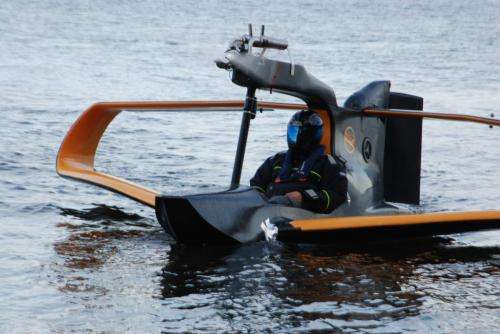
(Phys.org) -- A single-seat carbon-fiber airplane designed for water operations and proposed as a “fun flyer” has taken its first test flight at Finland’s Lake Hepari. The June test flight comes after more than a year since its introduction at an air show in Germany in 2011. The earlier FlyNano was showcased as a single-occupant petrol/electric microlight amphibious aircraft. The new FlyNano has undergone key changes to advance its readiness for takeoff. Gone are the petrol-engine models. The new engine, propeller, controller and batteries combine to produce a stronger model than the earlier structure.

FlyNano has stated that due to advances in batteries and electric motors, they ditched combustion models. The carbon fiber-bodied aircraft is now electric.

This video is not supported by your browser at this time.

“When the FlyNano concept was presented last year at the Aero 2011 trade fair in Friedrichshafen, Germany, it was envisioned to be primarily powered with a combustion engine,” said the Finnish aeronautics firm by the same name, FlyNano.“ However, the development of electric motors and batteries has been immense during the past year and the demand for electric powerlines has been increasing continuously.”

The cruising speed is around 140 km/h (87 miles per hour). The rudder is controlled by pedals. “Elevons” (ailerons + elevators) and throttle are controlled intuitively by a stick with the right hand. The designers say their electric sea plane is quiet, and power-train vibration is reduced.

FlyNano's goal is to start production and deliver the first 35 planes to dealers by the end of 2013. The FlyNano plane has an ex-factory price listed on the company site as 32,000 euro ($40,000). Transport and storage trailer charges are extra.

A promotional portion of text on the site tells prospective customers that, “If you’ve ever had a pilot’s licence you’ll fly Nano right out of the box.” For the rest, knowledge of simple rules of the air will be required, says the team. The FlyNano FAQ page, however, directly answers the question of whether customers need a pilot’s license to fly the plane. According to the European Aviation Safety Association regulation. FlyNano is below the necessary weight of 70kg, which means that national authorities decide on the classification. "Nevertheless a good understanding of water plane operation, rules and aviation safety is requested." The company adds that “We will clear the situation in several countries around the world within the following months.”

FlyNano does not have a windshield, but in keeping with the company’s philosophy of “feel the wind,” the recommended gear includes helmet or at least goggles and drysuit/wetsuit or similar clothing.

Explore further: Multiview 3-D photography made simple

Related Stories

The 70 kilo single person plane

Apr 15, 2011

(PhysOrg.com) -- Aki Suokas, a Finnish aeronautical engineer, has just finished creating a unique single-seat aircraft this week. The project was completed at Aero Friedrichshafen, and it has been dubbed the ...

World's first aircraft with serial hybrid electric drive

Jun 24, 2011

Together with partners, Siemens has built the world’s first aircraft with a serial hybrid electric drive system. The two-seater motor glider DA36 E-Star is presented by Siemens, Diamond Aircraft and EADS ...

Solar power blooms in warren

Nov 18, 2011

General Motors is introducing a solar charging canopy that moves with the sun. The Tracking Solar Tree is located at GM Company Vehicle Operations.

Recommended for you

Multiview 3-D photography made simple

22 hours ago

Computational photography is the use of clever light-gathering tricks and sophisticated algorithms to extract more information from the visual environment than traditional cameras can.

Giant 3-D printed bugs shed light on insect anatomy

22 hours ago

Minute insects, from the Australian National Insect Collection, have been super sized by up to forty times using a novel 3D scanning system and printed using a state of the art 3D printer.

Mathematical algorithms cut train delays

Jun 18, 2013

Commuters are already seeing a reduction in delays and waiting times thanks to new software able to adapt railway schedules in real time following unforeseen disruptions.

User comments : 7

Adjust slider to filter visible comments by rank

Display comments: newest first

antialias_physorg
3 / 5 (2) Jun 18, 2012
Just searched around a bit, and it does sport a 70km operational range. That's not half bad for a battery operated flyer. If I had a lake next to my appartment (and a lake at work) then that would be a real option.
Eikka
not rated yet Jun 18, 2012
If I had a lake next to my appartment (and a lake at work) then that would be a real option.


Well, if I remember correctly, that thing has a 45 mph / 70 kph takeoff/landing speed, so it's pretty much a nice weather plane. If there's roughness in the water, touching down at speed will be quite hazardous. You can imagine what it feels like to bounce off of a wave in a canoe that's going 40 knots.

For reference, here's an ordinary motorboat going 40 knots on a calm lake: http://www.youtub...fjQL2uUk

Water is hard at speed.
jshloram
not rated yet Jun 18, 2012
Interesting, but not very convincing. What are they not showing us?
GSwift7
5 / 5 (1) Jun 18, 2012
If I had a lake next to my appartment (and a lake at work) then that would be a real option.


You would need time to re-charge the batteries before returning home, and battery performance deteriorates after repeated charging.

Something like this would be a ton of fun though.

I wonder how hard it is to keep water out of the cockpit, and what happens if those lower wings get a wave over them. I also wonder how easy/hard it would be to rock it from side to side with body movement.

lol, how long will it take for someone to launch one over a waterfall?

Interesting that it's water only, with no landing gear at all. I guess the weight budget favored water TOL over land.

I wonder how much space it takes to take off or land?
dschlink
not rated yet Jun 18, 2012
The propeller is directly in front of the operator's head! Is this to give the illusion of greater speed or simply a very bad design?
Eikka
not rated yet Jun 22, 2012
The propeller is directly in front of the operator's head! Is this to give the illusion of greater speed or simply a very bad design?


It's there to stop the propeller from catching water splashes and debris kicked up by the wings, or touching the water surface itself.
james_r_olson_1
1 / 5 (1) Jul 02, 2012
It appears this vehicle is flying in ground effect only. hence the seaplane configuration. Try flying in ground effect over the ground and, whoops! Anybodies guess why they don't just admit that it can't fly out of ground effect.

More news stories

Taiwan's Hon Hai to hire 3,000 after Mozilla tie-up

Taiwan's Hon Hai Precision said Thursday it aims to hire up to 3,000 new employees to develop devices and software for Mozilla's Firefox operating system as it seeks to diversify from its core manufacturing services.

AP buys stake in live video service Bambuser

The Associated Press said Thursday that it has bought a minority stake in the live video service Bambuser, boosting its ability to acquire and distribute video collected by people who have witnessed news events.

Sony chief says time needed to study proposal

Sony Corp. needs more time to study a key proposal from a U.S. hedge fund to spin off a part of its entertainment unit as a way to propel its fledgling revival, the chief executive told shareholders Thursday.

Dusty surprise around giant black hole

(Phys.org) —ESO's Very Large Telescope Interferometer has gathered the most detailed observations ever of the dust around the huge black hole at the centre of an active galaxy. Rather than finding all of ...

How do bees make honey? It's not just bee barf

(Phys.org) —Last weekend, my daughter asked me how bees made honey, and I realized that I didn't know the answer. How do bees make honey? I did some homework, and can now explain it to her – and to you.