Wishbones give insight into prehistoric flight
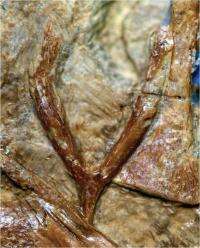
(Phys.org) -- A new study comparing birds’ wishbones has found prehistoric birds that disappeared 65 million years ago may have employed different flight styles to their modern-day counterparts.
Research published in PLoS ONE by PhD candidate Roger Close from Monash University’s School of Geosciences and his supervisor Dr Emily Rayfield from the University of Bristol, sheds light on birds from the Mesozoic Era (65-200 million years ago).
Mr. Close said the research was inspired by an earlier study of living birds that hinted at a link between wishbone shape and mode of flight, such as soaring, flapping or underwater flying.
“Spectacular fossils documenting the early evolutionary history of birds have been unearthed at an ever-increasing rate in recent years,” Mr. Close said.
“But to date relatively few studies have used this new evidence to broaden our understanding of the functional anatomy or biomechanics of early avian evolution.”
Drawing upon the wealth of recent fossil finds and a large sample of living species, the researchers used statistical analyses to compare wishbone shapes of Mesozoic birds with modern birds.
“The wishbone is well-suited to studying flight in extinct birds, as it is commonly preserved in the fossil record and its shape linked with flight style. In modern birds, the wishbone shows tremendous morphological variety, ranging from U- to V-shapes of varying widths and curvatures,” Mr. Close said.
“Similar shape diversity is seen in the Mesozoic species, including some morphologies unseen today, such as the boomerang-shaped wishbones of the most primitive birds, which resemble those of their close non-bird theropod dinosaur relatives.”
The researchers were able to confirm the major finding of a previous study, that wishbone shape varies depending on the flight mode of the species. For the more primitive groups of Mesozoic birds results indicated that, in contrast to their more anatomically-modern contemporaries, the functional role of the wishbone may have differed.
“While this may be interpreted as evidence that early birds flew differently to those alive today, it might equally well indicate that they had evolved different anatomical solutions to accomplish the same feats,” Mr. Close said.
“This is just one piece of the puzzle. A complete picture of the evolution of flight in early birds will only be gained through synthesizing findings from multiple lines of enquiry.”
Journal information: PLoS ONE
Provided by Monash University


