Study of moon rocks shows barrage 4 billion years ago was mainly asteroids
May 18, 2012 by Bob Yirka report
Moon

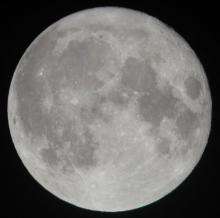
(Phys.org) -- Researchers have known for some years that the Earth and moon were subjected to a veritable barrage of objects striking their surfaces nearly four million years ago, but less certain was whether those objects were asteroids, comets or even pieces of other protoplanets after they broke apart. Now however, new research by a group of lunar scientists has found, after studying moon rocks brought back by astronauts during the Apollo 16 mission, that it appears they were mostly asteroids. But not, they write in their paper published in the journal Science, the same kind as we see falling on our planet today.

The researchers, led by Katherine Joy, looked at specific types of known as regolith breccias, which are in essence dirt balls with embedded fragments of rocks and other debris from impacts. They are believed to have formed somewhere around three and a half billion years ago, which was close to the time of the great barrage. To find out more about the fragments, they put samples in an and also used other micro-probing techniques to get a closer look. In so doing they found that many of the fragments were of nearly the same type as carbonaceous chondrite meteorites, which come from certain types of asteroids.

They also found a certain uniformity in the samples that is not present in samples from meteorites that have impacted the moon in more recent times, which the researchers write, suggests that such rocks striking the moon during the barrage were somewhat different from those that strike today which are quite diverse. They also found that the fragments found in different regolith breccias were sufficiently different from each other to rule out the possibility of them coming from a that broke apart.

That leaves asteroids as the most likely kind of object striking both the Earth and the moon during the barrage which other scientists have suggested occurred due to a relatively sudden change in the distance between the planets in the early solar system. The suspicion is that all or most of the planets formed in rather close proximity to the sun, then slowly moved farther away. If that was the case, then changes in gravitational effects caused by the planets would likely have had a profound impact on other bodies moving around, causing many of them perhaps, to run into one another and the planets. Some even suggest the bombardment that resulted could have been a major contributing factor to the development of life here on Earth, which many believe occurred right around the same time.

Explore further: Russia retrieves mice, newts from space

More information: Direct Detection of Projectile Relics from the End of the Lunar Basin–Forming Epoch, Science DOI: 10.1126/science.1219633

ABSTRACT
The lunar surface, a key proxy for the early Earth, contains relics of the asteroids and comets that have pummeled terrestrial planetary surfaces. Surviving fragments of projectiles in the lunar regolith provide a direct measure of the types and, thus, sources of exogenous material delivered to the Earth-Moon system. In ancient [>3.4 billion years ago (Ga)] regolith breccias from the Apollo 16 landing site we located mineral and lithologic relics of magnesian chondrules from chondritic impactors. These ancient impactor fragments are not nearly as diverse as those found in younger (3.4 Ga to today) regolith breccias and soils from the Moon, or that presently fall as meteorites to Earth. This suggests that primitive chondritic asteroids, originating from a similar source region, were common Earth-Moon-crossing impactors during the latter stages of the basin forming epoch.

Related Stories

Half-baked asteroids have Earth-like crust

Jan 07, 2009

Asteroids are hunks of rock that orbit in the outer reaches of space, and scientists have generally assumed that their small size limited the types of rock that could form in their crusts. But two newly discovered ...

The origin of the moon's craters

Mar 19, 2012

(PhysOrg.com) -- Moon's craters, together with samples of the surface returned during the Apollo program, tell the story of impacts from two different populations of small bodies. The first rocky collection ...

Image: Apollo 16: Footsteps Under High Sun

Jul 08, 2010

(PhysOrg.com) -- The lunar module Orion landed in the Descartes Highlands of the moon on April 21, 1972. The Apollo 16 mission targeted a highland region. Originally thought to be a volcanic site, the samples ...

Meteorites rich with information, expert says

Mar 28, 2007

A Purdue University professor on Wednesday (March 28) said at national convention that meteorites hold many clues into the creation and evolution of the solar system. Michael Lipschutz, a professor of inorganic chemistry and ...

Recommended for you

Russia retrieves mice, newts from space

2 hours ago

A Russian capsule filled with 45 mice and 15 newts along with other small animals returned from a month's mission in orbit on Sunday with data scientists hope will pave the way for a manned flight to Mars.

Mars rover Opportunity examines clay clues in rock

May 18, 2013

(Phys.org) —NASA's senior Mars rover, Opportunity, is driving to a new study area after a dramatic finish to 20 months on "Cape York" with examination of a rock intensely altered by water.

NASA's STEREO detects a CME from the sun

May 17, 2013

On 5:24 a.m. EDT on May 17, 2013, the sun erupted with an Earth-directed coronal mass ejection or CME, a solar phenomenon that can send billions of tons of solar particles into space that can reach Earth ...

Nine-year-old Mars rover passes 40-year-old record

May 17, 2013

While Apollo 17 astronauts Eugene Cernan and Harrison Schmitt visited Earth's moon for three days in December 1972, they drove their mission's Lunar Roving Vehicle 19.3 nautical miles (22.210 statute miles ...

Bright explosion on the Moon

May 17, 2013

For the past 8 years, NASA astronomers have been monitoring the Moon for signs of explosions caused by meteoroids hitting the lunar surface. "Lunar meteor showers" have turned out to be more common than anyone ...

User comments : 6

Adjust slider to filter visible comments by rank

Display comments: newest first

Ophelia
5 / 5 (3) May 18, 2012
"Study of moon rocks shows barrage 4 million years ago was mainly asteroids

"...
"Researchers have known for some years that the Earth and moon were subjected to a veritable barrage of objects striking their surfaces nearly four million years ago
"...
"The researchers ... looked at specific types of moon rocks known as regolith breccias, which are ... believed to have formed somewhere around three and a half billion years ago, which was close to the time of the great barrage."

Millions? Billions?

Physorg editors - do you exist?
Anda
5 / 5 (1) May 18, 2012
Billions...
Adam
1 / 5 (1) May 18, 2012
Headline write, summary wrong... Geez Editors.
chardo137
5 / 5 (1) May 18, 2012
Right.
Sonhouse
5 / 5 (1) May 19, 2012
I guess journalistic accuracy isn't high on the agenda at physorg.
Vendicar_Decarian
not rated yet May 19, 2012
"Billion", "million", "big", "not enough", "Who cares, we are the most powerful nation on earth.", it's all the same to the innumerate.

I found that out when asking Conservative Americans the size of their federal debt during the Bush Administration.

More news stories

Russia retrieves mice, newts from space

A Russian capsule filled with 45 mice and 15 newts along with other small animals returned from a month's mission in orbit on Sunday with data scientists hope will pave the way for a manned flight to Mars.

Galaxy's Ring of Fire

Johnny Cash may have preferred this galaxy's burning ring of fire to the one he sang about falling into in his popular song. The "starburst ring" seen at center in red and yellow hues is not the product of ...

Honeybees trained in Croatia to find land mines

(AP)—Mirjana Filipovic is still haunted by the land mine blast that killed her boyfriend and blew off her left leg while on a fishing trip nearly a decade ago. It happened in a field that was supposedly ...

German energy shift faces headwinds

Tense engineers have their eyes peeled on complex colour-coded diagrams on a wall-sized screen that makes their control room look like the inside of a spaceship.

Internet in 'coma' as Iran election looms

Iran is tightening control of the Internet ahead of next month's presidential election, mindful of violent street protests that social networkers inspired last time around over claims of fraud, users and ...