Quantum control protocols could lead to more accurate, larger scale quantum computations
Apr 04, 2012
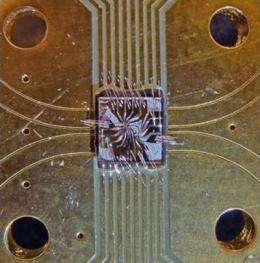
The quantum circuit used in the demonstration is a 3mm x 3mm chip with a 1mm x 1mm diamond in the middle. Credit: Delft University of Technology/UC Santa Barbara.

A protocol for controlling quantum information pioneered by researchers at UC Santa Barbara, the Kavli Institute of Nanoscience in Delft, the Netherlands, and the Ames Laboratory at Iowa State University could open the door to larger-scale, more accurate quantum computations. Their findings, in a paper titled "Decoherence-protected quantum gates for a hybrid solid-state spin register," are published in the current issue of the journal Nature.

"Although interactions between a bit ('qubit') and its environment tend to corrupt the information it stores, it is possible to dynamically control qubits in a way that facilitates the execution of algorithms while simultaneously protecting the qubits from environment-induced errors," said UCSB physicist David Awschalom. He and his group were responsible for developing the electron and nuclear spins used as the –– the quantum version of the computer bit –– in their demonstration and for helping to analyze the results.

Awschalom is director of UCSB's Center for Spintronics & Quantum Computation, professor of physics, electrical and computer engineering, and the Peter J. Clarke Director of the California NanoSystems Institute.

Dynamical protection of is essential for quantum computing as the qubits used for information processing and storage are highly susceptible to errors induced by interactions with atoms in the qubits' environment. The scientists' previous research has shown that quantum information stored in qubits can be effectively protected through successive control operations (rotations) on a qubit that filter out these unwanted interactions. However, these control operations also filter out the interactions between qubits that are essential for the realization of logic gates for quantum information processing. Thus, until recently, quantum information stored in protected qubit states could not be used for quantum computations.
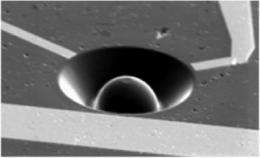
A 20 micron x 20 micron magnification of the diamond chip, showing an integrated diamond lens above the single particle spins where the calculations take place. Credit: UCSB

The research team, which also included members from the University of Southern California, showed that by precisely synchronizing the rotations of an electron spin with the rotation of a nearby nuclear spin, they could realize dynamical protection of both qubits from the environment while maintaining the interactions between the two spins that are necessary for quantum information processing. As a proof of principle, the researchers demonstrated the high-fidelity execution of a quantum search algorithm using this two-qubit system. Quantum search algorithms, if executed on a larger number of qubits, could provide search results of certain databases considerably faster than search algorithms performed on a classical computer.

The results of this study point to greater possibilities for quantum computers that overcome, according to Awschalom, the perception that spin qubits in semiconductors, such as those used in this work, suffer from too strong of environmental interactions to be useful qubits. These spin systems also offer the added benefit of operating at room temperature, in contrast to other candidate qubit systems which operate at only at a fraction of a degree above absolute zero.
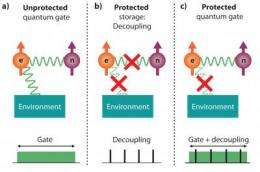
The US Department of Energy's Ames Laboratory led a team that demonstrated a protected quantum gate in a solid-state system. The physicists (c) isolated the system from forces in the environment while maintaining coherence between the nucleus and electron in the system. This was a major step forward in quantum information processing beyond simply (a) establishing coherence between parts of a quantum system (but without isolation from the environment) or (b) decoupling all parts of the system from the environment (and each other). Credit: Ames Laboratory--USDOE

"This demonstration of performing a quantum at the subatomic level with single spins suggests a pathway to build increasingly complex quantum machines, using control protocols that circumvent the expected limitations from real materials," said Awschalom.

Explore further: Researchers forward quest for quantum computing

Related Stories

At Yale, quantum computing is a (qu)bit closer to reality

Feb 15, 2012

(PhysOrg.com) -- Physicists at Yale University have taken another significant step in the development of quantum computing, a new frontier in computing that promises exponentially faster information processing ...

Better control of building blocks for quantum computer

Dec 23, 2010

Dutch scientists from the Kavli Institute of Nanoscience at Delft University of Technology and Eindhoven University of Technology have succeeded in controlling the building blocks of a future super-fast quantum ...

Subatomic quantum memory in diamond demonstrated

Jun 27, 2011

Physicists working at the University of California, Santa Barbara and the University of Konstanz in Germany have developed a breakthrough in the use of diamond in quantum physics, marking an important step ...

12-qubits reached in quantum information quest

May 08, 2006

In the drive to understand and harness quantum effects as they relate to information processing, scientists in Waterloo and Massachusetts have benchmarked quantum control methods on a 12-Qubit system. Their research was performed ...

Recommended for you

Researchers forward quest for quantum computing

2 hours ago

Research teams from UW-Milwaukee and the University of York investigating the properties of ultra-thin films of new materials are helping bring quantum computing one step closer to reality.

Hydrogen atoms under the magnifying glass

May 22, 2013

To describe the microscopic properties of matter and its interaction with the external world, quantum mechanics uses wave functions, whose structure and time dependence is governed by the Schrödinger equation. ...

Making quantum encryption practical

May 21, 2013

One of the many promising applications of quantum mechanics in the information sciences is quantum key distribution (QKD), in which the counterintuitive behavior of quantum particles guarantees that no one can eavesdrop on ...

Lab sets a new record for creating heralded photons

May 20, 2013

(Phys.org) —Entanglement, by general consensus of physicists, is the weirdest part of quantum science. To say that two particles, A and B, are entangled means that they are actually two parts of an inseparable ...

Competition in the quantum world

May 20, 2013

Innsbruck physicists led by Rainer Blatt and Peter Zoller experimentally gained a deep insight into the nature of quantum mechanical phase transitions. They are the first scientists that simulated the competition ...

User comments : 1

Adjust slider to filter visible comments by rank

Display comments: newest first

Cynical1
not rated yet Apr 05, 2012
Per electron spin - does it spin like a planet while orbiting sun? Or is more like the orbit - ie;a field that is spinning around the nuclei?

More news stories

Engineers pioneer flat spray-on optical lens

A University of British Columbia engineer and a team of U.S. researchers have made a breakthrough utilizing spray-on technology that could revolutionize the way optical lenses are made and used.

Researchers forward quest for quantum computing

Research teams from UW-Milwaukee and the University of York investigating the properties of ultra-thin films of new materials are helping bring quantum computing one step closer to reality.

How do cold ions slide

Things not always run smoothly. It may happen, actually, that when an object slides on another, the advancement may occur through a 'stop and go' series in the characteristic manner which scientists call ...

Theorists weigh in on where to hunt dark matter

(Phys.org) —Now that it looks like the hunt for the Higgs boson is over, particles of dark matter are at the top of the physics "Most Wanted" list. Dozens of experiments have been searching for them, but ...

Chemists find new compounds to curb staph infection

(Phys.org) —In an age when microbial pathogens are growing increasingly resistant to the conventional antibiotics used to tamp down infection, a team of Wisconsin scientists has synthesized a potent new ...