Multimodal bio-image sensor: Fusion of heterogeneous biochemical information
Mar 22, 2012 By Adarsh Sandhu
Multimodal bio-image sensor: Fusion of heterogeneous biochemical information
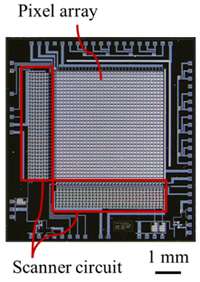
Photomicrograph of an actual multimodal bio-image sensor chip. Credit: Toyohashi University of Technology

The use of sensors is important for the quantitative analyses of chemical materials and physical phenomena, with research and development of biosensors for observing cell function being actively pursued.

Although there are several conventional that can be used to analyze from one perspective, the use of biosensors for multimodal analysis is challenging.

In this study, Hirokazu Nakazawa and colleagues at Toyohashi University of Technology (Toyohashi Tech) have devised a multimodal bio-image sensor that can render images of the two-dimensional distribution of concentration (pH) and fluorescence intensity for multimodal analyses of biochemical objects.

A prototype of the was fabricated at using facilities at Toyohashi Tech’s EIIRIS research complex using a modified CMOS fabrication process with a 5 μm design rule. The area of each individual sensor region was 54 μm× 40 μm, with 32 × 32 pixels (Fig. 1). The bonding wires and gold electrode pads (except those in the active region) were encapsulated to protect them from the liquid environment.

The multimodal bio-image sensor enabled the detection and display of a wide range of wavelengths of light at 5 frames per second, without the use of optical filters or gratings. The researchers also used the sensor to measure the variation of the pH distribution with time.

These results demonstrate the potential of this imaging sensor for intra- and extracellular measurements. The multimodal analysis approach is effective for obtaining biochemical information in real time using multimodal bio-image sensors with high spatial resolution.

Explore further: Sensitive bomb detector to rove in search of danger

More information: Hirokazu Nakazawa, et al. 'Multimodal bio-image sensor for real-time proton and fluorescence imaging,' Sensors and Actuators B: Chemical, in press, DOI:10.1016/j.snb.2011.11.010

Provided by Toyohashi University of Technology

not rated yet
add to favorites email to friend print save as pdf

Related Stories

World's Smallest 2.0µm-Pixel MOS Image Sensor

Feb 09, 2005

Panasonic, the leading brand by which Matsushita Electric Industrial Co., Ltd. is known, today announced the development of the world's smallest image sensor. The revolutionary MOS image sensor has only 2.0 × 2.0 μm ...

Odorant sensor fabricated from living cells

Oct 27, 2010

Dr. Misawa and colleagues at the Toyohashi University of Technology, Japan, focused on a chemical sensor composed of living cells from frog eggs and compact fluidic devices integrated with glass capillary ...

Canon Awarded for Most Innovative CMOS Image Sensor Technology

Aug 12, 2004

Semiconductor Insights (SI), the leader in technical and patent analyses of integrated circuits and structures, today announced that it has awarded Canon the 2004 INSIGHT Award for Most Innovative CMOS Image Sensor Technology. The specific device analyzed by SI was th ...

Recommended for you

Sensitive bomb detector to rove in search of danger

19 hours ago

European researchers have developed and tested a light-weight device capable of detecting extremely minute quantities of explosives from up to 20 metres away, providing an invaluable law-enforcement tool ...

How soon could car seats enter the 3-D comfort zone?

May 23, 2013

New 3D textiles made of recyclable polyester fibres could contribute help cars be easier to recycle. But recycling technology has yet to progress in separating seat material from other car components.

NASA: Austin, calling Austin. 3-D pizzas to go

May 22, 2013

(Phys.org) —The idea of living with 3-D printed food is neither unthinkable nor new; designers and futurists have been looking to 3-D printing as food's next frontier. In 2012, there was news that the Thiel ...

User comments : 0

More news stories

Google eyes emerging markets networks

Google has become deeply involved in a series of projects to build and operate wireless networks in emerging markets including sub-Saharan Africa and Southeast Asia, a report said Friday.

Facial-recognition technology proves its mettle

(Phys.org) —In a study that evaluated some of the latest in automatic facial recognition technology, researchers at Michigan State University were able to quickly identify one of the Boston Marathon bombing ...

Drones may violate international law

(Phys.org) —As President Obama gives a speech on national security—including defending U.S. use of drones to combat terrorism—Leila Sadat, JD, international law expert and professor of law at Washington University in ...

The long road to the 2000-watt society

The vision of a society in which each inhabitant of the earth manages to consume only 2000 watts has already been around for 15 years. During this time, there has been a steady increase in environmental awareness ...

Galaxies fed by funnels of fuel

(Phys.org) —Computer simulations of galaxies growing over billions of years have revealed a likely scenario for how they feed: a cosmic version of swirly straws.