Birds' diverse traits survive Amazon fires
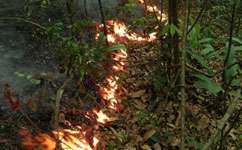
Research in the Amazon has shown that wildfires are less of a threat to the functional diversity of rainforest birds than you might expect.
Scientists from the UK and Brazil studied the range of physical and behavioural traits – the functional diversity – of birds in parts of the Brazilian Amazon forest affected by fires.
The fires had a major impact on the mix of bird species present, and there were fewer species in some areas, for example where the understorey had been opened up so much that primary-forest species couldn't return.
But the researchers also found the range of traits present among the area's birds had not been affected.
"Our research suggests that functional diversity may be more resilient than you would predict from looking at changes in species composition, which is good news for the recovery of ecosystem functions. Nevertheless, rainforest fires are still bad news indeed for the birds that depend on the dark understorey found in primary forests," explains Dr. Jos Barlow of Lancaster University, a joint author of the study.
Studies of disturbances to biodiversity typically focus on the number or abundance of species affected, but looking at species' traits is important to more fully understand the consequences of ecosystem degradation.
This is because of the different roles plants and animals play in an ecosystem. Losing a species entirely is obviously bad news, but it might not be a complete disaster if there are other organisms performing the same functions. To give a simplistic example, the loss of one insect-eating species won't upset the balance of the ecosystem provided some of the remaining species eat the same insects.
Unlike fire-adapted savannas and grasslands, humid tropical rainforests do not normally burn. As a result, the species there have no evolutionary adaptations to fire, and even small understorey fires can cause major structural damage to the forests, killing up to 50 per cent of the trees.
If these fires favor generalists – species that can thrive in a variety of conditions – over specialists that depend on one particular habitat, it could filter out some traits that are important for the overall biodiversity of the rainforest, reducing the ability of the forest to recover in the longer term.
This study aimed to find out how fires in the Amazon might affect trait diversity, using data taken three years after fires in 1997-8. The researchers looked at 28 forest areas that had either been burnt once, twice or not at all. They studied 21 traits to do with body mass, food preferences and foraging habits of 152 bird species that live in the understorey or lower levels of the forest.
Contrary to their expectations, the researchers found that there was no difference in the range of traits present between areas that had been burnt and areas that had not.
This was the case even though the areas that had been burnt twice were on average home to fewer species than the pristine sections, and had lost most of the forest specialists normally found in primary forests.
However, the study did show that vegetation structure has a strong influence on functional diversity.
"This suggests that fire intensity, rather than frequency, could have more of an effect on traits, because of the damage it causes to the birds' habitat rather than its direct effects of killing birds or the animals they eat," says joint author Dr. Marcus V Cianciaruso from Brazil's Universidade Federal de Goiás.
Fires are becoming more common in rainforests, due to the expansion of human activity and more frequent droughts caused by changes in the El Niño climate circulation and anomalies in Atlantic sea surface temperature, both of which affect the region's rainfall.
So land-use and climate changes are combining to bring new threats to one of the most biologically rich environments on the planet, and they're not likely to go away.
To be resilient to threats like wildfires, it's important that understory birds can recolonize burnt areas around the forest and the researchers emphasise in their paper that management strategies need to ensure rainforests don't become fragmented.
They also point out that, although birds are some of the best understood tropical creatures, we need much more detailed information for many species before we can fully understand the long-term effects of forest fires.
In particular, trait-based studies are important because conserving a range of functional traits gives us the best chance of keeping our ecosystems healthy.
The research is published in Animal Conservation.
More information: José Hidasi-Neto, Jos Barlow & Marcus Vinicius Cianciaruso, 2012, Bird functional diversity and wildfires in the Amazon: the role of forest structure. Animal Conservation, doi: 10.1111/j.1469-1795.2012.00528.x
Provided by PlanetEarth Online
This story is republished courtesy of Planet Earth online, a free, companion website to the award-winning magazine Planet Earth published and funded by the Natural Environment Research Council (NERC).


