Bees 'self-medicate' when infected with some pathogens
Mar 30, 2012
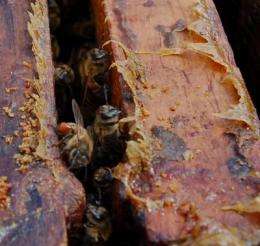
When faced with pathogenic fungi, bees line their hives with more propolis -- the waxy, yellow substance seen here. Propolis is a combination of plant resins and wax that has antifungal and antibacterial properties. Credit: Michael Simone-Finstrom, North Carolina State University

Research from North Carolina State University shows that honey bees "self-medicate" when their colony is infected with a harmful fungus, bringing in increased amounts of antifungal plant resins to ward off the pathogen.

"The colony is willing to expend the energy and effort of its to collect these resins," says Dr. Michael Simone-Finstrom, a postdoctoral research scholar in NC State's Department of and lead author of a paper describing the research. "So, clearly this behavior has evolved because the benefit to the colony exceeds the cost."

Wild honey bees normally line their with propolis, a mixture of plant resins and wax that has antifungal and . Domesticated honey bees also use propolis, to fill in cracks in their hives. However, researchers found that, when faced with a fungal threat, bees bring in significantly more propolis – 45 percent more, on average. The bees also physically removed infected larvae that had been parasitized by the and were being used to create fungal spores.

Researchers know propolis is an effective antifungal agent because they lined some hives with a propolis extract and found that the extract significantly reduced the rate of infection.

And apparently bees can sometimes distinguish harmful fungi from harmless ones, since colonies did not bring in increased amounts of propolis when infected with harmless fungal species. Instead, the colonies relied on physically removing the spores.

However, the self-medicating behavior does have limits. Honey bee colonies infected with pathogenic bacteria did not bring in significantly more propolis – despite the fact that the propolis also has antibacterial properties. "There was a slight increase, but it was not statistically significant," Simone-Finstrom says. "That is something we plan to follow up on."

There may be a lesson here for domestic beekeepers. "Historically, U.S. beekeepers preferred colonies that used less of this resin, because it is sticky and can be difficult to work with," Simone-Finstrom says. "Now we know that this is a characteristic worth promoting, because it seems to offer the bees some natural defense."

Explore further: Cat owners need better information about when to neuter their cat

More information: The paper, "Increased resin collection after parasite challenge: a case of self-medication in honey bees?," was co-authored by Dr. Marla Spivak of the University of Minnesota and is available online from PLoS ONE.

Related Stories

Marla Spivak: A scientist with a real bee in her bonnet

Jul 08, 2011

How do we study bees and why are they disappearing?  How are scientists working to save bees? Marla Spivak--a MacArthur Fellow and Distinguished McKnight Professor, and extension entomologist in the Department ...

Honeybees entomb to protect from pesticides

Apr 08, 2011

(PhysOrg.com) -- With the drastic rise in the disappearance of honeybee colonies throughout the world in recent years there has become a large focus on the study of honeybees and the effects of pesticides ...

Fungus Foot Baths Could Save Bees

Jul 28, 2008

One of the biggest world wide threats to honey bees, the varroa mite, could soon be about to meet its nemesis. Researchers at the University of Warwick are examining naturally occurring fungi that kill the varroa mite. They ...

Deadly fly parasite spotted for first time in honey bees

Jan 03, 2012

Honey bees can become the unwitting hosts of a fly parasite that causes them to abandon their hives and die after a bout of disoriented, "zombie-like" behavior, San Francisco State University researchers have ...

Recommended for you

Bittersweet: Bait-averse cockroaches shudder at sugar

5 hours ago

Sugar isn't always sweet to German cockroaches, especially to the ones that avoid roach baits. In a study published May 24 in the journal Science, North Carolina State University entomologists show the ne ...

White tiger mystery solved

7 hours ago

White tigers today are only seen in zoos, but they belong in nature, say researchers reporting new evidence about what makes those tigers white. Their spectacular white coats are produced by a single change ...

Scientists announce Top 10 New Species from 2012

14 hours ago

An amazing glow-in-the-dark cockroach, a harp-shaped carnivorous sponge and the smallest vertebrate on Earth are just three of the newly discovered top 10 species selected by the International Institute for ...

User comments : 0

More news stories

Scientists discover how rapamycin slows cell growth

University of Montreal researchers have discovered a novel molecular mechanism that can potentially slow the progression of some cancers and other diseases of abnormal growth. In the May 23 edition of the prestigious journal ...

Future doctors unaware of their obesity bias

Two out of five medical students have an unconscious bias against obese people, according to a new study by researchers at Wake Forest Baptist Medical Center. The study is published online ahead of print in the Journal of ...

WHO: Scientific red tape mars efforts vs. virus

International efforts to combat a new pneumonia-like virus that has now killed 22 people are being slowed by unclear rules and competition for the potentially profitable rights to disease samples, the head ...