Research provides octagonal window of opportunity for carbon capture
February 8, 2012 By Chad Boutin
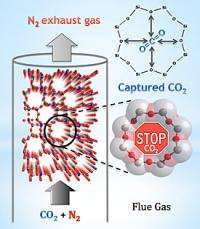
The roughly octagonal pores in zeolite SSZ-13 are like stop signs for carbon dioxide, capturing molecules of the greenhouse gas while apparently letting other substances through. The material could prove to be an economical smokestack filter. Credit: NIST
(PhysOrg.com) -- Filtering carbon dioxide, a greenhouse gas, from factory smokestacks is a necessary, but expensive part of many manufacturing processes. However, a collaborative research team from the National Institute of Standards and Technology and the University of Delaware has gathered new insight into the performance of a material called a zeolite that may stop carbon dioxide in its tracks far more efficiently than current scrubbers do.
Zeolites are highly porous rocksthink of a sponge made of stoneand while they occur in nature, they can be manufactured as well. Their toughness, high surface area (a gram of zeolite can have hundreds of square meters of surface in its myriad internal chambers) and ability to be reused hundreds of times makes them ideal candidates for filtering gas mixtures. If an unwanted molecule in the gas mixture is found to stick to a zeolite, passing the mixture through it can scrub the gas of many impurities, so zeolites are widely used in industrial chemistry as catalysts and filters.
The team explored a zeolite created decades ago in an industrial lab and known by its technical name, SSZ-13. This zeolite, which has octagonal windows between its interior pore spaces, is special because it seems highly capable of filtering out carbon dioxide (CO2) from a gas mixture. That makes SSZ-13 a promising candidate for scrubbing this greenhouse gas out of such things as factory smokestacks, says Craig Brown, a researcher at the NIST Center for Neutron Research (NCNR). So we explored, on an atomic level, how it does this so well.
Using neutron diffraction, the team determined that SSZ-13s eight-sided pore windows are particularly good at attracting the long, skinny carbon dioxide molecules and holding onto their positively-charged central carbon atoms, all the while allowing other molecules with different shapes and electronic properties to pass by unaffected. Like a stop sign, each pore halts one CO2 moleculeand each cubic centimeter of the zeolite has enough pores to stop 0.31 grams of CO2, a quantity that makes SSZ-13 highly competitive when compared to other adsorbent materials.
Brown says a zeolite like SSZ-13 probably will become a prime candidate for carbon scrubbing because it also could prove more economical than other scrubbers currently used in industry. SSZ-13s ability to attract only CO2 could mean its use would reduce the energy demands of scrubbing, which can require up to 25 percent of the power generated in a coal or natural gas power plant.
Many industrial zeolites attract water and carbon dioxide, which are both present in flue exhaustmeaning both molecules are, in a sense, competing for space inside the zeolite, Brown explains. We suspect that this novel CO2 adsorption mechanism means that water is no longer competing for the same site. A zeolite that adsorbs CO2 and little else could create significant cost savings, and thats what this one appears to do.
Brown says his team is still collecting data to confirm this theory, and that their future efforts will concentrate on exploring whether SSZ-13 is equally good at separating CO2 from methanethe primary component of natural gas. CO2 is also released in significant quantities during gas extraction, and the team is hopeful SSZ-13 can address this problem as well.
More information: M.R. Hudson, et al. Unconventional, highly selective CO2 adsorption in zeolite SSZ-13. Journal of the American Chemical Society Published on the Web Jan. 10, 2012. DOI: 10.1021/ja210580b
Journal reference:
Journal of the American Chemical Society
Provided by
National Institute of Standards and Technology
-
From lemons to lemonade: Reaction uses carbon dioxide to make carbon-based semiconductor,
33 comments
-
Thioridazine kills cancer stem cells in human while avoiding toxic side-effects of conventional cancer treatments,
3 comments
-
SpaceX private rocket blasts off for space station (Update),
42 comments
-
Landmark calculation clears the way to answering how matter is formed,
55 comments
-
Research team claims to have found evidence Lake Cheko is impact crater for Tunguska Event,
18 comments
Expert discusses using small-pore zeolites to remove troublesome pollutant from exhaust
-
Hydrogen peroxide reactions that yield high energy
1 hour ago
-
How to find the concentration of nucleic acid solution using optical density?
6 hours ago
-
How do I turn sodium acetate trihydrate into sodium acetate anhydrous and vice versa?
7 hours ago
-
Calculating partial pressures Pa and Pw
9 hours ago
-
Gibbs Free Energy Change/Entropy
20 hours ago
-
What's the rule to covalent character
21 hours ago
- More from Physics Forums - Chemistry
More news stories
Computer model used to pinpoint prime materials for efficient carbon capture
When power plants begin capturing their carbon emissions to reduce greenhouse gases and to most in the electric power industry, it's a question of when, not if it will be an expensive undertaking.
12 hours ago |
not rated yet |
0
|
Scientists develop ultra-sensitive test that detects diseases in their earliest stages
Scientists have developed an ultra-sensitive test that should enable them to detect signs of a disease in its earliest stages, in research published today in the journal Nature Materials.
Chemistry / Analytical Chemistry
12 hours ago |
5 / 5 (1) |
0
|
New CO2-removing catalyst can take the heat
(Phys.org) -- The current method of removing the greenhouse gas carbon dioxide (CO2) from the flues of coal-fired power plants uses so much energy that no one bothers to use it. So says Roger Aines, principal ...
May 24, 2012 |
5 / 5 (9) |
11
|
High-speed method to aid search for solar energy storage catalysts
Eons ago, nature solved the problem of converting solar energy to fuels by inventing the process of photosynthesis.
May 25, 2012 |
5 / 5 (3) |
4
|
Researchers demonstrate possible primitive mechanism of chemical info self-replication
(Phys.org) -- When scientists think about the replication of information in chemistry, they usually have in mind something akin to what happens in living organisms when DNA gets copied: a double-stranded molecule ...
May 25, 2012 |
5 / 5 (4) |
2
|
Stunning image of smallest possible five-ringed structure
Scientists have created and imaged the smallest possible five-ringed structure about 100,000 times thinner than a human hair and you'll probably recognise its shape.
'Unzipped' carbon nanotubes could help energize fuel cells, batteries
Multi-walled carbon nanotubes riddled with defects and impurities on the outside could replace some of the expensive platinum catalysts used in fuel cells and metal-air batteries, according to scientists at ...
Change in developmental timing was crucial in the evolutionary shift from dinosaurs to birds: study
At first glance, it's hard to see how a common house sparrow and a Tyrannosaurus Rex might have anything in common. After all, one is a bird that weighs less than an ounce, and the other is a dinosaur that ...
T cells 'hunt' parasites like animal predators seek prey, study shows
By pairing an intimate knowledge of immune-system function with a deep understanding of statistical physics, a cross-disciplinary team at the University of Pennsylvania has arrived at a surprising finding: T cells use a movement ...
Yale study concludes public apathy over climate change unrelated to science literacy
Are members of the public divided about climate change because they don't understand the science behind it? If Americans knew more basic science and were more proficient in technical reasoning, would public consensus match ...
Land and sea species differ in climate change response: study
(Phys.org) -- Marine and terrestrial species will likely differ in their responses to climate warming, new research by Simon Fraser University and Australia’s University of Tasmania has found.
Feb 08, 2012
Rank: 1 / 5 (1)
Feb 08, 2012
Rank: 1 / 5 (4)
Feb 08, 2012
Rank: 5 / 5 (1)
ANY industrial waste product is a waste of resources, because it's something the industry has already paid for, and is simply throwing away. The best example is sulfur. It used to be mined, while smelters and power plants discharged large quantities into the air. Now, the world's sulfur needs are met by reclaimed "pollution", at lower cost than mining it.
Feb 09, 2012
Rank: 1 / 5 (1)
Feb 09, 2012
Rank: not rated yet
Feb 13, 2012
Rank: not rated yet