Will bubble-powered microrockets zoom through the human stomach?
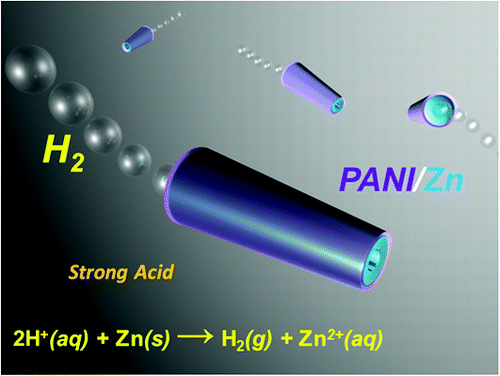
Scientists have developed a new kind of tiny motor — which they term a "microrocket" — that can propel itself through acidic environments, such as the human stomach, without any external energy source, opening the way to a variety of medical and industrial applications. Their report in the Journal of the American Chemical Society describes the microrockets traveling at virtual warp speed for such devices. A human moving at the same speed would have to run at a clip of 400 miles per hour.
Joseph Wang and colleagues explain that self-propelled nano- or microscale motors could have applications in targeted drug delivery or imaging in humans or as a way to monitor industrial applications, such as semiconductor processing. However, some versions of these small-scale motors are not self-propelled and require the addition of a fuel (commonly hydrogen peroxide). Other versions cannot withstand extreme environments such as the stomach, which is very acidic. That's why the researchers developed a new, tubular microrocket that can move itself without added fuels in very acidic conditions.
They tested the new microrocket in various acids and in acidified human blood serum. In such environments, a microrocket spontaneously produces bubbles of hydrogen gas, which propels it like the gases spewing out of a rocket's motor nozzle. The microrocket is ultrafast — it can move farther than 100 times its 0.0004-inch length in just one second. In contrast to current devices of this kind, the microrocket's interior is lined with zinc, which is more biocompatible and "greener" than other materials and leads to the generation of the hydrogen bubbles. Wang's team also developed a version with a magnetic layer, which enabled them to guide the microrockets toward cargo for pick-up, transport and release.
More information: Hydrogen-Bubble-Propelled Zinc-Based Microrockets in Strongly Acidic Media, J. Am. Chem. Soc., 2012, 134 (2), pp 897–900. DOI: 10.1021/ja210874s
Abstract
Tubular polyaniline (PANI)/Zn microrockets are described that display effective autonomous motion in extreme acidic environments, without any additional chemical fuel. These acid-driven hydrogen-bubble-propelled microrockets have been electrosynthesized using the conical polycarbonate template. The effective propulsion in acidic media reflects the continuous thrust of hydrogen bubbles generated by the spontaneous redox reaction occurring at the inner Zn surface. The propulsion characteristics of PANI/Zn microrockets in different acids and in human serum are described. The observed speed–pH dependence holds promise for sensitive pH measurements in extreme acidic environments. The new microrockets display an ultrafast propulsion (as high as 100 body lengths/s) along with attractive capabilities including guided movement and directed cargo transport. Such acid-driven microtubular rockets offer considerable potential for diverse biomedical and industrial applications.
Journal information: Journal of the American Chemical Society
Provided by American Chemical Society


