Scientists devise new imaging technique for analysis of biological samples
January 20, 2012

A pop quiz for cells

Enlarge

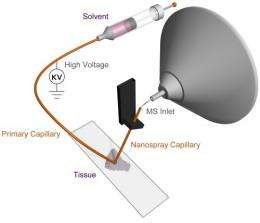
With nanoDESI, researchers use a liquid solvent to sample tissues and deliver the sampled molecules into the mass spectrometer (MS inlet). The solvent dissolves a tiny portion of the sample, mixing it into the liquid. The sample is then removed from the surface and turned into charged droplets at the entrance of a mass spectrometer.

(PhysOrg.com) -- When trying to understand how cells respond to toxins, scientists want to do as little sample preparation as possible. Preparing these cells by immersing them in chemicals or drying them out can erase vital information. At Pacific Northwest National Laboratory, scientists  proved that a new ionization technique they developed in 2009 can provide fingerprint and locate proteins, amino acids, and other chemicals in cells that make up tissues or microbial communities using mass spectrometry.

"The beauty of the technique is that it doesn't require any sample preparation," said Dr. Julia Laskin, who led the research project for PNNL's Imaging Initiative. "Here, you just take your sample, slice it, and put it in front of the instrument for analysis."

The technique, known as Nanospray Desorption Electrospray Iionization or nano-DESI, allows scientists to efficiently determine which molecules reside in a precise spot on a sample. With this information, researchers can learn more about how diverse , such as tissues and microbes,  respond to environmental factors. For example, biochemists can gain see how the marine microbe Shewanella oneidensis alter metals to remediate hazardous materials in the soil. For example, S. oneidensis can change very soluble hexavalent uranium to less soluble form, limiting its movement in groundwater. Another opportunity lies with medical researchers learning how nicotine and other toxins affect brain .

"Great discoveries often require great tools," said Dr. Louis Terminello, who leads the Chemical Imaging Initiative at PNNL. "The discoveries needed to solve today's problems aren't something that you're going to get by eyeballing a sample."
A pop quiz for cells
Enlarge

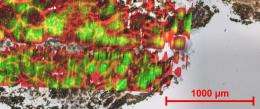
This sample shows an overlay of the optical and nano-DESI image of a human kidney tissue sample.

From the beginning, the team was convinced that the liquid bridge used in nano-DESI could be scaled down to analyze small areas on biological samples. By making adjustments, the team was able to scale the probe down to analyze an area about 10 micrometers in diameter, about the same size as a single red blood cell or mid-sized bacteria.

"With this probe, we are getting down to individual cells," said Laskin.

The team first analyzed rat brain tissues, which provide an outstanding test case for the technique, because they are very dense and yield high signals. The nano-DESI was able to draw up and analyze the molecules from different regions on the sample. Then, the team moved onto "airy" kidney tissues, and again were able to analyze micrometer-sized areas.

With each sample, the nanoDESI generated reams of mass spectra. Existing software packages could not process the data. The job fell to Brandi Heath, a team member who recently completed her bachelor's degree and is working on her master's degree at Washington State University. She read the charts and determined the fatty acids, amino acids, lipids, and other molecules that resided at different locations on the tissue.

"It was very tedious, but in the end, very rewarding," said Heath.

"Compared to other online liquid extraction techniques, nano-DESI has about an order of magnitude better spatial resolution," Laskin added. "It is comparable, spatially, to what laser-based techniques can give."

The team is working on two efforts related to their work with nanoDESI. First, they are working with Drs. Dongsheng Li and James Carson through the Initiative to understand and visualize the mass spectrometry data on the fly. Also, the team is working with Drs. Matthew Marshall, Margaret Romine, Grigoriy Pinchuk, and Jim Fredrickson to analyze different microbial communities of interest to the Department of Energy.

More information: Laskin J, et al. 2012. "Tissue Imaging Using Nanospray Desorption Electrospray Ionization Mass Spectrometry." Analytical Chemistry 84(1):141-148. DOI: 10.1021/ac2021322

Journal reference: Analytical Chemistry search and more info website

Provided by Pacific Northwest National Laboratory search and more info website


Rank 5 /5 (2 votes)
Relevant PhysicsForums posts

More news stories

Computer model used to pinpoint prime materials for efficient carbon capture

When power plants begin capturing their carbon emissions to reduce greenhouse gases – and to most in the electric power industry, it's a question of when, not if – it will be an expensive undertaking.

Chemistry / Materials Science

created 8 hours ago | popularity not rated yet | comments 0 | with audio podcast

Scientists develop ultra-sensitive test that detects diseases in their earliest stages

Scientists have developed an ultra-sensitive test that should enable them to detect signs of a disease in its earliest stages, in research published today in the journal Nature Materials.

Chemistry / Analytical Chemistry

created 8 hours ago | popularity not rated yet | comments 0 | with audio podcast

New CO2-removing catalyst can take the heat

(Phys.org) -- The current method of removing the greenhouse gas carbon dioxide (CO2) from the flues of coal-fired power plants uses so much energy that no one bothers to use it. So says Roger Aines, principal ...

Chemistry / Materials Science

created May 24, 2012 | popularity 5 / 5 (9) | comments 11 | with audio podcast

High-speed method to aid search for solar energy storage catalysts

Eons ago, nature solved the problem of converting solar energy to fuels by inventing the process of photosynthesis.

Chemistry / Materials Science

created May 25, 2012 | popularity 5 / 5 (3) | comments 4 | with audio podcast

Researchers demonstrate possible primitive mechanism of chemical info self-replication

(Phys.org) -- When scientists think about the replication of information in chemistry, they usually have in mind something akin to what happens in living organisms when DNA gets copied: a double-stranded molecule ...

Chemistry / Materials Science

created May 25, 2012 | popularity 5 / 5 (4) | comments 2 | with audio podcast


Stunning image of smallest possible five-ringed structure

Scientists have created and imaged the smallest possible five-ringed structure – about 100,000 times thinner than a human hair – and you'll probably recognise its shape.

'Unzipped' carbon nanotubes could help energize fuel cells, batteries

Multi-walled carbon nanotubes riddled with defects and impurities on the outside could replace some of the expensive platinum catalysts used in fuel cells and metal-air batteries, according to scientists at ...

Change in developmental timing was crucial in the evolutionary shift from dinosaurs to birds: study

At first glance, it's hard to see how a common house sparrow and a Tyrannosaurus Rex might have anything in common. After all, one is a bird that weighs less than an ounce, and the other is a dinosaur that ...

T cells 'hunt' parasites like animal predators seek prey, study shows

By pairing an intimate knowledge of immune-system function with a deep understanding of statistical physics, a cross-disciplinary team at the University of Pennsylvania has arrived at a surprising finding: T cells use a movement ...

Land and sea species differ in climate change response: study

(Phys.org) -- Marine and terrestrial species will likely differ in their responses to climate warming, new research by Simon Fraser University and Australia’s University of Tasmania has found.

Yale study concludes public apathy over climate change unrelated to science literacy

Are members of the public divided about climate change because they don't understand the science behind it? If Americans knew more basic science and were more proficient in technical reasoning, would public consensus match ...