Microbe metabolism: For the smallest organisms, size determines how microbes spend energy
Every living organism balances a budget of sorts — by allocating energy to various parts of its body to fuel essential life processes. Throughout its lifetime, an organism may rebalance this budget to spend more energy on certain processes over others. How an organism spends its energy determines, in large part, its ability to survive in the world, and researchers who study “bioenergetics” are modeling energy use in organisms to understand how populations grow and evolve.
Researchers at MIT have now come up with a model for how energy is spent in the smallest, simplest organisms on Earth, ranging from single-celled bacteria to multicellular microbes. The model divides an organism’s possible energy use into two broad categories: growth and reproduction, and maintenance and repair. Based on the size of a given organism, the model accurately predicts what fraction of energy is spent on each category.
This information, the scientists say, could be crucial for determining how populations of bacteria and other microbes grow and spread in oceans and soil. The model may also help researchers interpret major evolutionary shifts: As microbes evolved to be more complex, they likely rebudgeted energy to support new cellular machinery.
The researchers published their results in the Dec. 26 issue of the Proceedings of the National Academy of Sciences.
Mick Follows, co-author of the paper and a senior research scientist in MIT’s Department of Earth, Atmospheric and Planetary Sciences, says all organisms, at one point or another, face a decision to repair or reproduce, some investing more energy in one process over the other.
“You can imagine a life strategy for one organism might be, ‘I’m not going to spend anything on maintenance, I’m just going to reproduce as quickly as possible and hope I make so many copies that some of them will get through,’” Follows says. “And the opposite strategy is, ‘Well, I’m going to invest less in reproduction, and really take care of myself and keep myself in prime condition and not die if I can help it.’”
Follows’ graduate student Christopher Kempes developed a mathematical model that predicts, broadly, how microbes allocate energy. Kempes devised equations to represent how fast a given microbe grows, as well as the total amount of food an organism can convert to energy. The team, along with research scientist Stephanie Dutkiewicz, then compiled data from other researchers who measured the weight of various microbes over a lifetime, including single-celled bacteria and tiny, multicellular shrimp.
The MIT team combined the data with their equations, and found some interesting patterns among the microbes.
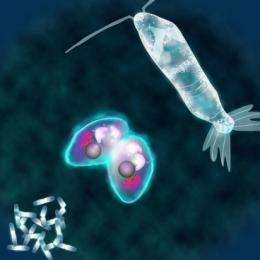
For the gut microbe Escherichia coli, almost every ounce of energy is spent on reproduction. Throughout its lifetime, a single E. coli bacterium grows and divides continuously, quickly colonizing a stomach lining or Petri dish with millions of simple cells. Slightly more complex green algae exhibit a similar trajectory, reproducing up until the very end before refocusing energy inward, on processes that maintain cellular machinery. In contrast, tiny, millimeter-long crustaceans are more self-involved, spending most of their lifetime maintaining complex components before expending energy on reproduction.
The general trend, Follows says, seems to be that the bigger and more complex a microorganism, the more energy it spends on looking out for itself, or repairing internal structures. Smaller, simpler organisms focus more on growing and proliferating, counting on sheer numbers to increase their survival chances.
“You can get an inkling of how you’re going from very simple cells that can grow faster,” Follows says. “As they add machinery, they invest more in maintenance. And then at some point, that strategy also becomes energy-intensive. But at that point, multicellularity allows you to share energy and resources with other cells.”
These trends, the team speculates, may reflect broad evolutionary changes between single-celled prokaryotes such as E. coli, more complex eukaryotes such as green algae and simple multicellular organisms such as tiny shrimp. Through their model, the researchers are able to determine the very smallest size of the simplest organisms, based on how they use energy, as well as the size at which organisms evolve to be multicellular.
“Those evolutionary transitions occur in our model at very predictable stages,” Kempes says. “These transitions allow the organism to get bigger, and that’s the story of how life got so complex.”
Steven Allison, an assistant professor of ecology and evolutionary biology at the University of California at Irvine, says the group’s new model may be used to evaluate how all organisms, large and small, expend energy.
“The key innovation here is that microbes' use of energy and resources can change through their life cycles,” Allison says. “These differences have not been appreciated before. This means that it may be possible to predict population growth rates based on the size of the cells and their type.”
The team plans to incorporate the mathematical model for a single organism’s energy use into models of large-scale populations. Follows says knowing how a single organism allocates energy could help researchers more accurately model how microbes spread throughout an environment. For example, if a scientist builds a model to represent bacteria in the ocean, the population may look very different depending on whether the researcher programs the bacteria to expend all their energy on reproduction or repair.
“In some sense, today’s models of phytoplankton in the ocean don’t use this kind of information,” Follows says. “We need to make [these models] better.”
Journal information: Proceedings of the National Academy of Sciences
Provided by Massachusetts Institute of Technology
This story is republished courtesy of MIT News (web.mit.edu/newsoffice/), a popular site that covers news about MIT research, innovation and teaching.


