Trillion-frame-per-second video
December 13, 2011 by Larry Hardesty
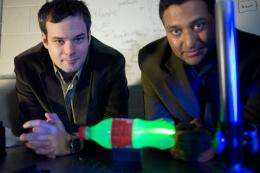
Media Lab postdoc Andreas Velten, left, and Associate Professor Ramesh Raskar with the experimental setup they used to produce slow-motion video of light scattering through a plastic bottle. Photo: M. Scott Brauer
By using optical equipment in a totally unexpected way, MIT researchers have created an imaging system that makes light look slow.
MIT researchers have created a new imaging system that can acquire visual data at a rate of one trillion exposures per second. Thats fast enough to produce a slow-motion video of a burst of light traveling the length of a one-liter bottle, bouncing off the cap and reflecting back to the bottles bottom.
Media Lab postdoc Andreas Velten, one of the systems developers, calls it the ultimate in slow motion: Theres nothing in the universe that looks fast to this camera, he says.
The system relies on a recent technology called a streak camera, deployed in a totally unexpected way. The aperture of the streak camera is a narrow slit. Particles of light photons enter the camera through the slit and pass through an electric field that deflects them in a direction perpendicular to the slit. Because the electric field is changing very rapidly, it deflects late-arriving photons more than it does early-arriving ones.
The image produced by the camera is thus two-dimensional, but only one of the dimensions the one corresponding to the direction of the slit is spatial. The other dimension, corresponding to the degree of deflection, is time. The image thus represents the time of arrival of photons passing through a one-dimensional slice of space.
This video is not supported by your browser at this time.
Video: Melanie Gonick
The camera was intended for use in experiments where light passes through or is emitted by a chemical sample. Since chemists are chiefly interested in the wavelengths of light that a sample absorbs, or in how the intensity of the emitted light changes over time, the fact that the camera registers only one spatial dimension is irrelevant.But its a serious drawback in a video camera. To produce their super-slow-mo videos, Velten, Media Lab Associate Professor Ramesh Raskar and Moungi Bawendi, the Lester Wolfe Professor of Chemistry, must perform the same experiment such as passing a light pulse through a bottle over and over, continually repositioning the streak camera to gradually build up a two-dimensional image. Synchronizing the camera and the laser that generates the pulse, so that the timing of every exposure is the same, requires a battery of sophisticated optical equipment and exquisite mechanical control. It takes only a nanosecond a billionth of a second for light to scatter through a bottle, but it takes about an hour to collect all the data necessary for the final video. For that reason, Raskar calls the new system the worlds slowest fastest camera.
Doing the math
After an hour, the researchers accumulate hundreds of thousands of data sets, each of which plots the one-dimensional positions of photons against their times of arrival. Raskar, Velten and other members of Raskars Camera Culture group at the Media Lab developed algorithms that can stitch that raw data into a set of sequential two-dimensional images.
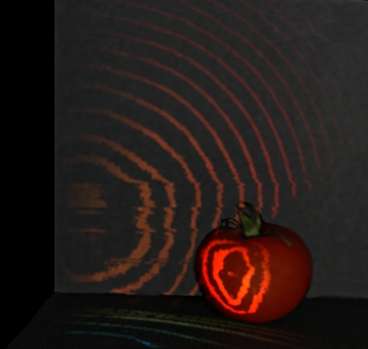
One of the things that distinguishes the researchers' new system from earlier high-speed imaging systems is that it can capture light 'scattering' below the surfaces of solid objects, such as the tomato depicted here. Image: Di Wu and Andreas Velten, MIT Media Lab
The streak camera and the laser that generates the light pulses both cutting-edge devices with a cumulative price tag of $250,000 were provided by Bawendi, a pioneer in research on quantum dots: tiny, light-emitting clusters of semiconductor particles that have potential applications in quantum computing, video-display technology, biological imaging, solar cells and a host of other areas.The trillion-frame-per-second imaging system, which the researchers have presented both at the Optical Society's Computational Optical Sensing and Imaging conference and at Siggraph, is a spinoff of another Camera Culture project, a camera that can see around corners. That camera works by bouncing light off a reflective surface say, the wall opposite a doorway and measuring the time it takes different photons to return. But while both systems use ultrashort bursts of laser light and streak cameras, the arrangement of their other optical components and their reconstruction algorithms are tailored to their disparate tasks.
Because the ultrafast-imaging system requires multiple passes to produce its videos, it cant record events that arent exactly repeatable. Any practical applications will probably involve cases where the way in which light scatters or bounces around as it strikes different surfaces is itself a source of useful information. Those cases may, however, include analyses of the physical structure of both manufactured materials and biological tissues like ultrasound with light, as Raskar puts it.
As a longtime camera researcher, Raskar also sees a potential application in the development of better camera flashes. An ultimate dream is, how do you create studio-like lighting from a compact flash? How can I take a portable camera that has a tiny flash and create the illusion that I have all these umbrellas, and sport lights, and so on? asks Raskar, the NEC Career Development Associate Professor of Media Arts and Sciences. With our ultrafast imaging, we can actually analyze how the photons are traveling through the world. And then we can recreate a new photo by creating the illusion that the photons started somewhere else.
Its very interesting work. I am very impressed, says Nils Abramson, a professor of applied holography at Swedens Royal Institute of Technology. In the late 1970s, Abramson pioneered a technique called light-in-flight holography, which ultimately proved able to capture images of light waves at a rate of 100 billion frames per second.
But as Abramson points out, his technique requires so-called coherent light, meaning that the troughs and crests of the light waves that produce the image have to line up with each other. If you happen to destroy the coherence when the light is passing through different objects, then it doesnt work, Abramson says. So I think its much better if you can use ordinary light, which Ramesh does.
Indeed, Velten says, As photons bounce around in the scene or inside objects, they lose coherence. Only an incoherent detection method like ours can see those photons. And those photons, Velten says, could let researchers learn more about the material properties of the objects, about what is under their surface and about the layout of the scene. Because we can see those photons, we could use them to look inside objects for example, for medical imaging, or to identify materials.
Im surprised that the method Ive been using has not been more popular, Abramson adds. Ive felt rather alone. Im very glad that someone else is doing something similar. Because I think there are many interesting things to find when you can do this sort of study of the light itself.
Provided by
Massachusetts Institute of Technology
This story is republished courtesy of MIT News (http://web.mit.edu/newsoffice/), a popular site that covers news about MIT research, innovation and teaching.
-
From lemons to lemonade: Reaction uses carbon dioxide to make carbon-based semiconductor,
32 comments
-
Thioridazine kills cancer stem cells in human while avoiding toxic side-effects of conventional cancer treatments,
3 comments
-
SpaceX private rocket blasts off for space station (Update),
42 comments
-
Climate scientists say they have solved riddle of rising sea,
31 comments
-
SpaceX capsule has 'new car' smell, astronauts say (Update),
4 comments
-
Need a rigid insulation material???
23 hours ago
-
magnets or EMF in car bumpers to protect from fender bender
May 26, 2012
-
length of wire in a coil of known dimensions?
May 25, 2012
-
India Engineering Powerhouse
May 25, 2012
-
electromagnet core dereference between hard and soft iron
May 25, 2012
-
Measuring water pressure in an open tank
May 24, 2012
- More from Physics Forums - General Engineering
More news stories
Browser wars flare in mobile space
The browser wars are heating up again, but this time the fight is for dominance of the mobile Internet.
15 hours ago |
5 / 5 (2) |
3
Probability of contamination from severe nuclear reactor accidents is higher than expected: study
Catastrophic nuclear accidents such as the core meltdowns in Chernobyl and Fukushima are more likely to happen than previously assumed. Based on the operating hours of all civil nuclear reactors and the number ...
Technology / Energy & Green Tech
May 22, 2012 |
3.6 / 5 (25) |
56
|
HyperSolar shows dirty water no barrier to power world
(Phys.org) -- The Santa Barbara, California, company, HyperSolar, is set to transparently share the ups and downs of its research experiences toward the companys ultimate vision, successfully producing ...
SpotterRF debuts Radar Backpack Kit (w/ Video)
(Phys.org) -- SpotterRF has announced a special radar backpack kit designed to enhance situational awareness for soldiers on the ground. The company says its special radar is designed for warfighters as part ...
Tesla to launch electric sedan in US on June 22
Tesla Motors said Tuesday it would begin deliveries of "the world's first premium electric sedan" on June 22, slightly ahead of schedule.
Technology / Energy & Green Tech
May 22, 2012 |
4.5 / 5 (12) |
18
Stunning image of smallest possible five-ringed structure
Scientists have created and imaged the smallest possible five-ringed structure about 100,000 times thinner than a human hair and you'll probably recognise its shape.
'Unzipped' carbon nanotubes could help energize fuel cells, batteries
Multi-walled carbon nanotubes riddled with defects and impurities on the outside could replace some of the expensive platinum catalysts used in fuel cells and metal-air batteries, according to scientists at ...
Change in developmental timing was crucial in the evolutionary shift from dinosaurs to birds: study
At first glance, it's hard to see how a common house sparrow and a Tyrannosaurus Rex might have anything in common. After all, one is a bird that weighs less than an ounce, and the other is a dinosaur that ...
Computer model used to pinpoint prime materials for efficient carbon capture
When power plants begin capturing their carbon emissions to reduce greenhouse gases and to most in the electric power industry, it's a question of when, not if it will be an expensive undertaking.
T cells 'hunt' parasites like animal predators seek prey, study shows
By pairing an intimate knowledge of immune-system function with a deep understanding of statistical physics, a cross-disciplinary team at the University of Pennsylvania has arrived at a surprising finding: T cells use a movement ...
Land and sea species differ in climate change response: study
(Phys.org) -- Marine and terrestrial species will likely differ in their responses to climate warming, new research by Simon Fraser University and Australia’s University of Tasmania has found.
Dec 13, 2011
Rank: 5 / 5 (6)
Dec 13, 2011
Rank: 2.3 / 5 (3)
From rangefinding to characterization of chemical processes to visualizations of protein configurations.
Very impressive.
A way to get an even more super slo mo might be to pass the light through a cold cloud of atoms to slow it down before coming to the electric fied of the slit.
Dec 13, 2011
Rank: 3.8 / 5 (4)
Must require insane amounts of memory though, like even half of a billionth of a second would be 500 frames.
It's incredible how you can watch the wave-fronts of the light expanding as they move.
Certainly a win for the wave theory of light.
Dec 13, 2011
Rank: 3 / 5 (2)
i thought light speed would have limited the fps to under 300 million.
Gotta admit though it is cool.
Dec 13, 2011
Rank: not rated yet
Dec 13, 2011
Rank: 3.3 / 5 (4)
Light speed wouldn't limit the number of frames.
That's probably actually unlimited, except by the technology's ability to store the data in memory.
Photons can be leaving the source object at different fractions of a trillionth of a second, or reflect from an imperfection or different surface a fraction of a trillionth of a second later, so they could arrive at a hypothetical camera offset by a ten-trillionth or a 100 trillionth of a second.
Frames per second is probably only limited hypothetically at around 10^-44 seconds.
Of course, the problem would be designing some thing capable to detecting that, which would clearly require the absolute limits of nano-technology.
Dec 13, 2011
Rank: not rated yet
With visible laser light, the usual answer is "the light is scattered from the beam path by dust or water droplets" but there's no indication of that here.
Dec 13, 2011
Rank: 5 / 5 (6)
Dec 13, 2011
Rank: 1.8 / 5 (4)
Dec 13, 2011
Rank: 3 / 5 (2)
Dec 13, 2011
Rank: 4.3 / 5 (3)
I think this was a kind of proof of concept, which is why the 1d stream that needs to be built up in layers.
I think the next step is to create a slit array in order to create full video rather than build it up over multiple shots.
Due to the human factor (Adjusting the camera over and over again) and the time factor (that conditions can change between shots, possibly in unexpected ways), there is a high propensity for artifacts and, in cases, skewed data due to misalignment.
That said, it's absolutely frikkin awesome.
Dec 13, 2011
Rank: 5 / 5 (2)
the way I understand it they generate 500 points per pulse and then rotate the mirrors for the next shot. So effectively they are taking the equivalent of 500 images over the entire sequence. That's not too much in terms of data. The reconstruction, however, is probably a bitch.
Bright light gets scattered in water to some degree. What you are seeing are the scattered photons at each point the pulse travels through the water.
(More precisely: The individual images are the summation over the scattered photons of many pulses at a certain time after the pulse is fired)
Dec 13, 2011
Rank: 1 / 5 (3)
Even with nano-sized photoelectric receptors, you would have to build a camera the size of the solar system or bigger to detect changes on a Planck time-scale. The camera would have to be 1.8*10^31 times bigger than the one used in this experiment if you used same sized photoelectric receptors.
Dec 13, 2011
Rank: 1 / 5 (1)
Dec 13, 2011
Rank: not rated yet
Dec 13, 2011
Rank: not rated yet
One assumes there is some photonic crystal or some such that responds to the electric field in a manner that achieves the deflection, because photons don't bend in electric fields.
Dec 13, 2011
Rank: 1 / 5 (3)
"Forgive my nitpicking, but light (photons) does not have an electric charge, so it cannot be deflected by electric or magnetic fields." - lomed
You are forgiven.
Dec 13, 2011
Rank: not rated yet
Dec 14, 2011
Rank: not rated yet
Dec 14, 2011
Rank: 1 / 5 (1)
They interleave the data, not only between multiple cameras, but between multiple pulses.
Dec 14, 2011
Rank: 1 / 5 (1)
Dec 14, 2011
Rank: 4 / 5 (4)
http://www.youtub...lQTmx1LE
Still, this actually has a ton of very important applications, and quite an engineering (and imagineering) feat!
Dec 14, 2011
Rank: 1 / 5 (1)
That's pretty cool. Wonderful implementation of the technology. Given that it works so well here (loved the video), we should probably reexamine the need (or IMHO lack thereof) of the concept of "gravitational lensing".
I think what we've got here is a fantastic practical application of a fundamental physical law (one that I believe EU theory relies on as well, if I'm not mistaken) that if extrapolated to a large enough scale indicates that what we call "gravitational lensing" is probably nothing of the sort.
Dec 14, 2011
Rank: 5 / 5 (1)
This experiment was possible BECAUSE our current physics theory is reliable. Also, in principle it's something we've been doing for a while with some xray diffraction techniques. This is just a very clever application of it.
gravitational lensing works on a different principle, and is independently supported by many other observations - including observations of our own sun. Experiments have shown that our line of sight around the sun bends ever so slightly so that we can see a tiny amount more around the sun than we would be able to without gravitational lensing.
Also, the theories involved in grav lensing have been proven in many other ways as well.
Dec 14, 2011
Rank: not rated yet
Dec 14, 2011
Rank: 3 / 5 (2)
Yes, like I said, this is done by interleaving data sets...
Dec 15, 2011
Rank: not rated yet
I wonder if this guy read the article before commenting?
Let me help some of you who are not understanding this concept.
This system does not work like a typical camera. It converts a stream of photons into a string of electrical signals. The timing is determined by the order of arrival. The position is determined by the properties of each signal.
Dec 17, 2011
Rank: 1 / 5 (2)
They should not be there.
Dec 19, 2011
Rank: not rated yet
Yeah, the responses to this article is a good sampling of how many posters actually understand the scientific content of the articles in general.
Dec 20, 2011
Rank: not rated yet