Thinner thermal insulation
December 2, 2011

Thinner thermal insulation

Enlarge

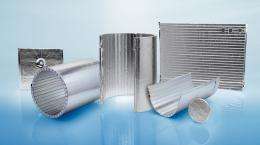
Vacuum insulation panels, VIPs for short, insulate ten times better than conventional insulation of the same thickness. Credit: va-Q-tec AG

(PhysOrg.com) -- Insulation panels that are both thin and effective are expensive. At present these high-end products are built into energy-saving refrigerators. Innovative components and production techniques are now set to sink the costs – so that private home-builders can also benefit from the new technology.

In Germany, the rising cost of heating has sparked a renovation boom. In order to lower energy costs, more and more homeowners are investing in insulation facades. But the typical insulation layers on the market have one drawback: they add bulk. The 20-centimeter-thick outer skin changes the building’s visual appearance and can result in significant follow-up costs – with a need to fit new, deeper window sills and sometimes even roof extensions. Fraunhofer researchers are now developing films for a material that will insulate homes without much additional structural alteration: vacuum isolation panels, VIPs for short. The panels are only two centimeters thick and yet perform just as well as a classic 15-centimeter-thick insulation layer made from polyurethane foam. The inner workings of the VIPs are made mostly from pyrogenic silica. A high-tech film holds the material together and makes it air-tight.

Dr. Klaus Noller from the Fraunhofer Institute for Process Engineering and Packaging IVV in Freising and Prof. Gerhard Sextl from the Fraunhofer Institute for Silicate Research ISC in Würzburg have been involved with the development of VIPs since the very beginning. They now want to ready the panels for cost-effective mass production. “The key elements are the films: they dictate the quality, life span and price,” acknowledges Noller. “The current production method is time-consuming and expensive: three of the five layers of plastic have to be coated with aluminum and stuck together. This requires seven production steps, which drives the price up.” At present, these expensive VIPs are employed only where a space saving is worth the money: for example in high-end and freezers.

The new film is easier to produce because it is made up of just two plastic films with three barrier layers: one aluminum-coated plastic film is coated with a micrometer-thin layer of ORMOCER – an ISC invention – and then coated again with aluminum. ORMOCERs contain an organic-inorganic hybrid silicon-oxygen polymer matrix, which makes the material exceptionally tight and stable. “That’s what makes it perfect for insulation panels,” says Noller. “Gases and liquids cannot easily penetrate the ORMOCER layer.” The new insulation films can be fashioned in just five stages. First a film is coated, then the ORMOCER layer applied, then coated a second time before the barrier film is applied to the sealing film. “The end product is better and cheaper than the insulation films already on the market,” claims Sextl.

Researchers have also optimized the production of the VIP insulation elements: at the Fraunhofer Application Center for Processing Machines and Packaging Technology AVV in Dresden they have developed an automated process for gently sealing the pyrogenic silica cores with the high-barrier film. The films and production process have now been patented. As soon as the new VIPs are being produced in large enough quantities, the price should fall. Sextl and Noller are convinced that the thin panels will then be of interest for the building industry.

Now researchers want to simplify the production process further and carry out long-term tests. Until now the panels had to last just twelve years – the average lifespan of a refrigerator. The building sector has higher expectations: a facade should last fifty years. Noller and his colleagues are now testing the stability of films and elements in climate chambers, which simulate the seasonal changes in heat and frost and in humidity. The results should be available in just a few months.

Provided by Fraunhofer-Gesellschaft search and more info website

Filter


Move the slider to adjust rank threshold, so that you can hide some of the comments.


Display comments: newest first

Isaacsname
Dec 02, 2011

Rank: not rated yet
I hope it's cheaper than reflectix. I didn't know they also use fumed silica in milkshakes AND kitty litter.....ugh
wiyosaya
Dec 02, 2011

Rank: not rated yet
There already is a technology out there that can give as much as R20/inch. Its called the Gas Filled Panel http://gfp.lbl.gov/
Where are these in the marketplace given that this technology is easily made and installed?
Vendicar_Decarian
Dec 02, 2011

Rank: 2.3 / 5 (3)
Clearly improved consumptive energy efficiency is impossible.

If God wanted Americans to wrap their houses in Commie Cling Wrap to save energy he wouldn't have made oil in infinite abundance.
aiyoung
Dec 03, 2011

Rank: not rated yet
@Wiyosaya

Looking at the link you posted, R20/in insulation is impressive, but anything filled with xenon is going to be really expensive.

Xenon costs around $120 per 100 grams!
Rank 5 /5 (3 votes)
Relevant PhysicsForums posts

More news stories

Browser wars flare in mobile space

The browser wars are heating up again, but this time the fight is for dominance of the mobile Internet.

Technology / Software

created 15 hours ago | popularity 5 / 5 (2) | comments 3

Probability of contamination from severe nuclear reactor accidents is higher than expected: study

Catastrophic nuclear accidents such as the core meltdowns in Chernobyl and Fukushima are more likely to happen than previously assumed. Based on the operating hours of all civil nuclear reactors and the number ...

Technology / Energy & Green Tech

created May 22, 2012 | popularity 3.6 / 5 (25) | comments 56 | with audio podcast

HyperSolar shows dirty water no barrier to power world

(Phys.org) -- The Santa Barbara, California, company, HyperSolar, is set to transparently share the ups and downs of its research experiences toward the company’s ultimate vision, successfully producing ...

Technology / Energy & Green Tech

created May 24, 2012 | popularity 4.8 / 5 (16) | comments 17 | with audio podcast report

SpotterRF debuts Radar Backpack Kit (w/ Video)

(Phys.org) -- SpotterRF has announced a special radar backpack kit designed to enhance situational awareness for soldiers on the ground. The company says its special radar is designed for warfighters as part ...

Technology / Hi Tech & Innovation

created May 26, 2012 | popularity 5 / 5 (5) | comments 13 | with audio podcast report

Tesla to launch electric sedan in US on June 22

Tesla Motors said Tuesday it would begin deliveries of "the world's first premium electric sedan" on June 22, slightly ahead of schedule.

Technology / Energy & Green Tech

created May 22, 2012 | popularity 4.5 / 5 (12) | comments 18


Stunning image of smallest possible five-ringed structure

Scientists have created and imaged the smallest possible five-ringed structure – about 100,000 times thinner than a human hair – and you'll probably recognise its shape.

'Unzipped' carbon nanotubes could help energize fuel cells, batteries

Multi-walled carbon nanotubes riddled with defects and impurities on the outside could replace some of the expensive platinum catalysts used in fuel cells and metal-air batteries, according to scientists at ...

Change in developmental timing was crucial in the evolutionary shift from dinosaurs to birds: study

At first glance, it's hard to see how a common house sparrow and a Tyrannosaurus Rex might have anything in common. After all, one is a bird that weighs less than an ounce, and the other is a dinosaur that ...

Computer model used to pinpoint prime materials for efficient carbon capture

When power plants begin capturing their carbon emissions to reduce greenhouse gases – and to most in the electric power industry, it's a question of when, not if – it will be an expensive undertaking.

T cells 'hunt' parasites like animal predators seek prey, study shows

By pairing an intimate knowledge of immune-system function with a deep understanding of statistical physics, a cross-disciplinary team at the University of Pennsylvania has arrived at a surprising finding: T cells use a movement ...

Land and sea species differ in climate change response: study

(Phys.org) -- Marine and terrestrial species will likely differ in their responses to climate warming, new research by Simon Fraser University and Australia’s University of Tasmania has found.