A tale of tails
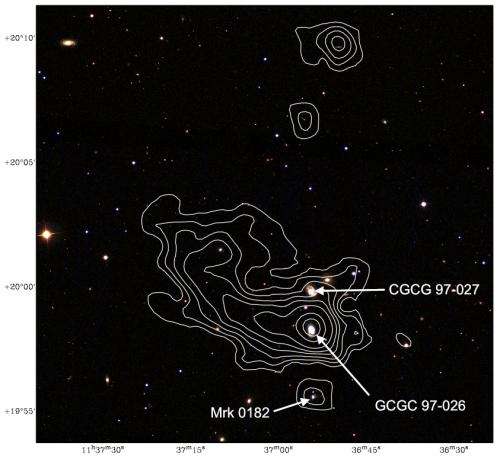
A visible light image of the RSCG 42 group of galaxies (CGCG 097−026, CGCG 097−027 and Mrk 0182) in Abell 1367. This is based on a composite of images taken from the Sloan Digital Sky Survey through three colour filters. The white contours show the neutral hydrogen distribution, with the highest contour coinciding with the spiral galaxy GCGC 97-026 and a huge gas tail emanating from this galaxy in a north-easterly direction. Four other galaxies in the RSCG 42 group have associated neutral hydrogen here marked by contour lines.
(PhysOrg.com) -- An international group of astronomers led by Tom Scott at the Instituto de Astrofísica de Andalucía in Granada, Spain, has discovered extraordinarily long one-sided gaseous tails in two groups of galaxies that are amongst the longest structures ever observed in such environments. They emanate from CGCG 097-026 and FGC1287, two spiral galaxies in small groups in the outskirts of the galaxy cluster known as Abell 1367 in the constellation of Leo, at a distance of 300 million light years. The new work, which could lead to a major shift in our understanding of galaxy evolution, is published in the journal Monthly Notices of the Royal Astronomical Society.
Clusters of galaxies are the biggest structures in the Universe that are held together by gravity. They are like a huge metropolis populated by galaxies that interact with one another and with their environment, the hot gas trapped within the cluster's gravitational field. In the last few decades, astronomers have revealed that, in order to enjoy life in these big cities, galaxies have to pay an entrance fee: they are stripped of their cold hydrogen gas when they enter.
Without this gas, the fuel for future star formation, they age much more quickly than their counterparts who shun the big conurbations. Scientists believe that this is why clusters of galaxies have a significantly larger fraction of passive, quiescent objects where stars are no longer forming than is found in lower density environments. The research by Scott and his team might change this view, showing that galaxies can be robbed of their gas reservoir well before reaching the outskirts of the metropolis.
The astronomers made their discovery after using the Expanded Very Large Array (EVLA) of the National Radio Astronomy Observatory (NRAO) in the USA to study Abell 1367 in detail. "When we looked at the data, we were amazed to see these tail structures" says Tom Scott.
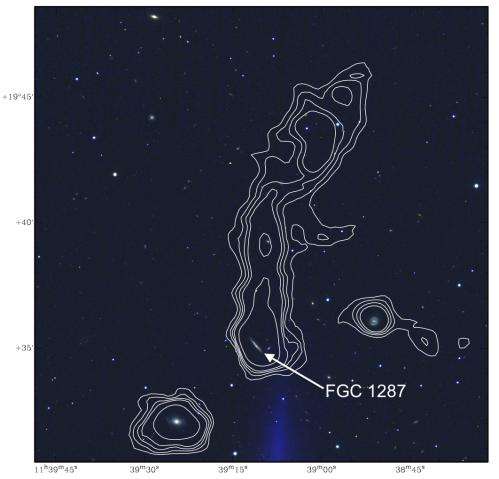
A visible light image of the FGC 1287 group of galaxies in Abell 1367. This is based on a composite of images taken from the Sloan Digital Sky Survey through three colour filters. The white contours show the neutral hydrogen distribution. The huge gas tail emanates from the edge on spiral galaxy FGC 1287. Two other members of the group have associated neutral hydrogen here marked by contour lines.
'The projected lengths of the gaseous tails are 9 to 10 times that of the size of the parent galaxies, i.e., 520,000 and 815,000 light years respectively. In both cases the amount of cold hydrogen gas in the tails is approximately the same as that remaining in the galaxy's disk. In other words, these galaxies have already left behind half of their fuel for star formation before entering the sphere of influence of the cluster."The commonly accepted scenario invoked to explain the loss of gas in galaxies is based on the idea that when galaxies enter a big cluster, they lose their gas interacting with the hot intra-cluster medium. Like a meteor entering the Earth's atmosphere, the atomic hydrogen is stripped by the pressure that builds up from moving through the dense, hot gas that pervades the cluster, the stripped gas being dispersed within the intergalactic medium. Scientists call this mechanism ram-pressure stripping.
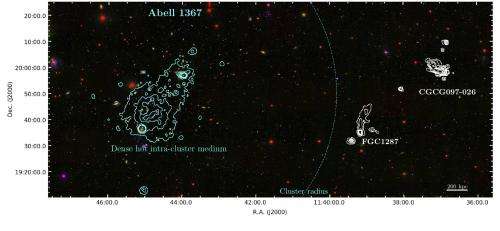
Image showing a wide angle view of Abell 1367 and the positions of the RSCG 42 and FGC 1287 groups. The cyan contours trace the X-ray emission from the hot intra-cluster gas at the centre of the cluster and the white contours show the cold neutral hydrogen gas detected in the two groups.
However, in this case, the perturbed galaxies are still well outside the sphere of influence of this cluster medium and it is not clear which mechanism is responsible for these unique gas tails."We considered the various physical processes proposed by theorists in the past to describe gas removal from galaxies, but no one seems to be able to explain our observations" says Luca Cortese, researcher at ESO-Garching, Germany, and co-author of this work. "Whereas in the case of CGCG97-026, the gravitational interaction between the various members of the group could explain what we see, FGC1287 is completely different from any case we have seen before."
Indeed, ram pressure stripping does not seem to be a viable explanation in this case. As this galaxy is located in the outskirts of the cluster, it lies beyond what is thought to be the sphere of influence of the hot and diffuse gas in Abell 1367. To make things even more complicated, gravitational interactions are apparently unable to explain the extraordinary length of the tail and the lack of any sign of disturbance in the stellar body of the galaxy.
The origin of these extraordinary tails still remains a puzzle for scientists, and they perhaps require some physical mechanism that has not been considered before.
"Although the mechanism responsible for this extraordinary gas tail remains to be determined, our discovery highlights how much there still is to learn about environmental effects in galaxy groups" says team member Elias Brinks, a scientist at the University of Hertfordshire. "This discovery might open a new chapter in our understanding of environmental effects on galaxy evolution."
More information: The new research appears in "Two long tails in the outskirts of Abell 1367", Scott T., Cortese L., Brinks E., Bravo-Alfaro H., Auld R. and Minchin R., Monthly Notices of the Royal Astronomical Society, in press. A preprint of the paper can be seen at http://arxiv.org/abs/1111.7144
Journal reference:
Monthly Notices of the Royal Astronomical Society
Provided by
Royal Astronomical Society
-
From lemons to lemonade: Reaction uses carbon dioxide to make carbon-based semiconductor,
32 comments
-
Thioridazine kills cancer stem cells in human while avoiding toxic side-effects of conventional cancer treatments,
3 comments
-
SpaceX private rocket blasts off for space station (Update),
42 comments
-
Climate scientists say they have solved riddle of rising sea,
31 comments
-
SpaceX capsule has 'new car' smell, astronauts say (Update),
4 comments
-
Distance of planets from stars and revolution
8 hours ago
-
revamping general concept and cosmological principle
May 25, 2012
-
Transiting Exoplanet Light Curve
May 25, 2012
-
Math behind Theoretical Physics
May 24, 2012
-
Do we know whats at the center of galaxies yet?
May 23, 2012
-
Structure of the Milky Way?
May 20, 2012
- More from Physics Forums - General Astronomy
More news stories
Land and sea species differ in climate change response: study
(Phys.org) -- Marine and terrestrial species will likely differ in their responses to climate warming, new research by Simon Fraser University and Australia’s University of Tasmania has found.
6 hours ago |
3.8 / 5 (4) |
5
|
Yale study concludes public apathy over climate change unrelated to science literacy
Are members of the public divided about climate change because they don't understand the science behind it? If Americans knew more basic science and were more proficient in technical reasoning, would public consensus match ...
8 hours ago |
4.8 / 5 (5) |
20
|
10 million years needed to recover from mass extinction
It took some 10 million years for Earth to recover from the greatest mass extinction of all time, latest research has revealed.
Space & Earth / Earth Sciences
8 hours ago |
4 / 5 (4) |
1
|
Sophisticated simulations predict future warming
The chances of our planet being hit by a global warming of 3 degrees Celsius by 2050 is as likely as it being hit by an increase of 1.4 degrees, new research shows. Presented in the journal Nature Geoscience, the British study ...
Space & Earth / Earth Sciences
May 22, 2012 |
4.1 / 5 (10) |
51
Aliens don't want to eat us, says former SETI director
Alien life probably isnt interested in having us for dinner, enslaving us or laying eggs in our bellies, according to a recent statement by former SETI director Jill Tarter.
Space & Earth / Space Exploration
May 25, 2012 |
4.4 / 5 (15) |
41
Stunning image of smallest possible five-ringed structure
Scientists have created and imaged the smallest possible five-ringed structure about 100,000 times thinner than a human hair and you'll probably recognise its shape.
'Unzipped' carbon nanotubes could help energize fuel cells, batteries
Multi-walled carbon nanotubes riddled with defects and impurities on the outside could replace some of the expensive platinum catalysts used in fuel cells and metal-air batteries, according to scientists at ...
Change in developmental timing was crucial in the evolutionary shift from dinosaurs to birds: study
At first glance, it's hard to see how a common house sparrow and a Tyrannosaurus Rex might have anything in common. After all, one is a bird that weighs less than an ounce, and the other is a dinosaur that ...
Computer model used to pinpoint prime materials for efficient carbon capture
When power plants begin capturing their carbon emissions to reduce greenhouse gases and to most in the electric power industry, it's a question of when, not if it will be an expensive undertaking.
T cells 'hunt' parasites like animal predators seek prey, study shows
By pairing an intimate knowledge of immune-system function with a deep understanding of statistical physics, a cross-disciplinary team at the University of Pennsylvania has arrived at a surprising finding: T cells use a movement ...
Scientists develop ultra-sensitive test that detects diseases in their earliest stages
Scientists have developed an ultra-sensitive test that should enable them to detect signs of a disease in its earliest stages, in research published today in the journal Nature Materials.


Dec 06, 2011
Rank: 1.6 / 5 (7)
It seems that science has made some wrong choices in the process of coming to agreement on what we are seeing with our telescopes. After all, were one to step back just a bit and re-visit the claims made by Hannes Alfven, they would find that Alfven's electrical universe exhibits much support from modern observations. We must switch our mental gears, and start the process of growing a fresh limb to the body of science. And we must protect this new electrical line of investigation from hostile attack, as it is supported by many observations of the interstellar and intergalactic mediums.
There is more than enough evidence by now to accommodate the construction of a new all-electric scientific framework, and we can do it without any strange matters or forces.
Dec 06, 2011
Rank: 1.8 / 5 (8)
For intelligent criticisms of existing quantum theory, and a rock-solid path forward for how to fix these problems, see the Common Sense Science group's publications.
When it comes to explaining how life uses water to harness electricity, read Gerald Pollack's Gels, Cells and the Engines of Life.
Archaeology and geology have been covered in extensive depth by prior generations with the catastrophist-velikovsky debates.
To see how ancient human writings and drawings support the view of an electrical plasma-based universe, check out David Talbott's Thunderbolts of the Gods video on YouTube.
For an understanding of how electrical stars work, see Don Scott's website and book, The Electric Sky.
For interstellar "dust", see Gerrit Verschuur.
A new scientific framework means that there is much, much work to be done.
Dec 06, 2011
Rank: 1 / 5 (5)
http://www.presto...ndex.htm
Dec 07, 2011
Rank: 1 / 5 (6)
The mistake is the assumption that the gas must be pre-existing and originate within the host galaxy. While hard to get over astronomer's presumptions, this model fits the observation, once again. If it walks like a duck....
Dec 07, 2011
Rank: 1.5 / 5 (8)
Perhaps these newly discovered tails will help astronomers decide if galaxies are formed by fragmentation or by accretion.
With kind regards,
Oliver K. Manuel
Former NASA Principal
Investigator for Apollo
http://www.omatumr.com
Dec 07, 2011
Rank: 3 / 5 (2)
4 of a kind.
Dec 07, 2011
Rank: 1 / 5 (1)
Not quite, actually. The electric universe theory is not based upon a thought experiment. It is a physical theory based upon the observation that cosmic plasmas behave as laboratory plasmas. The spinning ring model for the electron -- which can extend the EU theory -- follows along the same philosophical path, insofar as it identifies the weakest arguments inherent to conventional wisdom. People frequently claim that conventional thinkers *want* mainstream science -- like the Higgs Boson -- to be disproven. And yet, they do not actually put any earnest effort into identifying the mistakes. These mistakes are largely mistakes in logic and reason -- not experiments or observations -- and the pattern that we're seeing is that in each case the errors exist at the very base of the idea -- it's hypothesis (that gravity is the universe's dominant force, that particles can be point sources, that the cytoplasm is a liquid, etc.).
Dec 07, 2011
Rank: 1 / 5 (2)
At the end of the day, it is electricity which is both real and powerful enough to do everything that we see with our scopes. Filaments are to be expected within an electric universe. Plasmas are electrical in the lab, and 99 % of what we see in space is in the plasma state.
Dec 07, 2011
Rank: 1 / 5 (2)