Prototype device measures absolute optical power in fiber at nanowatt levels
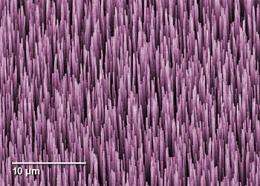
Colorized micrograph of multi-walled carbon nanotubes, each 40 micrometers long, which absorb more than 99.9 percent of the light inside NIST’s prototype fiber-coupled radiometer. Credit: Huang/NanoLab, colorized by Talbott/NIST
(PhysOrg.com) -- Researchers at the National Institute of Standards and Technology (NIST) have demonstrated a prototype device capable of absolute measurements of optical power delivered through an optical fiber.
The device is the world's first fiber-coupled cryogenic radiometer that links optical fiber power measurements directly to fundamental electrical units and national standards. It uses a microscopic forest of carbon nanotubesthe world's darkest materialto measure values that are about one-thousandth of the levels typically attained with a cryogenic radiometer lacking direct fiber input capability. With improvements in temperature control and speed, the device could meet the needs for ultraprecise calibrations at ultralow power in telecommunications, medical devices and other industries.
Optical power and energy are traceable to fundamental electrical units. Radiometers absorb optical energy and convert it to heat. Then the electrical power needed to induce the same temperature increase is measured. Because optical and electrical heating are not exactly equivalent, measurement uncertainties can be relatively large from a metrology point of view.
The demonstration is also a step toward converting radiometry from a classical practice based on electrical units to a quantum practice based on single particles of light (photons).
"We have many customers who request optical power measurements in fiber, mainly for optical communications," project leader John Lehman says. "Also, our single-photon measurements are done in fiber."
The new radiometer is about 70 millimeters (mm) long and incorporates a 1.45-mm-thick optical fiber capped by a light-trapping cavity at one end with the nanotube absorber and a heater. The ultra-dark nanotubes are grown on a tiny X-shaped piece of micromachined silicon. Light absorption was so high it was difficult to determine measurement uncertainties; Lehman travelled to a special facility at the National Physical Laboratory (the British equivalent of NIST) to make some measurements.
Experiments and calculations indicate the new radiometer can measure a power level of 10 nanowatts with an uncertainty of 0.1 percent. By comparison, typical measurements of optical power delivered through fiber have an uncertainty of 3 percent or more at similar power levels. More importantly, these commercial devices rely on a series of calibrations to establish traceability to national standards.
NIST aims to develop an absolute quantum standard for optical power and energy based on single photons. The effort includes development of sources and detectors spanning a wide range of optical power measurements, from single photon counts to trillions of photons. Single photons are already used in quantum communications systems, which offer novel capabilities such as detecting extremely weak optical signals and providing quantum guarantees on security.
More information: D. Livigni, N. Tomlin, C.L. Cromer and J.H. Lehman. Fiber-coupled cryogenic radiometer with carbon nanotube absorber. Paper presented at 11th International Conference on New Developments and Applications in Optical Radiometry (NEWRAD 2011), Maui, Hawaii, Sept. 19-23, 2011.
D.J. Livigni, N.A. Tomlin, C.L. Cromer and J.H. Lehman. Optical fiber-coupled cryogenic radiometer with carbon nanotube absorber. Metrologia. Forthcoming.
Journal reference:
Metrologia
Provided by
National Institute of Standards and Technology
-
From lemons to lemonade: Reaction uses carbon dioxide to make carbon-based semiconductor,
32 comments
-
Thioridazine kills cancer stem cells in human while avoiding toxic side-effects of conventional cancer treatments,
3 comments
-
SpaceX private rocket blasts off for space station (Update),
42 comments
-
Climate scientists say they have solved riddle of rising sea,
31 comments
-
SpaceX capsule has 'new car' smell, astronauts say (Update),
4 comments
-
Why does a boiled egg rotates while a raw egg doesn't?
43 minutes ago
-
Lightning strike in mindair
51 minutes ago
-
Why does light move?
2 hours ago
-
How to calculate the repulsion force between a permanent and an electromagnet?
3 hours ago
-
Why does light allow us to see things?
3 hours ago
-
Room temperature superconductivity
4 hours ago
- More from Physics Forums - General Physics
More news stories
'Unzipped' carbon nanotubes could help energize fuel cells, batteries
Multi-walled carbon nanotubes riddled with defects and impurities on the outside could replace some of the expensive platinum catalysts used in fuel cells and metal-air batteries, according to scientists at ...
Nanotechnology / Nanomaterials
5 hours ago |
1 / 5 (1) |
0
|
Dopant gives graphene solar cells highest efficiency yet
(Phys.org) -- By taking advantage of graphenes favorable electrical and optical properties, and then adding an organic dopant, researchers have achieved the highest power conversion efficiency yet for ...
In nanorod crystal growth, nanoparticles seen as artificial atoms
In the growth of crystals, do nanoparticles act as "artificial atoms" forming molecular-type building blocks that can assemble into complex structures? This is the contention of a major but controversial theory ...
May 24, 2012 |
4.8 / 5 (6) |
0
|
First direct observation of oriented attachment in nanocrystal growth
Berkeley Lab researchers have reported the first direct observation of nanoparticles undergoing oriented attachment, the critical step in biomineralization and the growth of nanocrystals. A better understanding ...
May 24, 2012 |
4.7 / 5 (3) |
0
|
Synthetic nano-waste does not disappear
(Phys.org) -- Tiny particles of cerium oxide do not burn or change in the heat of a waste incineration plant. They remain intact on combustion residues or in the incineration system, as a new study by Swiss ...
Nanotechnology / Bio & Medicine
May 25, 2012 |
5 / 5 (2) |
1
|
Change in developmental timing was crucial in the evolutionary shift from dinosaurs to birds: study
At first glance, it's hard to see how a common house sparrow and a Tyrannosaurus Rex might have anything in common. After all, one is a bird that weighs less than an ounce, and the other is a dinosaur that ...
Computer model used to pinpoint prime materials for efficient carbon capture
When power plants begin capturing their carbon emissions to reduce greenhouse gases and to most in the electric power industry, it's a question of when, not if it will be an expensive undertaking.
T cells 'hunt' parasites like animal predators seek prey, study shows
By pairing an intimate knowledge of immune-system function with a deep understanding of statistical physics, a cross-disciplinary team at the University of Pennsylvania has arrived at a surprising finding: T cells use a movement ...
Land and sea species differ in climate change response: study
(Phys.org) -- Marine and terrestrial species will likely differ in their responses to climate warming, new research by Simon Fraser University and Australia’s University of Tasmania has found.
Yale study concludes public apathy over climate change unrelated to science literacy
Are members of the public divided about climate change because they don't understand the science behind it? If Americans knew more basic science and were more proficient in technical reasoning, would public consensus match ...
10 million years needed to recover from mass extinction
It took some 10 million years for Earth to recover from the greatest mass extinction of all time, latest research has revealed.