Ironing out the details of the Earth's core
December 20, 2011 by Katie Neith

Ironing out the details of the Earth's core

Enlarge

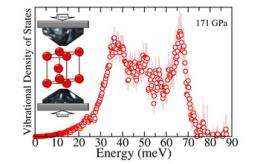
The vibrational spectrum of iron, the most abundant element in Earth's core, at 171 gigapascals. By squeezing iron between two diamond anvils (inset), Caltech researchers reproduced the pressures found in Earth's core. [Credit: Caitlin A. Murphy/Caltech]

(PhysOrg.com) -- Identifying the composition of the earth's core is key to understanding how our planet formed and the current behavior of its interior. While it has been known for many years that iron is the main element in the core, many questions have remained about just how iron behaves under the conditions found deep in the earth. Now, a team led by mineral-physics researchers at the California Institute of Technology (Caltech) has honed in on those behaviors by conducting extremely high-pressure experiments on the element.

"Pinpointing the properties of iron is the gold standard—or I guess 'iron standard'—for how the core behaves," says Jennifer Jackson, assistant professor of mineral physics at Caltech and coauthor of the study, which appears in the December 20 issue of Geophysical Research Letters. "That is where most discussions about the deep interior of the earth begin. The temperature distribution, the formation of the planet—it all goes back to the core."

To learn more about how iron behaves under the extreme conditions that exist in the earth's core, the team used diamond anvil cells (DAC) to compress tiny samples of the . The DACs use two small diamonds to squeeze the iron, reproducing the types of pressures felt in the earth's core. These particular samples were pressurized to 171 Gigapascals, which is 1.7 million times the pressure we feel on the surface of the earth.

To complete the experiments, the team took the DACs to the Advanced Photon Source at Argonne National Laboratory in Illinois, where they were able to use powerful X-rays to measure the vibrational density of states of compressed iron. This information allows the researchers to determine how quickly sound waves move through iron and compare the results to seismic observations of the core. 

"The vibrational properties that we were able to measure at extraordinarily high pressures are unprecedented," says Jackson. "These pressures exist in the earth’s outer core, and are very difficult to reproduce experimentally."

Caitlin Murphy, a graduate student in Jackson's group and first author of the paper, says the group was happy to find that their data set on the vibrational properties of iron evolved smoothly over a very wide pressure range, suggesting that their pressure-dependent analysis was robust, and that iron did not encounter any phase changes over this pressure range. To help achieve these successful measurements at high pressures, the group used some innovative techniques to keep the iron from thinning out in the DACs, such as preparing an insert to stabilize the sample chamber during compression. Additionally, they measured the volume of the compressed iron sample in situ and hydrostatically loaded the iron sample with neon into the sample chamber.

"These techniques allowed us to get the very high statistical quality we wanted in a reasonable amount of time, thus allowing us to obtain accurate vibrational properties of compressed iron, such as its Grüneisen parameter," says Jackson. "The Grüneisen parameter of a material describes how its total energy changes with compression and informs us on how iron may behave in the earth’s core. It is an extremely difficult quantity to measure accurately."

The team was also able to get a closer estimate of the melting point of iron from their experiments—which they report to be around 5800 Kelvin at the boundary between the earth’s solid inner core and liquid outer core. This information, combined with the other vibrational properties they found, gives the group important clues for estimating the amount of , or impurities, in the core. By comparing the density of iron at the relevant pressure and temperature conditions with seismic observations of the core's density, they found that iron is 5.5 percent more dense than the solid inner core at this boundary.   

"With our new data on iron, we can discuss several aspects of the earth's core with more certainty and narrow down the amount of light elements that may be needed to help power the geodynamo—the process responsible for maintaining the earth's magnetic field, which originates in the core," says Jackson.

According to Murphy, the next step is to perform similar experiments alloying iron with nickel and various light elements to determine how the density and, in particular, the vibrational properties of pure are affected. In turn, they will be able to evaluate the amount of light elements that produce a closer match to seismic observations of the core.

"There are a few candidate light elements for the core that everyone is always talking about—sulfur, silicon, oxygen, carbon, and hydrogen, for instance," says Murphy. "Silicon and oxygen are a few of the more popular, but they have not been studied in this great of detail yet. So that's where we will begin to expand our study."

The study, "Grüneisen parameter of hcp-Fe to 171 GPa," was funded by the California Institute of Technology, the National Science Foundation, and the U.S. Department of Energy. Bin Chen, a former postdoctoral scholar in Jackson's lab, and Wolfgang Sturhahn, senior technologist at NASA's Jet Propulsion Laboratory and visiting associate at Caltech, were also coauthors on the paper.

Journal reference: Geophysical Research Letters search and more info website

Provided by California Institute of Technology search and more info website

4.9 /5 (11 votes)  

Filter


Move the slider to adjust rank threshold, so that you can hide some of the comments.


Display comments: newest first

omatumr
Dec 20, 2011

Rank: 1.4 / 5 (9)
All four planets close to the Sun have iron cores because they accreted directly from the iron-rich material that surrounded the pulsar core on which the Sun formed.

See: "The Sun's origin, composition and source of energy," 32nd Lunar & Planetary Science Conference (2001)

www.omatumr.com/lpsc.prn.pdf
jsdarkdestruction
Dec 21, 2011

Rank: 3.7 / 5 (6)
The sun is not a pulsar supernova remnant. Neutron repulsion is pure fantasy with a little nonsense and alot of denial and handwaving thrown in to spice it up. Pauli exclusion principle is nothing new and thats all it is.
Vendicar_Decarian
Dec 21, 2011

Rank: 2.3 / 5 (6)
I'm surprised that Psychiatric patient OmaTard isn't claiming that the core of the earth is pure hydrogen.
omatumr
Dec 21, 2011

Rank: 1.8 / 5 (5)
Neutron repulsion is recorded in nuclear rest mass data on the front cover of this book:

www.amazon.com/Or...06465620

1975 data reported as evidence of super-heavy elements convinced Dr. Glenn T. Seaborg
to organize the 1999 ACS Symposium, with the Cradle of the Nuclides on the front cover:

www.omatumr.com/a...enon.pdf

Since E = mc^2, and every nucleus is composed of Z
positively charged protons (P) and (A-Z) neutral neutrons (N):

1. Attractive forces between N and P
__reduce the rest mass when Z /A ~0.5

2. Repulsive forces between N and N
__increase the rest mass for Z/A <0.5

3. Repulsive forces between P and P
__increase the rest mass for Z/A >0.5

The Pauli exclusion principle explains none of the ~265 Bohr-Wheeler mass parabolas.

You can see the individual mass data points here:

https://dl-web.dr...8949abdc
barakn
Dec 21, 2011

Rank: 2.6 / 5 (5)
^report abuse
He linked to his own book on Amazon. Blatant spamming.
Starcaptain
Dec 24, 2011

Rank: 2.3 / 5 (3)
^report abuse
He linked to his own book on Amazon. Blatant spamming.

You're an idiot. He provided a valuable counter argument and even said it was written in 1975.
Starcaptain
Dec 24, 2011

Rank: 1 / 5 (1)
All four planets close to the Sun have iron cores because they accreted directly from the iron-rich material that surrounded the pulsar core on which the Sun formed.

See: "The Sun's origin, composition and source of energy," 32nd Lunar & Planetary Science Conference (2001)

http://www.omatum....prn.pdf

I wish it made more sense, as almost any planet to survive a supernova would likely be barren.
But I was wondering a similar situation. Those 2 recent planets. Kepler 20e being and Kepler 20f. are earth sized from a supernova that blew them away. And also could have heated up the core. Given a couple billion years could the planet redistribute resources from meteorites and evolution? Could this be a cycle in some solar systems.
Rank 4.9 /5 (11 votes)
Relevant PhysicsForums posts

More news stories

Land and sea species differ in climate change response: study

(Phys.org) -- Marine and terrestrial species will likely differ in their responses to climate warming, new research by Simon Fraser University and Australia’s University of Tasmania has found.

Space & Earth / Environment

created 6 hours ago | popularity 3.8 / 5 (4) | comments 5 | with audio podcast

Yale study concludes public apathy over climate change unrelated to science literacy

Are members of the public divided about climate change because they don't understand the science behind it? If Americans knew more basic science and were more proficient in technical reasoning, would public consensus match ...

Space & Earth / Environment

created 8 hours ago | popularity 4.8 / 5 (5) | comments 20 | with audio podcast

10 million years needed to recover from mass extinction

It took some 10 million years for Earth to recover from the greatest mass extinction of all time, latest research has revealed.

Space & Earth / Earth Sciences

created 8 hours ago | popularity 4 / 5 (4) | comments 1 | with audio podcast

Sophisticated simulations predict future warming

The chances of our planet being hit by a global warming of 3 degrees Celsius by 2050 is as likely as it being hit by an increase of 1.4 degrees, new research shows. Presented in the journal Nature Geoscience, the British study ...

Space & Earth / Earth Sciences

created May 22, 2012 | popularity 4.1 / 5 (10) | comments 51

Aliens don't want to eat us, says former SETI director

Alien life probably isn’t interested in having us for dinner, enslaving us or laying eggs in our bellies, according to a recent statement by former SETI director Jill Tarter.

Space & Earth / Space Exploration

created May 25, 2012 | popularity 4.4 / 5 (15) | comments 41


Stunning image of smallest possible five-ringed structure

Scientists have created and imaged the smallest possible five-ringed structure – about 100,000 times thinner than a human hair – and you'll probably recognise its shape.

'Unzipped' carbon nanotubes could help energize fuel cells, batteries

Multi-walled carbon nanotubes riddled with defects and impurities on the outside could replace some of the expensive platinum catalysts used in fuel cells and metal-air batteries, according to scientists at ...

Change in developmental timing was crucial in the evolutionary shift from dinosaurs to birds: study

At first glance, it's hard to see how a common house sparrow and a Tyrannosaurus Rex might have anything in common. After all, one is a bird that weighs less than an ounce, and the other is a dinosaur that ...

Computer model used to pinpoint prime materials for efficient carbon capture

When power plants begin capturing their carbon emissions to reduce greenhouse gases – and to most in the electric power industry, it's a question of when, not if – it will be an expensive undertaking.

T cells 'hunt' parasites like animal predators seek prey, study shows

By pairing an intimate knowledge of immune-system function with a deep understanding of statistical physics, a cross-disciplinary team at the University of Pennsylvania has arrived at a surprising finding: T cells use a movement ...

Scientists develop ultra-sensitive test that detects diseases in their earliest stages

Scientists have developed an ultra-sensitive test that should enable them to detect signs of a disease in its earliest stages, in research published today in the journal Nature Materials.