Evolution at warp speed: Hatcheries change salmon genetics after a single generation
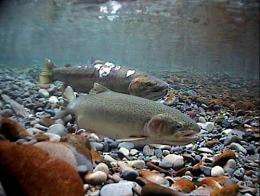
Steelhead trout return to spawn. (Photo by John McMillan, courtesy of Oregon State University)
The impact of hatcheries on salmon is so profound that in just one generation traits are selected that allow fish to survive and prosper in the hatchery environment, at the cost of their ability to thrive and reproduce in a wild environment.
These findings, published this week in Proceedings of the National Academy of Sciences, show a speed of evolution and natural selection that surprised researchers.
They confirmed that a primary impact of hatcheries is a change in fish genetics, as opposed to a temporary environmental effect.
"We've known for some time that hatchery-born fish are less successful at survival and reproduction in the wild," said Michael Blouin, a professor of zoology at Oregon State University. "However, until now, it wasn't clear why. What this study shows is that intense evolutionary pressures in the hatchery rapidly select for fish that excel there, at the expense of their reproductive success in the wild."
Hatcheries are efficient at producing fish for harvest, the researchers said, but this and other studies continue to raise concerns about the genetic impacts that hatchery fish may have when they interbreed with wild salmon, and whether or not they will help wild salmon runs to recover.
These findings were based on a 19-year genetic analysis of steelhead in Oregon's Hood River. It examined why hatchery fish struggle to reproduce in wild river conditions, a fact that has been made clear in previous research. Some of the possible causes explored were environmental effects of captive rearing, inbreeding among close relatives, and unintentional "domestication selection," or the ability of some fish to adapt to the unique hatchery environment.
The study confirmed that domestication selection was at work.
When thousands of smolts are born in the artificial environment of a hatchery, those that survive best are the ones that can deal, for whatever reason, with hatchery conditions. But the same traits that help them in the hatchery backfire when they return to a wild river, where their ability to produce surviving offspring is much reduced.
"We expected to see some of these changes after multiple generations," said Mark Christie, an OSU post-doctoral research associate and lead author on the study. "To see these changes happen in a single generation was amazing. Evolutionary change doesn't always take thousands of years."
It's not clear exactly what traits are being selected for among the thousands of smolts born in hatcheries, the scientists said, but one of the leading candidates is the ability to tolerate extreme crowding. If research can determine exactly what aspect of hatchery operations is selecting for fish with less fitness in the wild, it could be possible to make changes that would help address the problem, they said.
Historically, hatchery managers preferred to use fish born in hatcheries as brood stock to create future generations, because whatever trait they had that allowed them to succeed in the hatchery helped produce thousands of apparently healthy young salmon. But they later found that those same fish were released they had a survival and reproductive success that was far lower than those born in the wild.
Billions of captive-reared salmon are intentionally released into the wild each year in order to increase fishery yields and bolster declining populations. The steelhead studied in this research are, in fact, listed as threatened under the Endangered Species Act, and part of their recovery plan includes supplementation with hatchery fish.
"It remains to be seen whether results from this one study on steelhead generalize to other hatcheries or salmon species," Blouin said.
"Nevertheless, this shows that hatcheries can produce fish that are genetically different from wild fish, and that it can happen extraordinarily fast," he said. "The challenge now is to identify the traits under selection to see if we can slow that rate of domestication."
Provided by
Oregon State University
-
From lemons to lemonade: Reaction uses carbon dioxide to make carbon-based semiconductor,
32 comments
-
Thioridazine kills cancer stem cells in human while avoiding toxic side-effects of conventional cancer treatments,
3 comments
-
SpaceX private rocket blasts off for space station (Update),
42 comments
-
Climate scientists say they have solved riddle of rising sea,
31 comments
-
SpaceX capsule has 'new car' smell, astronauts say (Update),
4 comments
-
What would stain as translucent on light-coloured fabric?
May 26, 2012
-
How do I identify different bacteria on culture plates?
May 26, 2012
-
Why Do Dogs do Strange things...
May 25, 2012
-
What does exophillic and endophillic mean in terms of mosquito and their control?
May 24, 2012
-
Semen stains glows under black lights (uv light)?
May 23, 2012
-
Question on Human Chromosome 2
May 23, 2012
- More from Physics Forums - Biology
More news stories
Manufacturing genes to attack flu virus
An international research team has manufactured a new protein that can combat deadly flu epidemics.
7 hours ago |
not rated yet |
0
|
Scientist: Evolution debate will soon be history
(AP) -- Richard Leakey predicts skepticism over evolution will soon be history. Not that the avowed atheist has any doubts himself.
May 26, 2012 |
3.5 / 5 (20) |
95
More plant species responding to global warming than previously thought
(Phys.org) -- Far more wild plant species may be responding to global warming than previous large-scale estimates have suggested.
May 22, 2012 |
4.6 / 5 (14) |
18
|
For monogamous sparrows, it doesn't pay to stray (but they do it anyway)
It's quite common for a female song sparrow to stray from her breeding partner and mate with the male next door, but a new study shows that sleeping around can be costly.
May 22, 2012 |
5 / 5 (2) |
8
|
Thousands of shellfish found dead in Peru
Thousands of crustaceans were found dead off the coast of Lima following the mystery mass death of dolphins and pelicans, the Peruvian Navy said Friday.
May 26, 2012 |
4.7 / 5 (7) |
7
Stunning image of smallest possible five-ringed structure
Scientists have created and imaged the smallest possible five-ringed structure about 100,000 times thinner than a human hair and you'll probably recognise its shape.
'Unzipped' carbon nanotubes could help energize fuel cells, batteries
Multi-walled carbon nanotubes riddled with defects and impurities on the outside could replace some of the expensive platinum catalysts used in fuel cells and metal-air batteries, according to scientists at ...
Change in developmental timing was crucial in the evolutionary shift from dinosaurs to birds: study
At first glance, it's hard to see how a common house sparrow and a Tyrannosaurus Rex might have anything in common. After all, one is a bird that weighs less than an ounce, and the other is a dinosaur that ...
Computer model used to pinpoint prime materials for efficient carbon capture
When power plants begin capturing their carbon emissions to reduce greenhouse gases and to most in the electric power industry, it's a question of when, not if it will be an expensive undertaking.
T cells 'hunt' parasites like animal predators seek prey, study shows
By pairing an intimate knowledge of immune-system function with a deep understanding of statistical physics, a cross-disciplinary team at the University of Pennsylvania has arrived at a surprising finding: T cells use a movement ...
Land and sea species differ in climate change response: study
(Phys.org) -- Marine and terrestrial species will likely differ in their responses to climate warming, new research by Simon Fraser University and Australia’s University of Tasmania has found.
Dec 19, 2011
Rank: 2.1 / 5 (7)
Dec 19, 2011
Rank: 1.2 / 5 (19)
That is not evolution, that is just selection.
Dec 19, 2011
Rank: 4.6 / 5 (18)
What?? That is exactly what evolution is. Evolution is any change across successive generations of biological populations.
Dec 19, 2011
Rank: 3.5 / 5 (14)
Derp
Dec 19, 2011
Rank: 5 / 5 (1)
Dec 19, 2011
Rank: 1.8 / 5 (18)
You don't seem to know who you are and you don't seem to know that evolution is theorized to result from selection -- it is not the selection process.
And putting your comment in quotes to imply I said it is dishonest.
Dec 19, 2011
Rank: 4 / 5 (16)
It's not dishonest if it's true and either way, I don't give a rat's ass.
Evolution is a change in a population over time. You're clearly misguided, thinking the process by which it happens has any bearing on whether or not it's evolution. You need to look up the definitions of selection and evolution. The change brought upon by selection is evolution, by definition.
Also, in this case, there is no "theorized." We can watch it happen. It is fact. The differential selection changes gene frequencies in the population. We can track these genes and their frequencies.
Dec 19, 2011
Rank: 1.6 / 5 (20)
Dec 19, 2011
Rank: 3.8 / 5 (10)
And that selection has resulted in evolution...
I feel like I'm being trolled.
Read and comprehend this, please. Evolution- change in a population over time. CHANGE IN A POPULATION OVER TIME.
THIS IS THE DEFINITION. THIS IS NOT DISPUTABLE.
Dec 19, 2011
Rank: 1.2 / 5 (55)
It's a common rhetorical tactic among creationists to conflate the two terms so they can say they support evolution (thus avoiding criticism) while not really buying into it. That is dishonest, though for many probably not intentional.
For dogbert, I believe it is intentional since he so diligently avoids answering the actual question. He does this on any controversial topic.
Dec 20, 2011
Rank: 3.3 / 5 (4)
Dec 20, 2011
Rank: 3.7 / 5 (9)
Yes.
No.
Yes.
No.
Yes.
No.
No!
Yes!
Just trick them like you would a child.
Dec 20, 2011
Rank: 1 / 5 (4)
Dogbert, historically, evolution has been chained/shackled to TIME. Your argument is not entirely without merit! Especially since you amply your statement by indicating "extreme selection pressures" Recommendation: Advance your argument and do so in a manner that is hermeneutically correct for the discipline of evolution. You have raised a valid point/question! Just how much 'time' and how much 'pressure' can humanity exert in a given time, that is biologically equivalent to the process we know as evolution?!? Is short term economically motivated 'selection' going to create the historical norm of Long Term Change that we call evolution? If yes, that is, within a single NON-breeding period - no exchange of DNA has occurred- what were the triggers and where did they have the greatest effect? You may B on 2 something!
word
Dec 20, 2011
Rank: 3.7 / 5 (3)
So yes it is evolution as the populations dominent genes are replaced and the wild genes become resessive.
Dec 20, 2011
Rank: 1 / 5 (4)
Nope: I did not say there was no genetic change. The change HAD to occur before the eggs were fertilised. The ingredients that made mom and pop fish had to be 'changed'/affected before the mom and dad fish mated. In one generation, it should be possible to see what was effected since TIME had been so thoroughly negated and yet one could argue that a type of 'selection' had taken place, though, opposing what is traditionally and historically considered genetically and evolutionarily significant time lapse. Find the points of change and therein reveal the agents of change! That is what made the Dogbert post somewhat compelling and worthy of examination. He may well be on to something and deserves benefit of the doubt.
word-to-ya-muthas
Dec 20, 2011
Rank: 3 / 5 (4)
I can make E. coli plates with antibiotic agar and evolve a population of antibiotic-resistant bacteria in a matter of weeks. Evolution doesn't require any minimum amount of time to pass to occur.
How would that change anything?
A change in gene frequency is a change in gene frequency. This is no different than camouflage-driven predation selection. A quick disappearance of the unfit individuals isn't that unbelievable.
Dec 20, 2011
Rank: 4 / 5 (5)
Any population has a certain amount of genetic diversity. Some fish had genes that would benefit them in hatcheries even before they were in the hatcheries. There wasn't a "change" that occurred before the selection, there was just preexisting diversity.
Dec 20, 2011
Rank: 1.8 / 5 (5)
word-
Dec 20, 2011
Rank: 1 / 5 (4)
Selection embodied by a manmade effort to accidentally or intentionally impose change, must occur over relatively short period of time because humanity has only been around for a fraction of a second in comparison to the time exercised by the process of evolution! THAT is the difference. Extreme doses of a drug are adminstered to lab animals to synthesize the lapse of smaller doses over TIME. Man has been scientifically aware for a femtosecond compared to the body of work that evolution has effected. Again, this is why Dogbert's post makes sene: He addresses a single generational influx of change visa time!
Dec 20, 2011
Rank: 4 / 5 (4)
Selection. The death of fish that didn't have the right genes to handle the crowded conditions of the hatchery.
Who's ignoring time? Whether it's in one generation or many millions/billions/trillions, of course evolution happens over time.
I still haven't seen a convincing argument or even an explanation of this. This isn't a hard concept. Evolution is what happens to a population, selection is how it happens, in this case. The population shifted from the natural gene distri
Dec 20, 2011
Rank: 3.4 / 5 (5)
The population shifted from the natural gene distribution to the augmented one BROUGHT ON by selection. Evolution and selection are two separate, but related things. They're not interchangeable. Evolution happens VIA selection. The environment eliminates unfit fish: Bam! Those genes are gone and the population has changed. Evolution. That's all there is to it. Change in gene frequency over time.
Dec 20, 2011
Rank: 1.8 / 5 (5)
The Dogbert assertion is valid because no one, not you nor the article's experimenters has proven that there were anything called, "augmented genes"! The presence of ANY genes is evident and all that was described...nothing augmented, nothing specially introduced. Those that were present were provoked, triggered for change within one generation, not two, not ten, not a billion! TIME is implied and explicit in all mention of evolution, BUT how SHORT a time is required for genetic change is being demonstrated here where no DNA is/was transferred. The Dogbert assertion is valid as a question and starting point for experimentation. Selection is NOT evolution was Dogbert's assertions and you have now also stated this: that's one for Dogbert!!!
word-
word-
Dec 20, 2011
Rank: 1 / 5 (5)
Dec 20, 2011
Rank: 1 / 5 (9)
It's pavlovian conditioning.
If you lived your entire life in a CELL with no knowledge of how to "hunt" for food for yourself, because you were previously being fed by an owner, and no prior knowledge of what the hunting act was, nor of predators nor predation nor migration, and then suddenly found yourself thrust into the middle of a complete wilderness, you would soon die of starvation, or be eaten by a lion or some other creature.
Fish in a hatchery don't tend to die for any reason, unless your pond loses oxygen or becomes contaminated with a poison or pathogen, and none of that would be "selecting" for any alleged "domestication gene" any more than if those conditions occured in the wild.
I don't think any of you fools have ever dealt with real animals in your ignorant lives. You just listened to your brain-dead professor in college and said, "Uh, huh. That's gotta be right..."
Dec 20, 2011
Rank: 2.3 / 5 (3)
Yet accurate.
Dec 20, 2011
Rank: 1.8 / 5 (5)
How do you find making up statements (lying) and attributing those lies to someone else to be "accurate"?
Dec 20, 2011
Rank: 5 / 5 (2)
Dec 20, 2011
Rank: 3.7 / 5 (3)
"These findings were based on a 19-year genetic analysis of steelhead in Oregon's Hood River"
Augmented gene DISTRIBUTION. Reading comprehension is a fantastic skill; I suggest you use it.
You don't need to introduce new genes to change the gene distribution of a population. All you need to do is eliminate the unfit ones, which worked out well enough in one generation, as described, meaning the unfit parental generation fish died, leaving the fit ones to reproduce.
I don't think you're interpreting "change" correctly here. "One generation" is defined as one round of breeding.
Dec 20, 2011
Rank: 3.8 / 5 (4)
Again, you're making an assumption. There can't be selection without differential breeding.
Not it's not. Selection is not evolution, but it leads to evolution. Have you just been skimming what I've posted? I've addressed this before. It's very clear in this case that evolution occurred. The population changed due to differential survival and it's only logical the population genetics changed.
It's implied the unfit parentals died and the fit ones didn't.
Dec 20, 2011
Rank: 4 / 5 (4)
What do you think happens when unfit fish die and can't reproduce? The fit ones do, eliminating the unfit genes. This is only logical.
What do you suggest to be the change between the parental generation and the next one then?
All it takes is one round of selection to eliminate unfit genes. This is demonstrated every day in laboratories.
Implying there wasn't one round of reproduction.
Dec 20, 2011
Rank: 4 / 5 (4)
What you're thinking of here is an old and flawed evolutionary hypothesis. A giraffe's neck doesn't grow because it wills it to grow. Its sperm cells don't change because it wants to be taller. There has to be a difference in phenotype due to a difference in genotype and selection based on that. Selective pressure doesn't change your gametes to better fit the environment.
Dec 20, 2011
Rank: 1 / 5 (5)
word-to-ya-muthas
Dec 20, 2011
Rank: 1 / 5 (5)
Dec 20, 2011
Rank: 1.1 / 5 (54)
Where the Hell are you getting this from dogbert? He said nothing of the sort. He said in paraphrase: "this is not evolution, this is selection." Now you are saying because of dogbert's unique insight we are going to learn the "what and why" (whatever the hell that means) about evolution.
What?
To reiterate, you are saying 1) we can learn from this, which I don't think anyone has disputed, and 2) dogbert's comments have some sort of special insight into this? He said nothing of the sort. Go back and read what he said, then read what you said. They don't follow each other. They aren't necessarily exclusive but THEY DO NOT FOLLOW.
NON SEQUITUR.
Dec 20, 2011
Rank: 1 / 5 (4)
Dec 20, 2011
Rank: 1 / 5 (4)
Dec 20, 2011
Rank: 1 / 5 (4)
I don't think you're interpreting "change" correctly here. "One generation" is defined as one round of breeding
Dec 20, 2011
Rank: 1 / 5 (5)
word-
Dec 20, 2011
Rank: 1.1 / 5 (54)
210, dogbert is trying to confuse you. Seems like it has worked.
Here's dogbert's second post you said I should go back to.
More trickery. He's implying the "everything's a theory" crap in a very subtle manner. Typical for him.
Third post. Addressed by the above. See wolves into dogs.
Dec 20, 2011
Rank: 4.2 / 5 (5)
Different genes encode for different traits. This is not disputable.
Please tell me how there can be selection without there being evolution of a population.
Don't give me some roundabout bullshit.
Edit: And just because evolution happens over time doesn't mean it can't happen in one generation (meaning one breeding cycle).
Dec 20, 2011
Rank: 1 / 5 (5)
Franky - maybe the two of you 'bumped heads' sometime back; Just as you and I have! I can still see his point and it is not without merit. He, and Pirouette, and Me and several dozen people have gotten into it with you...and yet, I STILL communicate with you...when you have something to say, Mr. Wright or Mr. Wrong. Selecting traits we like in our food has been presented in the article as possibly occurring within one generation. The selection of traits by humans and their viability as candidates for becoming the evolved creatures of the future is controversial. Dogbert's FIRST post is amendable to a new way of looking at evolutionary triggers. He is not wrong for that. After his first post, he tried to defend himself against attack, some personal - I will have nothing to do with that. These salmon do not do well in nature; Human selection may need closer examination!
word-
Dec 20, 2011
Rank: 3.7 / 5 (3)
How so? You're trying to give evolution a definition it doesn't have. If we select particular traits, and therefore genes, we've induced evolution in the population. Plain and simple. There's nothing to question here. This is completely comparable to peppered moth evolution and nobody seems to dispute that as evolution.
Dec 20, 2011
Rank: 1 / 5 (5)
Selections to meet human tastes may, MAY not be what Evolutionists had in mind. Charles Darwin, or at least, his adherents use the phrase: NATURAL SELECTION and define it as" the nonrandom process by which biological traits become either more or less common in a population as a function of differential reproduction of their bearers." Now, if traits selected for by man for commercial goods do not enhance the survivability of that species, in Nature, (poor ability to reproduce) and the selection process imposed is so intense that it occurs in one generation in that one species in a manmade environment, all natural variables pushed aside - hummm???
Dec 20, 2011
Rank: 1 / 5 (5)
These Salmon when released back into the wild reproduce very poorly. Evolution has been the lynch-pin of species survival universally. We humans intervene for a particular outcome, taste, size, color, texture of meat. We are pursing an outcome that is not an Evolutionary dictum but a culinary one. We make super-drug resistant germs by abusing antibiotics an ethical mis-step that naturally did NOT have to occur and the drugs are man made. It can be argued that this is not D work of Evolution.
word-
Dec 20, 2011
Rank: 4.3 / 5 (6)
Now you're implying a dispute that doesn't exist. Evolution is evolution whether it's brought about by natural or artificial selection.
Dec 20, 2011
Rank: 4.4 / 5 (7)
Again, the mechanism has no bearing on whether or not it's evolution. It's a change in gene frequency either way and by definition, evolution does not make a distinction between mechanisms. ALL it implies is that gene frequencies of a population change.
Dec 21, 2011
Rank: 1.4 / 5 (9)
That is not evolution. Evolution posits speciation from changes as a result of selection, mutation and genetic drift.
Selection is a mechanism, a process. It does not represent evolution.
Adult human beings who can drink milk, for example, represent such a change selected in herders. Those human adults who can drink milk are not a new species of human being. They simply have a specific trait which is lacking in much of the population.
All dogs are dogs, despite excessive selection pressures which human beings have placed on them. They are examples of selection, not evolution.
Dec 21, 2011
Rank: 1.1 / 5 (54)
Actually it is. Change "gene" to "allele" and you actually get the textbook definition. Go ahead, open one up.
Dogs evolved from wolves dogbert. You are intentionally conflating what I said. Humans (as part of nature) and nature selected wolves until they became dogs. You can scream "dogs are dogs" until you are blue in the face but it doesn't change that fact the wolves ARE NOT dogs and humans most certainly had a hand in that evolutionary process.
Please stop your dishonesty dogbert. It's becoming obvious in this topic.
Dec 21, 2011
Rank: 1.4 / 5 (10)
The term evolution as it applies to biological systems has a distinct meaning. You may certainly argue that the word simply means change, but then you rob the word of meaning. Since I presume you accept evolution as the mechanism driving diversity, I don't see why you want to make the word essentially meaningless.
Dec 21, 2011
Rank: 1.1 / 5 (55)
Are you willing to admit wolves evolved into dogs, or will you continue ignoring that and just respond with "dogs are dogs"? You have a history of ignoring the parameters of questions asked to you and providing either irrelevant or vague answers. This is because you are intentionally dishonest and know your ideology does not stand up to scrutiny in such a forum as this.
Since we cannot agree on a definition of evolution, will you say unequivocally that speciation via evolution occurs? Just in case you decide to go on another obfuscation spree, I'll reword the question as simply as possible.
Does speciation occur? Please provide an example of an organism that has speciated into another. Any will do. I just need to hear "X evolved into Y" or something equivalent come out of your mouth.
I have no faith in you though.
Dec 21, 2011
Rank: 4.5 / 5 (8)
No. Stop it. You can't change the definition to suit your own agenda.
Evolution- any change across successive generations in the heritable characteristics of biological populations
JUST BECAUSE IT'S NOT A NEW SPECIES DOES NOT MEAN IT'S NOT EVOLUTION. At this point, you're clearly trolling.
Dec 21, 2011
Rank: 1.4 / 5 (9)
Your welcome to believe that evolution means just change. Change is indisputable and evident to everyone. The question you present with your insistance on defining evolution as merely change is why you continue to use the term evolution when you have stripped it of meaning. Why not just use the word change?
Dec 21, 2011
Rank: 4.3 / 5 (6)
What? It means exactly what it means, a change in the genetics of a population. What are you getting at? Neither the speed at which it happens nor the mechanism matter.
Humans can evolve to become taller and still be humans, if you're going to bring up your "its not evolution if it's still the same species. This is convention. Most, if not all, of the scientific community has absolutely no problem with this definition.
So then it begs the question- how would YOU define evolution and precisely why isn't the conventional definition satisfactory?
Dec 21, 2011
Rank: 4.2 / 5 (6)
Because there's a bit more to it than that- it's the change in genetics over time.
"Change" by itself is so vague. Even then, you'd have to describe what is changing, bringing you back to the conventional definition, but taking more time to do so.
But then you could carry on your current point and say "well, why not describe the mechanisms in the definition as well?" to which I would say that if you read a dictionary, a definition of a word isn't an endless tree of definitions of each of the words within the definition itself, so why should it be that way for "evolution"?
If you want to learn further, there are plenty of resources by which to do so besides merely the basic definition.
Dec 21, 2011
Rank: 4.2 / 5 (5)
Dec 21, 2011
Rank: 1.8 / 5 (11)
As I said, you're welcome to diminish the word evolution. I prefer for such words to retain their meaning, but you don't have to care about such things.
Dec 21, 2011
Rank: 1 / 5 (53)
dogbert,
As I said, you're welcome to diminish the word evolution. I prefer for such words to retain their meaning, but you don't have to care about such things.
Dec 21, 2011
Rank: 3.8 / 5 (5)
Edit: And I do care about such things because your interpretation of it goes against accepted convention that has been used for decades.
Dec 22, 2011
Rank: 1.7 / 5 (6)
I already said it, but I'll say it again. The concept of evolution was created to posit speciation as a result of selection ( with the later addition of the mechanisms of mutation and genetic drift ).
You choose to redefine evolution to be any change whatsoever, even changes which are clearly not related to speciation.
People have selected for traits for all of our history. Change is universally accepted as a part of biological processes in the presence of selection. Prior to the work of Darwin and others of his time, we had no theoretical mechanism for speciation. Evolution theory provides that mechanism.
You diminish the word and concept when you redefine it to mean just change. The concept of speciation is an important concept.
Dec 22, 2011
Rank: 3 / 5 (2)
So: You would only consider drastic mutations, fragmenting populations due to an inability to breed, as evolution, such as a change in chromosome number? You wouldn't consider dinosaurs developing feathers as evolution?
Dec 22, 2011
Rank: 1.5 / 5 (8)
No. You have been arguing that any change is evolution. I have been arguing that it is more than just change.
You will doubtless continue to argue that the process is the result and that every process is the result. Not scientific, but I don't see any way to redirect you.
Dec 23, 2011
Rank: 4 / 5 (3)
As previously stated-
"I'm not going to be able to change your mind."
I'm just in it for the clarification now. Can we get back to that and not do this roundabout bullshit?
So you would only consider mutations that produce separate, non-breeding populations as evolution?
Simple question, simple answer.
Dec 23, 2011
Rank: 3.2 / 5 (5)
Evolution is not just "change in general" because it is specifically the change in the distribution of characteristics from generation to generation. It's not change in general, because it's not talking about how rocks change due to erosion, and it's not talking about change in general in a group of organisms because many organisms change quite drastically as they mature. It's talking about change between generations attributable to differential success in reproduction.
Dec 23, 2011
Rank: 4 / 5 (2)
Not necessarily. There doesn't have to be selection for evolution to take place. What about neutral mutations that don't affect survival and don't have any effect on reproductive success?
Edit: and yes, I do agree with your first part. Species is an arbitrary man-made idea.
Dec 23, 2011
Rank: 3 / 5 (4)
Dec 23, 2011
Rank: 3.3 / 5 (4)
Dec 23, 2011
Rank: 5 / 5 (1)
Which is implied by "neutral"
Edit: So if a trait is neutral there isn't selection for or against, and its proliferation just comes down to random chance.
Dec 24, 2011
Rank: 5 / 5 (2)
Background I am a Fish Bioligist U of Wash '68 well aquainted with Aquaculture.
The managment or the Migratory Fisheries in the NW has two factions: Natural production and Hatchery propagation; and they have argued for decades, this study is a response to the fray.
Rainbow Trout in all its variations (Steelhead sea run to the hyper domesticated hatchery raised food market trout) all have the set of genes that perpetuated their Line in the enviorment it lived in.
Hatchery production yeilds fish for suitable for hatchery opperations, and the wild produces fish that hedge their bets with variablity in case of changed conditions to enhance long term survival and do very poorly in hatcheries (I have raised both side by side).
Epigenetics: a soft hatchery life yeilds lazy fish. Emerging from gravel into current and predation turns on some genes that hatchery life does not.
Dec 24, 2011
Rank: 3 / 5 (6)
"A usable definition of the word "species" and reliable methods of identifying particular species is essential for stating and testing biological theories and for measuring biodiversity. ...
"Some biologists may view species as statistical phenomena, as opposed to the traditional idea, with a species seen as a class of organisms. In that case, a species is defined as
a separately evolving lineage that forms a single gene pool.
"Although properties such as DNA-sequences and morphology are used to help separate closely related lineages, this definition has fuzzy boundaries. ...Biologists have proposed a range of more precise definitions, but the definition used is a pragmatic choice that depends on the particularities of the species of concern."
The Internet is always there, do not forget that.
Dec 24, 2011
Rank: not rated yet
Finally someone mentioned EPIGENETICS! There has been so much debate over "how to define evolution" but the definitions being used range over decades and there are key differences causing problems here.
The most important difference to note is that evolution can happen over the lifespan of a single individual by the fore mentioned epigenetics.
A more, full definition of evolution would be the change of phenotype by the mechanisms of selection, mutation, genetic drift (e.g. cross over) and epigenetics (typically, a change of gene expression by environmental factors).
As of late, that is the definition I hear most compared to that of previous definitions which left out epigenetics and included speciation and genotypic changes.
With respect to selection though, biochemically there is no distinction between natural/artificial or high/low selective pressure. Therefore any debate about human selection not causing evolution is non sequitur.
Dec 25, 2011
Rank: not rated yet
With a human population of 7Bn and rising, it isn't a trivial matter, shifty. I think the best option would be to somehow nake the farmed fish into a new species, so that escaped fish don't damage the survival chances of wild ones.
Dec 25, 2011
Rank: 3 / 5 (2)
Dec 25, 2011
Rank: 3.4 / 5 (5)
"In fact, if you were told which traits evolved on which branches, you could precisely predict which traits each living species would have. Conversely, if given the features of each living species, you could explain the variation between the species by invoking just four events of trait evolution."And again:
"The organism experiences its environment in one continuous nested process, adjusting and changing, leaving imprints in its epigenetic system, its genome as well as on the environment, all of which are passed on to subsequent generations. Thus, there is no separation between development and evolution."
You should really read through this before posting again:
http://www.i-sis....yclo.php
Dec 25, 2011
Rank: 3 / 5 (2)
Dec 25, 2011
Rank: 2.6 / 5 (5)
See if you referenced your stuff then I wouldnt have a leg to stand on. But then I guess it is hard to reference yourself unless you have a website like zephyr/jigga.Naw anybody can poke holes in your fabrications. Thats what the internet is for.
Dec 28, 2011
Rank: 3.6 / 5 (9)
Your calling it mere selection doesn't stop it from being part of the evolutionary process.
You got that right.
It was a lie. You are a rats ass. I give rats asses ones.
True. You changed into a rats ass.>>
Dec 28, 2011
Rank: 3.2 / 5 (9)
Wanna bet? Its the definition of some people not everyone.
The environment changed and that was the trigger. It had the greatest effect on who survived to reproduce. The article supposed crowding as the main cause. I suspect the food source was more important. One single kind of food that the fish did not have to learn very much about. Stupid fish were more likely survive than in the wild. Crowding would likely be secondary UNLESS young salmon have a severe problem with crowding.>>
Dec 28, 2011
Rank: 3.2 / 5 (9)
That is multiple generations and if you start with E. Coli that have resistance already or there is contamination by bacteria that are resistant and can exchange genes with E Coli then you have only emphasized certain genes or combinations of genes. IF you start with E. Coli with no resistance and there is no contamination THEN you have significant evolution and with all those generations over weeks that would be evolution. To you and me. Not to a Creationist who I guarantee will only respond that they are still bacteria.>>
Dec 28, 2011
Rank: 3.3 / 5 (7)
Well the Creationists would still say the result was still bacteria BUT they would also claim it human intervention.
Yes but that is not evolution. You can't get speciation that way and speciation is a key part of evolution.
The Origin of Species by means of natural selection, not a change in gene frequencies by a Monk that Darwin never heard of. I don't think Wallace would have agreed either.
That is clearly what was going on.
Nearly any wild population not including Cheetahs.
Ethelred
Dec 28, 2011
Rank: 3.3 / 5 (7)
Irrelevant. Change in the environment is still change in the environment whether it is by human intervention or a meteor strike or an earthquake.
No. Dogbert's doubt is based on his religion not biology.
I see Doggy is giving me ones for supporting him about the lie. Well Doggy knows that means.
Ethelred
Dec 28, 2011
Rank: 3.6 / 5 (8)
Speaking of idiots. That was idiotic. Stick to math and let someone else do the word problems.
This allows those that can't learn to survive. Not conditioning AND it has nothing to do with the next generation which is what is failing to survive in the wild. Do read the article. If it helps you could write down in some kind of symbolic notation what is going on and when the reproduction occurs. You missed that last part completely.
I think you are the fool here. You can't read.
Ethelred
Dec 28, 2011
Rank: 3.3 / 5 (7)
You do to have speciation.
210
No. There is nothing that encodes the DNA besides a RNA virus. No species has a way to change the DNA except to increase the mutation rate and that is not encoding change it is random change.
No.
Those tools have already shown there is no way to encode change in the phenotype to the genotype.>>
Dec 29, 2011
Rank: 2.8 / 5 (5)
No. Go learn some biology. There is no way for the DNA to change except
Viral infection by retro viruses
Mutation - this can be caused by stress hormones BUT the mutations will be random.
Genetic engineering
I think that covers all the ways.
Ethelred
Dec 29, 2011
Rank: 3.4 / 5 (5)
No. Not in sexually species. That claim only fits non-sexually reproducing species.
Not for long. If they don't have genetic recombination with related organisms they will die out except perhaps in clonal organism that simply don't have any competition.
Ethelred
Dec 29, 2011
Rank: 3.4 / 5 (5)
Bullshit. Life created species when sexual reproduction evolved. I agree that non-sexually reproducing organisms don't have species. We mammals certainly do as do all other sexually reproducing species.
From Otto's link:
This is wrong. There is no feedback except for that of stress related hormones. That was written in 1966 and its just wrong.
Ethelred
Dec 30, 2011
Rank: 1.4 / 5 (12)
Our current definition of species is a group of organisms that can interbreed and produce fertile offspring. That is our CURRENT definition, it didn't used to be that way, species has meant many different things over the past few decades.
Species is a categorization, and all categorizations are man made. Nature does not categorize or classify. Each individual organism is unique, humans create systems of classification in order to ease the burden of identification for the purpose of communication. By classifying anything into a group you select specific traits that you consider important to use as a demarcation while simultaneously ignoring those traits that make each of those entities unique.
Dec 31, 2011
Rank: 5 / 5 (1)
What? Where, exactly, does "neutral" convey that it isn't detectable? You can't make a broad judgment like that without even considering what types of mutations can produce alleles with the same survival rate. How about eye color?
Of course not, because mutations like that don't invoke shifts in chromosome number or otherwise fragment populations and there can't be adaptation without differential survival.
Jan 10, 2012
Rank: 3 / 5 (2)
Species is the ONLY classification based on actual biology. It isn't my fault that biologists keep trying to use variants of definitions that don't fit actual biology. If you don't like the word defined as:
Sexually reproducing organisms that are capable of interbreeding are members of the same species.
Then please produce a word that fits that definition as it is biologically correct and any other is not. It is just plain counterproductive to use words that cannot convey meaning.
Is this getting across? Why I don't like argument by definition when we are trying to talk about what is really going on?
Ethelred
Jan 10, 2012
Rank: 1 / 5 (1)
Organisms that only reproduce by budding or splitting do not eventually die out, and indeed, that kind of reproduction, as long as it introduces errors, is sufficient. Reproduction, selection and mutation are all that's required for evolution to proceed. Sexual reproduction is just a fancy way of producing new mutations, which can include new combinations of already existing traits.
Jan 11, 2012
Rank: 3 / 5 (2)
I think new lines of descent in those die off at a higher percentage rate than sexual species do. Every mutation produces a new line of descent. There aren't very many lines from what I can see.
It is sufficient for lines of descent that are already well adapted and are not competing with sexually reproducing species. Sponges don't have a lot of competition except for other sponge lines of descent and they evolved a long time ago.>>
Jan 11, 2012
Rank: 3 / 5 (2)
No that is not right at all. First, new combinations are not mutations BUT they can do similar things. So don't muddle the two as new chemicals can do things no combination can. Second it is NOT a way to produce mutations. It is way to form new combinations but that is not the primary advantage.>>
Jan 11, 2012
Rank: 1 / 5 (1)
The network is the key difference. Bacteria can form reproductive networks without having separate sexes. In fact you see sexual reproduction without a species having specialized sexual pairs. The is a flatworm species that shows how it might have started, a flatworm is believed to have been the ancestor of the vertebrate species. Two individual flatworms compete to impregnate the other by driving a penis into the other flatworm. There is no vagina or cloaca. The penetration is quite literal and the penetrated flatworm is the one that has to produce the offspring.>>
Jan 11, 2012
Rank: 3 / 5 (2)
The answer is that they are looking at it the wrong way. Sexual species ARE the offspring. The whole lot is the offspring of the organisms, yes plural, that first produced offspring that could do that gene swap thing. A network of descent is more likely to succeed in the long run vs. individual lines since the mutations can be shared across the network over time.
This is related to some of the seemingly stupid claims Creationists make about there not being enough time. There hasn't been enough time for, oh say, vertebrates to move from the ocean to the trees IF they had to develop mutations along a single line. Each generation would get only so many chances to get a successful mutation and most mutations would be either neutral or fatal.>
Jan 11, 2012
Rank: 1 / 5 (1)
As far as I can tell I am the only person thinking about it this way at the moment. Dawkins comes close as he knows species form a network of reproduction but he doesn't seem to have thought of it in any way except in terms of last common ancestor. Maybe a hint in a book I read last month by Earnst Mayer.
Ethelred
Jan 11, 2012
Rank: 1 / 5 (1)
Many microorganisms are capable of swapping genes cross-species and then reproducing having both daughter cells with the newly acquired gene and trait. This does not make microorganisms capable of such feats members of the same species.
I'm not downplaying the importance of sexual reproduction for the relatively rapid development of complex traits. I'm just saying that an understanding of sexual reproduction and speciation is not necessary to grasping the basic mechanics of evolution.
Jan 11, 2012
Rank: 3 / 5 (2)
Horseshit. Its a vastly superior way.
Again where did I say otherwise? I did say that without some kind of exchange evolution would take much longer. Did you have problem with that?
I said that or rather something equivalent.
Actually is does if you want to use the word with bacteria. If you don't you need an alternative word. I asked if you had one.>>
Jan 11, 2012
Rank: 3 / 5 (2)
NOW. In that one sentence.
And where the heck did I say otherwise?
I am looking for a point in your comments. They seem to be directed at me as if I said things I didn't. Am I being paranoid or are you failing to make your point?>>
I hate that stupid 1000 character limit.
Jan 11, 2012
Rank: 1 / 5 (1)
Now if you have a problem with my species as networks idea I would appreciate knowing what it is as I could use some rational feedback. It keeps getting ignored as if it was somehow a new way to do the Frug or the Watusi* or something equally irrelevant to all that is rational.
*Two rather silly dance forms from the late fifties shortly before the British Invasion. I feel ill that I remember that they ever existed.
Ethelred
Jan 11, 2012
Rank: not rated yet
... Obviously. I NEVER implied there were NEW genes, just a new gene DISTRIBUTION.
On a side note- would you say that a change in gene distribution due to genetic drift is evolution?
Jan 12, 2012
Rank: 3.5 / 5 (2)
Not as you wrote it. The idea that a change in gene distribution is a key part of Darwinian Evolution, that is with The Origin of Species, is supposed to have gone away decades ago.
Genetic drift IS part of how evolution occurs. Mostly via gene LOSS not mere redistribution. I don't see how reversible change is going to produce new species.
To put in terms that Dogbert seems to like. Redistribution of genes, or rather changes in gene frequencies in a gene pool, is mere adaptation. While it is part of evolution it isn't enough to create new species and it sure isn't adding complexity.
Ethelred