How long do electrons live in graphene?
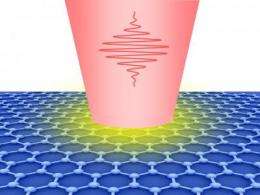
Together with international colleagues, scientists from the Helmholtz-Zentrum Dresden-Rossendorf (HZDR) have added another important component towards understanding the material graphene; a material that is currently receiving a lot of attention: They have determined the lifetime of electrons in graphene in lower energy ranges. This is of great relevance for the future development of fast electronic and optoelectronic components. The results were published just recently in the online edition of the journal Physical Review Letters.
After the discovery of graphene had been awarded the Nobel Prize in Physics last year, many research teams around the globe have been seeking to better understand the material's fundamental properties to permit such promising electronic and optoelectronic applications as transistors and rapid detectors for optical data transmission. Graphene – a single carbon layer that has its atoms arranged in a hexagon like a honeycomb – is also very interesting as a transparent electrode material for flat screens and solar cells. According to the HZDR researcher Dr. Stephan Winnerl, graphene might replace the scarce high tech metal indium in this field.
With subsidies from the German Research Foundation's Priority Program "Graphene" and funds from the European Union, Stephan Winnerl and his colleagues at the Helmholtz-Zentrum Dresden-Rossendorf (HZDR) together with scientists from the Technische Universität (TU) Berlin, the Grenoble High Magnetic Field Laboratory, and the Georgia Institute of Technology, USA, managed to determine the "lifetime" of electrons in graphene in lower energy ranges which had not been researched before.
The characteristic behavior of electrons in specific energy ranges typically found in solids is one of the many physical properties in which graphene is fundamentally different from most other materials: Normally, electrons can only adopt specific energy levels (these are referred to as energy bands), but not others (these are referred to as energy gaps). This principle is used, for example, for such optoelectronic components as light emitting diodes which emit light at very specific wavelengths: This releases energy which the electrons set free while "skipping over" energy gaps.
But graphene's behavior differs from other semiconductors: The energy bands touch each other without the appearance of any gaps. Instead of emitting light, graphene is capable of absorbing the radiation of lower energies below the visible spectrum, such as terahertz and infrared light; thus, making it a superb material for detectors.
To be able to develop rapid electronic and optoelectronic components based on graphene, one has to know precisely how long electrons linger at specific energy levels. The examination of such processes, which occur in the picosecond range, i.e. the time scale of one millionth of a millionth second, requires extremely rapid observation methods. The unique feature of the experiments conducted at the Helmholtz-Zentrum in Dresden is the exposure of the graphene samples to light that had longer wavelengths than ever before. This was made possible through the short radiation pulses of the HZDR's Free Electron Laser (FEL). The researchers were, thus, able to study the lifetime of electrons near the contact point of the energy bands which is the unique physical property characteristic of graphene.
The FEL excited the graphene samples with light that had different wavelengths in the infrared range. The researchers discovered that the energy of the light particles exciting the electrons as well as the oscillations of the atomic lattice influence the lifetime of the electrons: If the energy of the light particles is greater than the energy of the lattice oscillations, then the electrons will alter their energy state more rapidly and have a shorter lifetime. Conversely, the electrons will linger longer at a specific energy level if the excitation energy is lower than the energy of the lattice oscillations.
The insights gained from the experiments are substantiated by model calculations from the TU Berlin. These calculations permit a clear assignment of the experimental data to the physical mechanisms in graphene. The researchers have, thus, made a valuable contribution towards a better understanding of the electronic and optical properties of graphene.
More information: Winnerl, S.; Orlita, M.; Plochocka, P; Kossacki, P.; Potemski, M.; Winzer,T.; Malic, E.; Knorr, A.; Sprinkle, M.; Berger, C.; de Heer, W. A.; Schneider, H.; & Helm, M. (2011). Carrier dynamics in epitaxial graphene close to the Dirac point. Physical Review Letters 107, 237401, DOI: 10.1103/PhysRevLett.107.237401
Journal information: Physical Review Letters
Provided by Helmholtz Association of German Research Centres


