Climate change blamed for dead trees in Africa
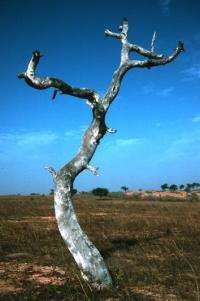
A dead ironwood tree (Prosopis africana) in Senegal, West Africa, is one of many trees that have died due to climate change. Credit: Patrick Gonzalez
Trees are dying in the Sahel, a region in Africa south of the Sahara Desert, and human-caused climate change is to blame, according to a new study led by a scientist at the University of California, Berkeley.
"Rainfall in the Sahel has dropped 20-30 percent in the 20th century, the world's most severe long-term drought since measurements from rainfall gauges began in the mid-1800s," said study lead author Patrick Gonzalez, who conducted the study while he was a visiting scholar at UC Berkeley's Center for Forestry. "Previous research already established climate change as the primary cause of the drought, which has overwhelmed the resilience of the trees."
The study, which is scheduled for publication Friday, Dec. 16, in the Journal of Arid Environments, was based upon climate change records, aerial photos dating back to 1954, recent satellite images and old-fashioned footwork that included counting and measuring over 1,500 trees in the field. The researchers focused on six countries in the Sahel, from Senegal in West Africa to Chad in Central Africa, at sites where the average temperature warmed up by 0.8 degrees Celsius and rainfall fell as much as 48 percent.
They found that one in six trees died between 1954 and 2002. In addition, one in five tree species disappeared locally, and indigenous fruit and timber trees that require more moisture took the biggest hit. Hotter, drier conditions dominated population and soil factors in explaining tree mortality, the authors found. Their results indicate that climate change is shifting vegetation zones south toward moister areas.
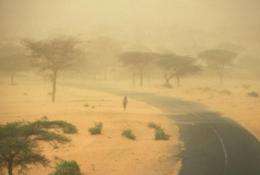
Rainfall in the African Sahel declined more than anywhere else in the world in the period of recorded measurements, causing increased aridity, as evidenced by this dust storm in Senegal. Credit: Patrick Gonzalez
"In the western U.S., climate change is leading to tree mortality by increasing the vulnerability of trees to bark beetles," said Gonzalez, who is now the climate change scientist for the National Park Service. "In the Sahel, drying out of the soil directly kills trees. Tree dieback is occurring at the biome level. It's not just one species that is dying; whole groups of species are dying out."The new findings put solid numbers behind the anecdotal observation of the decline of tree species in the Sahel.
"People in the Sahel depend upon trees for their survival," said Gonzalez. "Trees provide people with food, firewood, building materials and medicine. We in the U.S. and other industrialized nations have it in our power, with current technologies and practices, to avert more drastic impacts around the world by reducing our greenhouse gas emissions. Our local actions can have global consequences."
Provided by
University of California - Berkeley
-
From lemons to lemonade: Reaction uses carbon dioxide to make carbon-based semiconductor,
32 comments
-
Thioridazine kills cancer stem cells in human while avoiding toxic side-effects of conventional cancer treatments,
3 comments
-
SpaceX private rocket blasts off for space station (Update),
42 comments
-
Climate scientists say they have solved riddle of rising sea,
31 comments
-
SpaceX capsule has 'new car' smell, astronauts say (Update),
4 comments
-
Hypothetical desert earth
22 hours ago
-
More human population = greater mass?
May 25, 2012
-
Conversion from aircraft bearing to normal degrees
May 23, 2012
-
Interpretation/Analysis of the Lab results(HEPA filter)
May 22, 2012
-
Has anyone here attended the The Urbino Summer School in Paleoclimatology?
May 22, 2012
-
Earthquakes: Mag 6 N. Italy and Mag 5.6 W. Bulgaria
May 21, 2012
- More from Physics Forums - Earth
More news stories
Land and sea species differ in climate change response: study
(Phys.org) -- Marine and terrestrial species will likely differ in their responses to climate warming, new research by Simon Fraser University and Australia’s University of Tasmania has found.
5 hours ago |
3.7 / 5 (3) |
5
|
Yale study concludes public apathy over climate change unrelated to science literacy
Are members of the public divided about climate change because they don't understand the science behind it? If Americans knew more basic science and were more proficient in technical reasoning, would public consensus match ...
7 hours ago |
4.8 / 5 (5) |
19
|
10 million years needed to recover from mass extinction
It took some 10 million years for Earth to recover from the greatest mass extinction of all time, latest research has revealed.
Space & Earth / Earth Sciences
7 hours ago |
4 / 5 (4) |
1
|
Sophisticated simulations predict future warming
The chances of our planet being hit by a global warming of 3 degrees Celsius by 2050 is as likely as it being hit by an increase of 1.4 degrees, new research shows. Presented in the journal Nature Geoscience, the British study ...
Space & Earth / Earth Sciences
May 22, 2012 |
4.1 / 5 (10) |
51
Aliens don't want to eat us, says former SETI director
Alien life probably isnt interested in having us for dinner, enslaving us or laying eggs in our bellies, according to a recent statement by former SETI director Jill Tarter.
Space & Earth / Space Exploration
May 25, 2012 |
4.4 / 5 (15) |
41
Stunning image of smallest possible five-ringed structure
Scientists have created and imaged the smallest possible five-ringed structure about 100,000 times thinner than a human hair and you'll probably recognise its shape.
'Unzipped' carbon nanotubes could help energize fuel cells, batteries
Multi-walled carbon nanotubes riddled with defects and impurities on the outside could replace some of the expensive platinum catalysts used in fuel cells and metal-air batteries, according to scientists at ...
Change in developmental timing was crucial in the evolutionary shift from dinosaurs to birds: study
At first glance, it's hard to see how a common house sparrow and a Tyrannosaurus Rex might have anything in common. After all, one is a bird that weighs less than an ounce, and the other is a dinosaur that ...
Computer model used to pinpoint prime materials for efficient carbon capture
When power plants begin capturing their carbon emissions to reduce greenhouse gases and to most in the electric power industry, it's a question of when, not if it will be an expensive undertaking.
T cells 'hunt' parasites like animal predators seek prey, study shows
By pairing an intimate knowledge of immune-system function with a deep understanding of statistical physics, a cross-disciplinary team at the University of Pennsylvania has arrived at a surprising finding: T cells use a movement ...
Scientists develop ultra-sensitive test that detects diseases in their earliest stages
Scientists have developed an ultra-sensitive test that should enable them to detect signs of a disease in its earliest stages, in research published today in the journal Nature Materials.

Dec 12, 2011
Rank: 4.2 / 5 (5)
The region in this study is one of the most sensitive in the world to NATURAL climate change, and has been experiencing tremendous desertification and climate change for all of recorded history.
There are even several dry mega-lakes in the region which predate recorded history by thousands of years, having apparently dried up 1 or 2 thousand years before the Egyptian civilization even existed.
Lake Chad is a last remnant of that.
I'm not being denialist. It's just plain facts.
In this case, the majority of the changes really are natural variation continuing to do what it has always done for seven thousand years now.
Dec 12, 2011
Rank: 1.4 / 5 (10)
Dec 12, 2011
Rank: 5 / 5 (3)
If by "geoengineering" you mean dams, levees, tunnels, and irrigation, then yes it causes abnormal weather.
Entire basins have been drained in the U.S., not by global warming, but by diverting river waters for drinking and irrigation.
This caused desertification which was unrelated to CO2, simply because if you dry up a very large lake you alter the micro-climate of the surrounding area, and lower the humidity, etc.
Now they even had to install sprinklers in some locations to wet the soil in the dry lake bed and surrounding land to keep it from being blown away in the wind!!
No joke.
They pumped it dry for drinking water, and now they have to pump water back in to try to prevent further environmental damage.
This started like 100 years ago. It's a complete catastrophe.
Dec 12, 2011
Rank: 2.6 / 5 (5)
Dec 12, 2011
Rank: 2.6 / 5 (5)
Dec 12, 2011
Rank: 4.3 / 5 (3)
Been saying it for several years now, but nobody seems to listen.
Dec 12, 2011
Rank: 2 / 5 (3)
Dec 12, 2011
Rank: 1 / 5 (1)
Grudgingly, reluctantly, and as if by its own volition, a state of "being in agreement with Nanobanano" forces its way through my consciousness and out through my hands.
There! I said it! But I will retain possession of my soul, thank you, by modifying your statement somewhat:
"If by "geoengineering" you mean dams, levees, tunnels, and irrigation, then yes it CAN cause abnormal weather, and this is sometimes a great improvement. Look at Texas, for example. In its native condition, the Lone Star State had arguably only part of one natural lake. All of the rest - in a huge state now covered in lakes - are man-made. This has caused quite a beneficial change to our climate and weather."
Not for nothing was Texas stereotyped in the olden days as being a desert.
(Hmmm... I wonder if they'll take the bait...)
Dec 13, 2011
Rank: 3 / 5 (2)
Quote-""People in the Sahel depend upon trees for their survival," said Gonzalez. "Trees provide people with food, firewood, building materials and medicine."-end quote
..because..
Quote-"Trees are dying in the Sahel, a region in Africa south of the Sahara Desert, and human-caused climate change is to blame"-end quote.
Which means if the trees are not being used up so much, we could see them rebound more?(course, that goes for the world in general)
Dec 13, 2011
Rank: 1 / 5 (2)
Dec 13, 2011
Rank: 1.9 / 5 (9)
Did anyone else notice how old the data is?
Did anyone notice the dead tree pictured is one of well more than a dozen trees (not one of six) - and that only includes trees which lie directly behind it?
This article is nothing but a fabrication. The Sahel has been greening, and greening significantly. Even from the time of this article's "data" it was greening.
"Analyses made by several independent groups of temporal sequences of satellite data over two decades since early 1980s, showed a remarkable increasing trend in vegetation greenness."
http://www.eoeart...hel#gen2
This map is from the period of 1982-1999:
http://maps.grida...getation
And, Sahel farmers plant lots of trees:
http://www.voanew...649.html
Dec 13, 2011
Rank: 4 / 5 (2)
I was just contemplating how here is Chicago, when I was a child we used to have Stag Beetles and Junebugs all over the place, every summer. Then, every 7 and 14 years an army of cicadas would emerge from the earth. I also used to remember finding caterpillars here and there.
Haven't seen anything like that for YEARS! The cicadas come out half on the wrong year and 10% of what they used to be.
But, it can't be that this observable and quantifiable phenom could be caused by man-made global warming. Why?
Because then we would have to get off our lazy butts and make sacrifices to do something about it ("or else", which is not good and seems to be the direction towards which most of y'all don't seem to mind collectively dragging us.)
Dec 13, 2011
Rank: 2.3 / 5 (3)
Hmm wonder why you havent used more recent data? It couldnt be due to biassed cherrypicking couldnt it?
Naaaaaa!
Dec 13, 2011
Rank: 3 / 5 (4)
The locals have learned that planting trees as wind breaks is a good thing though, so things are starting to recover in more recent decades.
As said above, the "greening of the Sahel" has made headlines on quite a few occasions, and you can easily google it.
Dec 14, 2011
Rank: 2.5 / 5 (8)
Typical effect of global warming and climate change. I can't believe the morons posting excuse this as some local effect and even claim the Shahel are to be greening, when long term its a desert from AGW.
Geeze these rightwingers are toally goofy in the head.
Dec 14, 2011
Rank: 1.9 / 5 (9)
Besides, I did use some recent data, particularly in regards to tree planting (May 9, 2011). Can you say, "Double d'oh!"
Dec 14, 2011
Rank: 2 / 5 (8)
What's the matter, are you having difficulty reading the references?
Dec 14, 2011
Rank: 2.6 / 5 (5)
Just ignore her. She's obviously just a troll.
Dec 15, 2011
Rank: 2.1 / 5 (7)
Dec 15, 2011
Rank: 1.9 / 5 (10)
For instance, it meantions the bark beetle death of U.S. trees. This is an occurence that happens naturally during dry years, because the trees can't produce enough sap to push the beetles out. But, if this was a long-term problem, deforestation would be the result. However, U.S. trees are thriving like never before. There's so many that during the dry months they pose a significantly increasing fire risk.
Dec 15, 2011
Rank: 1 / 5 (3)
Still see you cherrypicking ;)
Dec 16, 2011
Rank: 1.9 / 5 (9)
How is using United Nations Environment Programme (UNEP) data cherry picking? Double d'oh!
How is using the Voice of America's Special English Agriculture Report cherry picking? Triple d'oh!
If you don't like my references, explain why and find your own dang references which refute them.
I doubt you can, or will. Can you say, "Quadruple d'oh!"
Dec 20, 2011
Rank: 2.6 / 5 (5)
Not like this! Your another right wing plant aren't you? If not, you certainly didn't even read the article. Here is the conclusion of the article;
That must all be caused by conservative wishful thinking. Actually is man made global warming from burning fossil fuels.
The best part about this AGW joke is it's going get worst.
Dec 21, 2011
Rank: 1.7 / 5 (6)
The biosphere is actually booming, as a result of CO2 production. D'oh!
Here's data from the same era as from the article (not that it'll matter to your faith-based alarmist mentality):
http://www.scienc...abstract
Dec 21, 2011
Rank: 1.6 / 5 (13)
Fill in the blank.