China's economic stability depends on more education, economist says
December 8, 2011 By Adam Gorlick

China's economic stability depends on more education, Stanford economist says

Enlarge

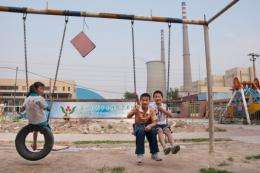
The playground outside a Beijing school for migrant students is overlooked by the cooling towers and smokestacks of a power plant. The students have moved here from China's rural areas, where it's not unusual for children to test three years behind their peers in good city schools. Credit: Adam Gorlick

(PhysOrg.com) -- As the world holds a collective breath waiting to see whether China’s white-hot economy blazes ahead or fizzles, Stanford economist Scott Rozelle is talking up a plan to protect the country’s future.

needs to make sure every kid goes to so they have the skills and training they’ll need to be productive workers,” he says.

With only 40 percent of the country’s poor and rural children now receiving a formal high school , that’s a tall – and expensive – order to fill. Rozelle figures China needs to invest at least $500 billion during the next decade to make sure nearly all the country’s children have the support they’ll need for a quality education.

But he warns the price will be even higher if the country falls short of that goal.

Hourly wages – now about $2 – rose by 19 percent in the past year. If China’s growth pattern continues, those wages can hit $10 to $15 by 2030. That trend is pushing China to shift from an economy based on labor-intensive, low-skilled manufacturing to one needing smarter, more literate workers.

Facing increasing payroll costs, employers cannot afford to hire workers who don’t have a set of basic skills and an ability to master complicated tasks. If the labor force cannot measure up, businesses – and the jobs they promise – will go elsewhere.

And if that happens?

“Then,” Rozelle says, “You have Mexico and the crisis that country is facing today.”

China is now in much the same situation as Mexico during the late 1980s and early 1990s, when wages began to skyrocket and the country planned to attract and create high-skilled jobs to support them.

The idea was to move Mexico from a middle-income nation to a rich one. But there wasn’t a deep enough labor pool to sustain the shift. While just over 80 percent of kids in Mexico’s well-off cities were going to high school, only about 40 percent of those living in rural and poor urban areas were getting a secondary education.

Factories paying low wages soon moved to other countries. Job opportunities dried up. Unemployment soared, and so did the power and presence of drug cartels and organized crime. Gang violence is scaring away tourists, foreign investment and domestic business plans. More than ever, Mexico is now swamped with crime and corruption instead of the spoils of an economic windfall that seemed within reach just three decades ago.

Should China fall into the same trap, Rozelle warns of a destabilized Asian behemoth that would put a crimp in worldwide trade and global prosperity. And without a strong economy to assure its own population of a rising quality of life, China might begin to assert its military to increase a sense of nationalism, he says.

“The world is much better off with a stable and growing China,” says Rozelle, co-director of the Rural Education Action Project at Stanford’s Freeman Spogli Institute for International Studies.

And he says China can avoid Mexico’s mistake by following the path of countries such as South Korea.

While Mexico’s fortunes and wages were rising, so too were South Korea’s. But China’s neighbor made a smooth transition from a low-wage, labor-intensive economy to a highly productive, innovative and service-based workforce.

They pulled it off because of a strong commitment to education. Even in the years when South Korea’s economy was fueled by low-wage, labor-intensive manufacturing, nearly everyone went to high school. Whether or not South Korean officials were betting that education and economic success went hand-in-hand, it turned out that a strong education system was one of the key factors in the country’s growth, Rozelle says.

“In the 1970s and early 1980s, you had young women who were making shirts and socks in sweatshops transform themselves into highly skilled workers doing high-fashion design and other high-wage, high productivity jobs in the 1990s and 2000s,” Rozelle says. “And the key to it all was that those women went to high school and learned the skills that high-wage paying employers demanded. It was mandatory and free, and those women learned how to read, write and do math.”

China has a lot of catching up to do if it aspires to South Korea’s model. With up to 60 percent of children in poor rural areas missing out on high school, China’s education system in those regions now looks more like Mexico’s.

But if China begins investing heavily, the country stands a good chance of hitting a sustainable economic stride. That means spending about $50 billion a year on services like early childhood education and computer-assisted learning while making sure schoolchildren have the health care, vision care and nutrition they need to pay attention and perform well in class.

“China has the money and the resources to contain the problem,” Rozelle says. “But it needs to do something right now, because time is running out.” 

Provided by Stanford University search and more info website

Filter


Move the slider to adjust rank threshold, so that you can hide some of the comments.


Display comments: newest first

bredmond
Dec 08, 2011

Rank: not rated yet
I dont know what the point of putting wages in dollars is. I guess it is just to show the wages are increasing. Otherwise, $2 is about Y13, and my experience has been that purchasing power in china is about equal within its borders.

China has had a long literary history as well as a long bureaucratic tradition. This would support the notion of the economic shift a la South Korea rather than Mexico. Education is highly valued in China, and words like nerd are unknown. When I try to explain it to my students, they only basicaly get what it means, but they dont appreciate why westerners think it is funny to punch a nerd.

China already uses its military to promote nationalism, but really i dont see it disproportionate to their GDP. In fact, nobody ever talks about the PLA. They prefer to talk to me about the NBA and how to make their spoken English better and why am i not married and dont have a girlfriend either. (its cause its hard to find a sophisitcated, unmarried girl here)
Rank not rated yet
Relevant PhysicsForums posts
  • Consumption rivalry
    createdMay 25, 2012
  • Bilateral trade between all countries
    createdMay 24, 2012
  • Is the economic foundation of social media in jeopardy?
    createdMay 20, 2012
  • Psychology: Rosenthal and Hawthorne Effect
    createdMay 15, 2012
  • Is GDP and National Income the Same Thing?
    createdMay 13, 2012
  • Difference between hourly wage and real GDP per hour worked?
    createdMay 12, 2012
  • More from Physics Forums - Social Sciences

More news stories

Change in developmental timing was crucial in the evolutionary shift from dinosaurs to birds: study

At first glance, it's hard to see how a common house sparrow and a Tyrannosaurus Rex might have anything in common. After all, one is a bird that weighs less than an ounce, and the other is a dinosaur that ...

Other Sciences / Archaeology & Fossils

created 7 hours ago | popularity 5 / 5 (4) | comments 0 | with audio podcast

Social welfare cuts ultimately come with heavy price, researchers say

(Phys.org) -- Slashing government funding for Medicaid, food stamps and other programs that serve the poor – while politically popular with some lawmakers and many conservatives – may do more harm ...

Other Sciences / Social Sciences

created May 24, 2012 | popularity 4 / 5 (21) | comments 155

Ancient Bethlehem seal unearthed in Jerusalem

Israeli archaeologists have discovered a 2,700-year-old seal that bears the inscription "Bethlehem," the Israel Antiquities Authority announced Wednesday, in what experts believe to be the oldest artifact ...

Other Sciences / Archaeology & Fossils

created May 23, 2012 | popularity 3.3 / 5 (15) | comments 24

Dollars and sense: Why are some people morally against tax?

As the U.S. presidential election campaigns heat up, the economic debate is dominated by bailouts, austerity and, inevitably, taxation. Now a new study published in Symbolic Interaction asks why tax is such an important issue ...

Other Sciences / Social Sciences

created May 23, 2012 | popularity 2.3 / 5 (3) | comments 19

Oldest Jewish archaeological evidence on the Iberian Peninsula

German archaeologists of the Friedrich Schiller University Jena found one of the oldest archaeological evidence so far of Jewish Culture on the Iberian Peninsula at an excavation site in the south of Portugal, ...

Other Sciences / Archaeology & Fossils

created May 25, 2012 | popularity 4.2 / 5 (6) | comments 12


Stunning image of smallest possible five-ringed structure

Scientists have created and imaged the smallest possible five-ringed structure – about 100,000 times thinner than a human hair – and you'll probably recognise its shape.

'Unzipped' carbon nanotubes could help energize fuel cells, batteries

Multi-walled carbon nanotubes riddled with defects and impurities on the outside could replace some of the expensive platinum catalysts used in fuel cells and metal-air batteries, according to scientists at ...

Computer model used to pinpoint prime materials for efficient carbon capture

When power plants begin capturing their carbon emissions to reduce greenhouse gases – and to most in the electric power industry, it's a question of when, not if – it will be an expensive undertaking.

T cells 'hunt' parasites like animal predators seek prey, study shows

By pairing an intimate knowledge of immune-system function with a deep understanding of statistical physics, a cross-disciplinary team at the University of Pennsylvania has arrived at a surprising finding: T cells use a movement ...

Land and sea species differ in climate change response: study

(Phys.org) -- Marine and terrestrial species will likely differ in their responses to climate warming, new research by Simon Fraser University and Australia’s University of Tasmania has found.

Yale study concludes public apathy over climate change unrelated to science literacy

Are members of the public divided about climate change because they don't understand the science behind it? If Americans knew more basic science and were more proficient in technical reasoning, would public consensus match ...