Spider know-how could cut future energy costs
November 24, 2011

Spider know-how could cut future energy costs

Enlarge

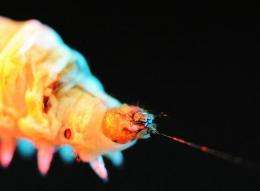
lkworm spinning silk. Photo: OSG

(PhysOrg.com) -- Scientists at Oxford University and The University of Sheffield have demonstrated that natural silks are a thousand times more efficient than common plastics when it comes to forming fibres.  

A report of the research is published this week in the journal .

The finding comes from comparing silk from the Chinese silkworm (Bombyx mori) to molten high density polyethylene (HDPE) - a material from which the strongest synthetic fibres are made. The researchers used polarised light shining through a disk rotating over a plate to study the how fibres are formed as the two materials are spun.

HDPE forms filaments at over 125 C and in addition requires substantial energy input in the form of “shear force” applied to the material in its molten form. Silks, in contrast, in the same set-up forms filaments at ambient temperature and in addition requires only a tenth of the shear force. If the energetic costs of melting HDPE are included for comparison, silks become a thousand times more efficient.

The discovery of low-energy method for fibre formation has led the researchers to view silks as a new class of polymers they call 'aquamelts'.

‘When aquamelts are quickly stretched they lose water, which helps them “lock in” fibre formation like a ratchet,’ said Dr Chris Holland of the Oxford Silk Group, part of Oxford University’s Department of Zoology. ‘This doesn’t happen with your everyday which need to be cooled to preserve the fibres, making them inefficient and harder to process.

‘Silk produced by spiders and silk moths demonstrates combinations of strength and toughness that still outperform their synthetic counterparts. Not only are silks superior to man-made fibres, they are produced at room temperature with just water as a by-product.’

Dr Oleksandr Mykhaylyk, of the University of Sheffield, said: ‘This is in stark contrast to oil-based high performance fibres that require high temperatures and create harmful waste. Whilst the high performance and sustainable credentials of silks are well known, the and silkworm can now add one more to the list, low energy costs.’

Dr Chris Holland said: 'Combining the best of polymer science with biology we were able to determine how much energy is required to form these two fibres. And it seems that we have discovered some fundamental differences between natural and synthetic materials. With hundreds of millions of years of R&D in fibre production it is not surprising that silkworms and spiders have found ways to conserve energy while still making superior fibres.'

However it is not just about saving energy or even money. Dr Oleksandr Mykhaylyk said: ‘The important point of this study are the intellectual advances and fundamental understanding that can be achieved when two normally separate disciplines interact as closely as we did.’

Professor Fritz Vollrath, who leads the Oxford Silk Group at Oxford University, said: ‘This project is about being inspired by Nature to discover and implement things that can help mankind to weather the upcoming storms on our quality of life. This new insight has significant implications for the design and processing of novel bio-inspired synthetic polymers as well as bio-polymer manufacture.’

Provided by Oxford University search and more info website

4.8 /5 (9 votes)  

Filter


Move the slider to adjust rank threshold, so that you can hide some of the comments.


Display comments: newest first

nxtr
Nov 24, 2011

Rank: 5 / 5 (1)
Bio synthetics are the natural next step in our industrial development.
Deesky
Nov 24, 2011

Rank: 5 / 5 (1)
Bio synthetics are the natural next step in our industrial development.

Yes, more generally, the field biomimetics has huge potential.

Today some researchers are using genetic computer algorithms to explore large solution spaces in the hope of converging to a solution with superior (even unexpected) characteristics and utility. And these approaches have had some success.

But with biomimetics, nature has already run the simulations for thousands or millions of years and has already found the optimal solution for a given requirement, so all we have to do is copy it or reverse engineer it and then, perhaps, improve on it further.

Still not an easy task, but it's ripe for exploitation.
materialsdave
Nov 25, 2011

Rank: not rated yet
If you'd like more details, the original article can be found at http://dx.doi.org...01103664 .

Dave Flanagan, Advanced Materials
Au-Pu
Nov 26, 2011

Rank: not rated yet
None of this is new.
But the big money goes towards what can be controlled best.
Nature has many lessons to teach us.
This is only one of them.
Arrogance and obsessions with control equal stupidity.
Rank 4.8 /5 (9 votes)
Relevant PhysicsForums posts
  • Calculating partial pressures Pa and Pw
    created1 hour ago
  • Gibbs Free Energy Change/Entropy
    created12 hours ago
  • What's the rule to covalent character
    created13 hours ago
  • Schwartz reagent-- NMR/MS/IR
    createdMay 26, 2012
  • High school chemistry EEI
    createdMay 25, 2012
  • oxidation of I- by KMnO4
    createdMay 25, 2012
  • More from Physics Forums - Chemistry

More news stories

Computer model used to pinpoint prime materials for efficient carbon capture

When power plants begin capturing their carbon emissions to reduce greenhouse gases – and to most in the electric power industry, it's a question of when, not if – it will be an expensive undertaking.

Chemistry / Materials Science

created 4 hours ago | popularity not rated yet | comments 0 | with audio podcast

Scientists develop ultra-sensitive test that detects diseases in their earliest stages

Scientists have developed an ultra-sensitive test that should enable them to detect signs of a disease in its earliest stages, in research published today in the journal Nature Materials.

Chemistry / Analytical Chemistry

created 4 hours ago | popularity not rated yet | comments 0 | with audio podcast

New CO2-removing catalyst can take the heat

(Phys.org) -- The current method of removing the greenhouse gas carbon dioxide (CO2) from the flues of coal-fired power plants uses so much energy that no one bothers to use it. So says Roger Aines, principal ...

Chemistry / Materials Science

created May 24, 2012 | popularity 5 / 5 (9) | comments 10 | with audio podcast

High-speed method to aid search for solar energy storage catalysts

Eons ago, nature solved the problem of converting solar energy to fuels by inventing the process of photosynthesis.

Chemistry / Materials Science

created May 25, 2012 | popularity 5 / 5 (3) | comments 4 | with audio podcast

Researchers demonstrate possible primitive mechanism of chemical info self-replication

(Phys.org) -- When scientists think about the replication of information in chemistry, they usually have in mind something akin to what happens in living organisms when DNA gets copied: a double-stranded molecule ...

Chemistry / Materials Science

created May 25, 2012 | popularity 5 / 5 (4) | comments 2 | with audio podcast


Nvidia trumpets Tegra 3 phone design wins for 2012

(Phys.org) -- Nvidia’s competitive war paint has a name, Tegra 3. On the heels of Nvidia announcements about lowering costs of its Tegra 3 processors and Nvidia-enabled tablets running Android Ice Cream ...

'Unzipped' carbon nanotubes could help energize fuel cells, batteries

Multi-walled carbon nanotubes riddled with defects and impurities on the outside could replace some of the expensive platinum catalysts used in fuel cells and metal-air batteries, according to scientists at ...

T cells 'hunt' parasites like animal predators seek prey, study shows

By pairing an intimate knowledge of immune-system function with a deep understanding of statistical physics, a cross-disciplinary team at the University of Pennsylvania has arrived at a surprising finding: T cells use a movement ...

Change in developmental timing was crucial in the evolutionary shift from dinosaurs to birds: study

At first glance, it's hard to see how a common house sparrow and a Tyrannosaurus Rex might have anything in common. After all, one is a bird that weighs less than an ounce, and the other is a dinosaur that ...

Land and sea species differ in climate change response: study

(Phys.org) -- Marine and terrestrial species will likely differ in their responses to climate warming, new research by Simon Fraser University and Australia’s University of Tasmania has found.

Scientist: Evolution debate will soon be history

(AP) -- Richard Leakey predicts skepticism over evolution will soon be history. Not that the avowed atheist has any doubts himself.