Hubble uncovers tiny galaxies bursting with starbirth in early Universe
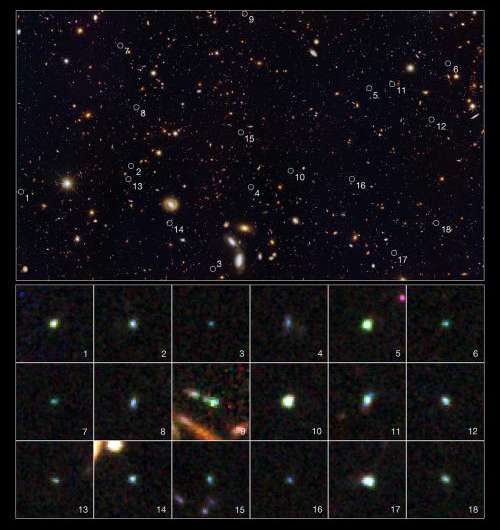
This image reveals 18 tiny galaxies uncovered by the NASA/ESA Hubble Space Telescope. The puny galaxies, shown in the postage-stamp-sized images, existed 9 billion years ago and are brimming with star birth. The dwarf galaxies are typically a hundred times less massive than the Milky Way galaxy but are churning out stars at such a furious pace that their stellar population would double in just 10 million years. Hubble’s Wide Field Camera 3 and Advanced Camera for Surveys spied the galaxies in a field called the Great Observatories Origins Deep Survey (GOODS). The galaxies' location in the GOODS field is marked in the large image. The galaxies stood out in the Hubble images because the energy from all the new stars caused the oxygen in the gas surrounding them to light up like a bright fluorescent sign. The rapid star birth likely represents an important phase in the formation of dwarf galaxies, the most common galaxy type in the cosmos. The galaxies are among 69 dwarf galaxies found in the GOODS and other fields. Images of the individual galaxies were taken November 2010 to January 2011. The large image showing the location of the galaxies was taken between September 2002 and December 2004, and between September 2009 and October 2009. Credit: NASA, ESA, A. van der Wel (Max Planck Institute for Astronomy), H. Ferguson and A. Koekemoer (Space Telescope Science Institute), and the CANDELS team
(PhysOrg.com) -- Using its infrared vision to peer nine billion years back in time, the NASA/ESA Hubble Space Telescope has uncovered an extraordinary population of tiny, young galaxies that are brimming with star formation.
The galaxies are churning out stars at such a rate that the number of stars in them would double in just ten million years. For comparison, the Milky Way has taken a thousand times longer to double its stellar population.
These newly discovered dwarf galaxies are around a hundred times smaller than the Milky Way. Their star formation rates are extremely high, even for the young Universe, when most galaxies were forming stars at higher rates than they are today. They have turned up in the Hubble images because the radiation from young, hot stars has caused the oxygen in the gas surrounding them to light up like a fluorescent sign.
This video is not supported by your browser at this time.
This video highlights 28 tiny galaxies uncovered by the NASA/ESA Hubble Space Telescope. The puny galaxies, shown in the postage-stamp-sized images, existed 9 billion years ago and are brimming with star birth. The dwarf galaxies are typically a hundred times less massive than the Milky Way galaxy but are churning out stars at such a furious pace that their stellar population would double in just 10 million years. Hubble’s Wide Field Camera 3 and Advanced Camera for Surveys spied the galaxies in a field called the UKIDSS Ultra Deep Survey, or UDS, (part of the UKIRT Infrared Deep Sky Survey). The galaxies stood out in the Hubble images because the energy from all the new stars caused the oxygen in the gas surrounding them to light up like a bright fluorescent sign. The rapid star birth likely represents an important phase in the formation of dwarf galaxies, the most common galaxy type in the cosmos. The galaxies are among 69 dwarf galaxies found in the UDS and other fields. The images were made from observations taken between August and December 2010. Credit: NASA & ESA
Astronomers believe this rapid starbirth represents an important phase in the formation of dwarf galaxies, the most common galaxy type in the cosmos."The galaxies have been there all along, but up until recently astronomers have been able only to survey tiny patches of sky at the sensitivities necessary to detect them," says Arjen van der Wel of the Max Planck Institute for Astronomy in Heidelberg, Germany, lead author of a paper that will appear in a forthcoming issue of the Astrophysical Journal. "We weren't looking specifically for these galaxies, but they stood out because of their unusual colours."
The observations were part of the Cosmic Assembly Near-infrared Deep Extragalactic Legacy Survey (CANDELS), an ambitious three-year survey to analyse the most distant galaxies in the Universe. CANDELS is the first census of dwarf galaxies at such an early epoch on the Universe's history.
"In addition to the images, Hubble has captured spectra from a handful of these galaxies that show us the detailed physics of what's happening within them and confirm their extreme star-forming nature," says co-author Amber Straughn at NASA's Goddard Space Flight Center in Greenbelt, USA.
The observations of ancient galaxies are somewhat at odds with recent detailed studies of the dwarf galaxies that are currently orbiting the Milky Way.
"Those studies suggest that star formation was a relatively slow process, stretching out over billions of years," explains Harry Ferguson of the Space Telescope Science Institute (STScI) in Baltimore, USA, co-leader of the CANDELS survey. "The CANDELS finding that there were galaxies of roughly the same size forming stars at very rapid rates at early times is forcing us to re-examine what we thought we knew about dwarf galaxy evolution."
Team member Anton Koekemoer, also of STScI, who is producing the Hubble imaging for the survey adds: "As our observations continue, we should find many more of these young galaxies and gather more details on their star-forming histories."
The CANDELS team uncovered the 69 young dwarf galaxies in near-infrared images taken with Hubble's Wide Field Camera 3 and Advanced Camera for Surveys. The observations concentrated on two regions of the sky called the Great Observatories Origins Deep Survey-South and the UKIDSS Ultra Deep Survey (part of the UKIRT Infrared Deep Sky Survey).
The observations suggest that the newly discovered galaxies were very common nine billion years ago. But it is a mystery why the newly found dwarf galaxies were making batches of stars at such a high rate. Computer simulations show that star formation in small galaxies may be episodic. Gas cools and collapses to form stars. The stars then reheat the gas through, for example, supernova explosions, which blow the gas away. After some time, the gas cools and collapses again, producing a new burst of star formation, continuing the cycle.
"While these theoretical predictions may provide hints to explain the star formation in these newly discovered galaxies, the observed 'bursts' are much more intense than those reproduced by the simulations," says van der Wel.
The NASA/ESA/CSA James Webb Space Telescope, an infrared observatory scheduled to be launched later this decade, will be able to probe these faint galaxies at an even earlier era to see the glow of the first generation of stars, providing detailed information of the galaxies' chemical composition.
"With Webb, we'll probably see even more of these galaxies, perhaps even pristine galaxies that are experiencing their first episode of star formation," Ferguson says. "Being able to probe down to dwarf galaxies in the early Universe will help us understand the formation of the first stars and galaxies."
More information: Research paper: http://www.spacete … heic1117.pdf
Provided by
ESA/Hubble Information Centre
-
From lemons to lemonade: Reaction uses carbon dioxide to make carbon-based semiconductor,
32 comments
-
Thioridazine kills cancer stem cells in human while avoiding toxic side-effects of conventional cancer treatments,
3 comments
-
SpaceX private rocket blasts off for space station (Update),
42 comments
-
Climate scientists say they have solved riddle of rising sea,
31 comments
-
SpaceX capsule has 'new car' smell, astronauts say (Update),
4 comments
-
Distance of planets from stars and revolution
7 hours ago
-
revamping general concept and cosmological principle
May 25, 2012
-
Transiting Exoplanet Light Curve
May 25, 2012
-
Math behind Theoretical Physics
May 24, 2012
-
Do we know whats at the center of galaxies yet?
May 23, 2012
-
Structure of the Milky Way?
May 20, 2012
- More from Physics Forums - General Astronomy
More news stories
Land and sea species differ in climate change response: study
(Phys.org) -- Marine and terrestrial species will likely differ in their responses to climate warming, new research by Simon Fraser University and Australia’s University of Tasmania has found.
4 hours ago |
3.7 / 5 (3) |
5
|
Yale study concludes public apathy over climate change unrelated to science literacy
Are members of the public divided about climate change because they don't understand the science behind it? If Americans knew more basic science and were more proficient in technical reasoning, would public consensus match ...
6 hours ago |
4.8 / 5 (5) |
12
|
10 million years needed to recover from mass extinction
It took some 10 million years for Earth to recover from the greatest mass extinction of all time, latest research has revealed.
Space & Earth / Earth Sciences
6 hours ago |
5 / 5 (3) |
1
|
Sophisticated simulations predict future warming
The chances of our planet being hit by a global warming of 3 degrees Celsius by 2050 is as likely as it being hit by an increase of 1.4 degrees, new research shows. Presented in the journal Nature Geoscience, the British study ...
Space & Earth / Earth Sciences
May 22, 2012 |
4.4 / 5 (9) |
51
Aliens don't want to eat us, says former SETI director
Alien life probably isnt interested in having us for dinner, enslaving us or laying eggs in our bellies, according to a recent statement by former SETI director Jill Tarter.
Space & Earth / Space Exploration
May 25, 2012 |
4.4 / 5 (15) |
41
Stunning image of smallest possible five-ringed structure
Scientists have created and imaged the smallest possible five-ringed structure about 100,000 times thinner than a human hair and you'll probably recognise its shape.
'Unzipped' carbon nanotubes could help energize fuel cells, batteries
Multi-walled carbon nanotubes riddled with defects and impurities on the outside could replace some of the expensive platinum catalysts used in fuel cells and metal-air batteries, according to scientists at ...
Change in developmental timing was crucial in the evolutionary shift from dinosaurs to birds: study
At first glance, it's hard to see how a common house sparrow and a Tyrannosaurus Rex might have anything in common. After all, one is a bird that weighs less than an ounce, and the other is a dinosaur that ...
Computer model used to pinpoint prime materials for efficient carbon capture
When power plants begin capturing their carbon emissions to reduce greenhouse gases and to most in the electric power industry, it's a question of when, not if it will be an expensive undertaking.
T cells 'hunt' parasites like animal predators seek prey, study shows
By pairing an intimate knowledge of immune-system function with a deep understanding of statistical physics, a cross-disciplinary team at the University of Pennsylvania has arrived at a surprising finding: T cells use a movement ...
Scientists develop ultra-sensitive test that detects diseases in their earliest stages
Scientists have developed an ultra-sensitive test that should enable them to detect signs of a disease in its earliest stages, in research published today in the journal Nature Materials.
Nov 10, 2011
Rank: 5 / 5 (7)
Nov 10, 2011
Rank: 2 / 5 (2)
Nov 10, 2011
Rank: 5 / 5 (1)
Not sure I follow. Why would you assume that our solar system was here before that time? That light traveled for many billions of years to get here.
Nov 10, 2011
Rank: 4 / 5 (8)
All of this is based on my understanding the current Standard model (LCDM).
The universe was something like 1/1,000th the size it is now at the surface of last scattering (400,000 yrs after the BB). But that is still really big. The light that has taken 13 billion years to reach us wasn't 13 billion light years away from us at the end of the dark ages (around 400 million years after the BB). The distance that light has traveled (13 gly) is more than the initial distance because of the expansion of the universe. Further, that light source is now more than 40 billion light years away from us and receding at faster than the speed of light due to expansion.
Basically, the light we see that left its source 13 billion light years ago was really far away from us when it was emitted. While it was travelling here we grew up.
Nov 10, 2011
Rank: 5 / 5 (6)
- The Universe started out small.
- Some time after the big bang, and inflationary period happened where the universe and the fabric of space expanded faster than the speed of light.
- Now the light is catching up with us.
Obviously, there are more complex mechanisms at play as well, and some mind numbing geometry to go with it, but that is the simplest part of the explanation why we would be able to 'see' so far back into time.
Nov 10, 2011
Rank: 3.9 / 5 (7)
Inflation is our explanation for how the universe got so big so fast, but it stopped less than one billionth of a billionth of a second after the BB. All was dark (opaque) until about 400 million after the big bang.
Point simply being, the emitter of light that reached us after 13 billion years was really far away when the light was originally emitted, AND the light was emitted no sooner than 400 million years after the BB, not immediately after the inflationary period. Obfuscated!. Quick, somebody do the math and tell us how far the emitter was from the glob of hydrogen that became the Milky Way at the time the 13 bly old light we are now observing was emitted!
Nov 10, 2011
Rank: 4.3 / 5 (3)
Nov 10, 2011
Rank: not rated yet
Yes, but being technically correct makes it harder to explain to someone wondering how it could be possible.
To those reading - I am aware that my explanation was not technically correct, but it demonstrates some of the principles that make the it possible for this phenomenon to occur.
I suppose more accurately, I could say that due to the inflationary epoch, the universe became so large so quickly that something emitting light at 400 million years time on one side of the universe would need to travel a distance of 13 billion LY to catch up with us moving in the other direction. Isotropically speaking, which it isn't.
Hahaha.
Another interesting fact: the big bang/inflation theory actually resembles an inside out black hole.
Nov 10, 2011
Rank: 3.4 / 5 (5)
that_guy: maybe the BB is an anti-matter BH turned inside out. Bazinga! Ok, yyz's speculation actually made sense. But I had to try.
Oh, and everyone go sign up for Galaxy Zoo instead of wasting your time playing MMORPG. Yeah, I am talking to you.
Nov 10, 2011
Rank: 1 / 5 (3)
http://en.wikiped...r_metric
Nov 10, 2011
Rank: 1 / 5 (3)
Fixed that for ya.
Nov 10, 2011
Rank: 5 / 5 (5)
Well, to be honest, I also based my supposition on the observed properties of starburst dwarf galaxies seen in the nearby universe, such as DDO 68, SBS0335-052 W and, significantly, I Zw 18, all extremely metal-poor local galaxies undergoing a starburst phase( with very similar diagnostics).
A recent paper compared characteristics seen in I Zw 18 with some distant active dwarf galaxies, similar to those discussed here: http://arxiv.org/...93v1.pdf
While still a speculative notion, it does give one pause for thought.
Nov 10, 2011
Rank: 1 / 5 (2)
The UDS & other observations I've read about, all seem to agree that the oldest galaxies are also small ones as compared to the Milky Way or Andromeda because these are more newly formed. It has appeared to me in my amateur studies of astronomy that no matter what arc any telescope is swung through (all the way to 360 degrees), the most powerful telescopes see only the smaller galaxy types from 10 to 13 billion LY. Now keep this picture in mind, a ring of galaxies on the edge of the observable universe 3-4 billion LY years wide encircle the more newly formed larger galaxies such as our own. DOES THIS NOT PLACE US NEAR THE CENTER OF THE UNIVERSE?
Nov 11, 2011
Rank: not rated yet
Although the guy that said this may have had it right:
'My own suspicion is that the Universe is not only stranger than we suppose, but stranger than we can suppose.'
Thanks again!
Nov 13, 2011
Rank: 2.3 / 5 (3)
Not at all, remember the further out you look, the longer back in time you are seeing. What now seems to be a spherical shell of small galaxies surrounding us just indicates that long ago most galaxies were small.
Nov 13, 2011
Rank: 3 / 5 (2)
If 10-13 billion years ago all galaxies were cubical, 7-10 b.y.a. all were spherical, 4-7 b.y.a all were doughnuts and less than 4 b.y.a all were spiral then looking out we would observe the following:
A series of concentric shells comprising different shaped galaxies starting with a sphere of spirals up to 4 light years out, followed with a concentric shell of doughnuts 4-7 l.y. away followed by spheres and then cubes at the appropriate distances.
The same view would be had from anywhere in the universe.
Nov 13, 2011
Rank: 2 / 5 (4)
I think I see the point you're making here, & it sounds similar to my original conjecture. When an explosion occurs, the first material to be ejected will be the material that forms the first galaxies, they will be smaller because mass is least dense at the surface of the mass from which the explosion originated, this forms the first & oldest ring of galaxies. Later as more dense material is ejected from the core, larger galaxies are formed thus creating an onion layer of galactic formation. Finally, as the densest material is ejected from the center mass of the explosion, we should expect to see the densest & thus largest galactic formations of the newer galaxies. Logical?
Nov 14, 2011
Rank: 5 / 5 (3)
The BB was not an explosion (yes this theory but it is the theory you are talking about). It is the expansion of space-time it self.
What high density material. We are talking about energy, then quarks/leptons, then nucleie, then atoms and the atoms are mostly hydrogen then less than 10% helium then .. well thats pretty much it. Some hydrogen with a neutron for deuterium maybe some with two neutrons for tritium and lithium, all together less than 1%.
SO where are you going get that separation by density?
There is no core to eject material from. It was just gas that was spreading out as the Universe expanded. Since the gas wasn't expanding INTO space but was dragged BY space it was pretty uniform.
All of space would have had the same density or nearly the same. We see this in the CMBR.
Ethelred
Nov 14, 2011
Rank: 3 / 5 (2)
Nov 14, 2011
Rank: 5 / 5 (1)
In my silly example the first, oldest galaxies that formed were ALL cubical, they took a few billion years to ALL evolve to spherical, witch after a few billion years ALL evolved into doughnuts which ALL turned into spirals.
So now, at present, ALL are spirals, every single one of them. But looking out we see the shells explained because we are looking back in time. Do you understand now? Do you also understand why an observer ANYWHERE in the universe will see the same thing?
Nov 14, 2011
Rank: 5 / 5 (1)
Nov 14, 2011
Rank: 1 / 5 (1)
Nov 14, 2011
Rank: 1 / 5 (1)
Nov 14, 2011
Rank: 1 / 5 (1)
Explain how "space" has "dragged" anything so as to create a ring of older smaller galactic formations that we can observationally demonstrate as surrounding newer galactic formations.
Nov 14, 2011
Rank: 5 / 5 (2)
Well, perhaps in cosmological terms "green peas" are "surprisingly close", but the original sample contained examples with redshifts of z=0.112-0.360, not exactly nearby, Local Cluster objects.
Sec. 5.3 of the discovery paper( http://arxiv.org/...55v1.pdf ) discusses similarities and differences between "green peas" and "UV-luminous high redshift galaxies", similar to the population discussed in the above article.
Interestingly, Cardamone et al find "green peas" may represent the last remnants of downsized versions of Lyman break galaxies and Lyman-alpha emitters found in the early universe.
It will be interesting to see just where these distant luminous dwarf galaxies fit in with current bottom-up LCDM galaxy formation models.
Nov 14, 2011
Rank: 4 / 5 (3)
The space between galaxies is now much less dense than it was 10 billion years ago.
How about a link for that? New galactic formations, to the best of my knowledge, are all dwarfs. We do see what were then new galaxies billions of light years away as well. So a link to give me a clue as to what you mean would be helpful.
Perhaps I should have written it as space-time which has expanded. I get the feeling that you have yet to see the balloon analogy.
http://astro.ucla...on0.html
http://astro.ucla...on2.html
Ethelred
Nov 14, 2011
Rank: 1 / 5 (1)
I well understand the "balloon", the galaxies on the surface of that balloon are supposedly the oldest & smallest, those inside are younger & larger because they were in an area where space was more dense for accretion of material to form larger galaxies. Anything I've read in cosmology implies that galaxies like Andromeda & Milky Way were formed more recently than the ones at 10 - 13 billion LY, skin of the balloon.
Nov 14, 2011
Rank: 1 / 5 (1)
Nov 14, 2011
Rank: 1 / 5 (1)
That they're metal poor is interesting, but why are they so apparently "young" in an older universe?
Indeed.
Nov 15, 2011
Rank: 3.4 / 5 (5)
@Ojorf: Don't bother getting upset about this character. "Orac" is a sockpuppet, possibly electronic. (There are a couple of others.) 'It' seems to up-rank and down-rank at random and has been doing this to all of us. It's most noticible in the physics threads and getting on all of our nerves. I've done some up-ranking for you (5's), to help counter the 'drag' on your average. Btw, my marks aren't just for show, they also show my 'like' for your answers. :)
Cheers, DH66
Nov 15, 2011
Rank: 5 / 5 (2)
Benni, did you read my attempt to explain to you why we see these galaxies, mentioned in this article, all at a distance of 10 - 13 b.l.y. away? We are NOT in the center of a ring of them, implying we are at the center of the universe. It is an illusion, as I explained. Your problem seems to be that you have a quite mistaken idea about what the Big Bang was. Please read this:
Thank you DarkHorse, much appreciated.
Benni, did you read my attempt to explain to you why we see these galaxies, mentioned in this article, all at a distance of 10 - 13 b.l.y. away? We are NOT in the center of a ring of them, implying we are at the center of the universe. It is an illusion, as I explained. Your problem seems to be that you have a quite mistaken idea about what the Big Bang was. Please read this:
http://www.thekey...eory.htm
Nov 15, 2011
Rank: 1 / 5 (1)
We are especially intrigued by the latest Hubble discovery that shows a new galactic discovery with extreme redshift > 7, a mere 200 - 500 million years after the BB. It is small in nature. We discuss issues like "inflation" vs "big bang", but never coming to a consensus because even the experts seemingly have none. The "experts" always frame the age of stellar objects in "post-big bang" terms, never "post-inflation", as if they are two unrelated issues. We often times find ourselves caught up in a conundrum, is this or is it that. So lately we've been studying "beryllium content" of stars to see if that can lead us to determine ages of galaxies, but the limitation of this is extreme redshift of distant galaxies.
Nov 15, 2011
Rank: 4 / 5 (4)
There is no inside. You do not understand the balloon.
Well you may have misunderstood. The Milky Way started the same all those others did and at around the same time.
Exactly, except that date is too early, this galaxy started early. There are some stars left from the very beginning when this was probably similar to those dwarf galaxies we see very far away and thus long ago.>>
Nov 15, 2011
Rank: 5 / 5 (2)
Inflation is an idea of why the Universe seems flat. It makes sense but could be wrong. For instance the BB could be wrong in the first place but the Universe definitely used to be much smaller. The question is how small was when it started up. In the Brane hypothesis it could have been a cold possibly infinite space to start with and the two branes collided in a higher dimension that branes are embedded in. Energy is released in the collision and space expands, with seeing as far a light has traveled in the meantime. I am not really fond of that idea myself.>>
Nov 15, 2011
Rank: 5 / 5 (2)
Benni, inflation is part of the Big Bang theory not something different. Inflation is also completely unrelated to the issue of galaxy formation. According to theory inflation started just 10^-36 seconds after the Big Bang and was over in less than 10^-4 seconds, the first atomic nuclei were only synthesized between 3 and 20mins after the Big Bang and galaxy formation only started millions of years later.
Post inflation and post Big Bang are practically the same thing as the difference is much less than a second.
Nov 16, 2011
Rank: 5 / 5 (2)
ALL of space-time apparently originated with the Big Bang, and like the balloon being blown up, expanded. BUT it is not expanding into some as yet unfilled space, like the balloon. You have to imagine JUST the balloon's surface, nothing more.
Nov 16, 2011
Rank: 5 / 5 (2)
Nov 16, 2011
Rank: 4 / 5 (4)
That is because the BB really only goes bag to when the original plasma phase ended and the Universe became transparent. Everything before that is just math. Inflation makes the end of the plasma phase very even.
The age of stars and galaxies used to be a rather bad fit. They are pretty close now with newer modeling. However new galaxies, they all seem to be dwarfs, are still forming. Presumably from gas that was much less dense than our galaxy started from.
Ethelred
Nov 16, 2011
Rank: 2.3 / 5 (3)
@Ojorf
I'm enjoying your comments. Our astronomy club is fairly new, less than a year, but we have a good time trading ideas. I'm printing out your commentaries for use in a presentation at our next meeting. Your commentaries are nicely condensed as opposed to having to spend hours trying to interpret papers professional astro-physicists prepare after presenting an abstract.
A couple of us are in an engineering discipline and are the ones the remainder of the group depend on to wade through the math when we encounter it.
Nov 16, 2011
Rank: 5 / 5 (1)
It sounds like your astronomy club should forget about any astro-physics papers and maths for now and get the basics of cosmology under the belt first. You seemed to have jumped in at the deep end and none of the stuff makes much sense (or the wrong sense) if you don't have a good grip on the basics first.
Do you understand the balloon analogy yet?
Nov 16, 2011
Rank: 2 / 5 (4)
It was two meetings ago, this was the topic we discussed. And someone brought up the "inside of the balloon", & what is going on there. She had an article that suggested galaxies inside the balloon skin(my terminology, not the article) were younger & larger than the ones on the surface. So we batted that one around the entire evening, mostly just trying to have serious fun guessing at the possibilities, but that's what amateurs do.
Next month it's my turn to make the group presentation (we take turns) & I'm working on "star content of beryllium", and how it is used to determine the age not only of a star but maybe even a galaxy. Wish me luck
Nov 16, 2011
Rank: 5 / 5 (1)
It is a common misconception when people do not understand the analogy, the fact that she had an article is just plain weird.
Good luck and let us know how it went!
Nov 20, 2011
Rank: 1 / 5 (2)
This would explain why nearby dwarf galaxies surrounding the Milky Way can be slow forming. The vast majority of the dwarf galaxies will be in the inactive state, as it's central core-star is likely relatively small, in proportion to the mass of it's host galaxy. As the core star grows in mass, it's more likely to be in the active state, as we see in more massive galaxies.
Dec 08, 2011
Rank: not rated yet
Understood. Jump starting violates the idea of zero total energy in the U. That is, as in the cyclic U, energy (and I would say time) is just borrowed from one source and paid back in the collapsing phase.
Also as I see it the U is going nowhere in space or time. And time runs in two opposite directions (one for matter, the other antimatter) as well as expanding in opposite directions in space.