Graphene ink created for ink-jet printing of electronic components
November 25, 2011 by Lin Edwards report

Graphene ink created for ink-jet printing of electronic components

Enlarge

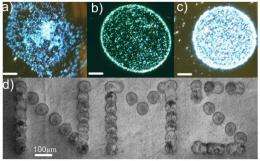
Dark field optical micrograph of inkjet printed drops on a) plasma cleaned, b) pristine and c) HMDS treated substrate. Scale: 20µm. d) SEM micrograph of printed pattern. Image from arXiv:1111.4970v1 [cond-mat.mtrl-sci]

(PhysOrg.com) -- A group of UK scientists has created a graphene ink that can be used to ink-jet print electronic devices such as thin film transistors.

Professor of Nanotechnology, Andrea Ferrari, and colleagues from the Engineering Department at the University of Cambridge have developed a method of creating a graphene ink that can be used with a modified ink-jet printer. Graphene consists of a of carbon only one atom thick, and has great advantages over polymer inks because of its greater and . Electronic components such as thin film transistors (TFTs) can already be created using ink-jet printing with ferro-electric polymer inks, but the performance of such components is poor and they are too slow for many applications.

Beginning with flakes of pure , the team exfoliated layers of graphene using exfoliation (LPE), which consists of sonication of the graphite in the presence of a solvent, N-Methylpyrrolidone (NMP). The graphene layers were ultracentrifuged and then filtered to remove any particles large enough (>1μm in diameter) to block the ink-jet printer heads. The graphene flakes were then used as the basis for a graphene-polymer ink, which was printed, using a modified ink-jet printer, onto Si/SiO2 substrates and the transparent substrate borosilicate glass. The final step in the process was annealing at high temperature to remove the solvent.

They demonstrated the new transparent graphene ink by using it to ink-jet print , which they made by printing the graphene ink on Si/SiO2 wafers. They used chromium-gold pads to define the source and drain contacts, and they then printed a layer of an organic polymer, PQT-12, on top.

The team achieved promising results at least comparable to current inks. They achieved mobilities of up to around 95cm2V−1s−1, about 80% transmittance and 30kohm sheet resistance. Non-graphene polymer inks typically achieve mobilities of less than 0.5cm2V−1s−1, while adding carbon nanotubes can increase this to around 50cm2V−1s−1.

The results should improve as the method is refined and enhanced. Their successful first demonstration paves the way for the development of flexible and cheap electronics that can be printed on a wide variety of substrates. Devices printed using graphene inks could include wearable computers, electrical paper, sensors, electronic tags, and flexible touch screens.

The paper is available online from arXiv.org.

More information: Ink-Jet Printed Graphene Electronics, arXiv:1111.4970v1 [cond-mat.mtrl-sci] http://arxiv.org/abs/1111.4970

Abstract
We demonstrate ink-jet printing as a viable method for large area fabrication of graphene devices. We produce a graphene-based ink by liquid phase exfoliation of graphite in N-Methylpyrrolidone. We use it to print thin-film transistors, with mobilities up to~95cm^2V^(-1)s(-1), as well as transparent and conductive patterns, with~80 % transmittance and~30kOhm/sq sheet resistance. This paves the way to all-printed, flexible and transparent graphene devices on arbitrary substrates.

© 2011 PhysOrg.com

4.8 /5 (15 votes)  

Filter


Move the slider to adjust rank threshold, so that you can hide some of the comments.


Display comments: newest first

rawa1
Nov 25, 2011

Rank: 1 / 5 (3)
The size and quality of graphene flakes must be very low, if they can pass the filter. It's rather graphite ink (i.e. chinese black ink) than graphene ink and it has nothing to do with graphene electronics, which is using carefully fabricated omnilayers.
Isaacsname
Nov 25, 2011

Rank: not rated yet
jeez man, did you read the paper ?, ..it's free. They describe the LPE process right on the 1st page.

http://arxiv.org/...70v1.pdf
antialias_physorg
Nov 25, 2011

Rank: 5 / 5 (2)
jeez man, did you read the paper ?, ..it's free.

You can't go around bothering people with facts.

That's un-american, that is.
TehDog
Nov 26, 2011

Rank: 5 / 5 (1)
I've been waiting for a development like this for a few years. Add this tech to 3-D printers. I can't even begin to imagine all the possibilities.
onesourcecomponents
Dec 17, 2011

Rank: not rated yet
This is what we have been waiting for. It opens up so many potentials for printing.
Callippo
Dec 17, 2011

Rank: 1 / 5 (1)
jeez man, did you read the paper ?, ..it's free
Yes and it doesn't counterargue my objection at least a bit. Graphene works just because it's monolayer of graphite. If you have many monolayers stacked without geometry control, it's just graphite ink without any particular electronic property. The line of pencil drawing has the same electronic properties. It's simply conductive ink. A number of such conductive inks exist based on metallic nanoparticles and they're working a way better because of their higher conductivity.
Rank 4.8 /5 (15 votes)
Relevant PhysicsForums posts
  • How to determine the flexural rigidity of a composite
    created2 hours ago
  • microstructure of titanium
    createdMay 26, 2012
  • Steam in My Espresso Machine
    createdMay 26, 2012
  • Density question
    createdMay 24, 2012
  • Mass transport originating from a point source at a solid gas interface
    createdMay 22, 2012
  • Ammonia dispersion in Air
    createdMay 22, 2012
  • More from Physics Forums - Materials & Chemical Engineering

More news stories

Stunning image of smallest possible five-ringed structure

Scientists have created and imaged the smallest possible five-ringed structure – about 100,000 times thinner than a human hair – and you'll probably recognise its shape.

Nanotechnology / Nanophysics

created 42 minutes ago | popularity 4.5 / 5 (2) | comments 0 | with audio podcast

'Unzipped' carbon nanotubes could help energize fuel cells, batteries

Multi-walled carbon nanotubes riddled with defects and impurities on the outside could replace some of the expensive platinum catalysts used in fuel cells and metal-air batteries, according to scientists at ...

Nanotechnology / Nanomaterials

created 6 hours ago | popularity 1 / 5 (1) | comments 0 | with audio podcast

Dopant gives graphene solar cells highest efficiency yet

(Phys.org) -- By taking advantage of graphene’s favorable electrical and optical properties, and then adding an organic dopant, researchers have achieved the highest power conversion efficiency yet for ...

Nanotechnology / Nanophysics

created May 21, 2012 | popularity 5 / 5 (10) | comments 14 | with audio podcast feature

In nanorod crystal growth, nanoparticles seen as artificial atoms

In the growth of crystals, do nanoparticles act as "artificial atoms" forming molecular-type building blocks that can assemble into complex structures? This is the contention of a major but controversial theory ...

Nanotechnology / Nanophysics

created May 24, 2012 | popularity 4.8 / 5 (6) | comments 0 | with audio podcast

First direct observation of oriented attachment in nanocrystal growth

Berkeley Lab researchers have reported the first direct observation of nanoparticles undergoing oriented attachment, the critical step in biomineralization and the growth of nanocrystals. A better understanding ...

Nanotechnology / Nanophysics

created May 24, 2012 | popularity 4.7 / 5 (3) | comments 0 | with audio podcast


Change in developmental timing was crucial in the evolutionary shift from dinosaurs to birds: study

At first glance, it's hard to see how a common house sparrow and a Tyrannosaurus Rex might have anything in common. After all, one is a bird that weighs less than an ounce, and the other is a dinosaur that ...

Computer model used to pinpoint prime materials for efficient carbon capture

When power plants begin capturing their carbon emissions to reduce greenhouse gases – and to most in the electric power industry, it's a question of when, not if – it will be an expensive undertaking.

T cells 'hunt' parasites like animal predators seek prey, study shows

By pairing an intimate knowledge of immune-system function with a deep understanding of statistical physics, a cross-disciplinary team at the University of Pennsylvania has arrived at a surprising finding: T cells use a movement ...

Land and sea species differ in climate change response: study

(Phys.org) -- Marine and terrestrial species will likely differ in their responses to climate warming, new research by Simon Fraser University and Australia’s University of Tasmania has found.

Yale study concludes public apathy over climate change unrelated to science literacy

Are members of the public divided about climate change because they don't understand the science behind it? If Americans knew more basic science and were more proficient in technical reasoning, would public consensus match ...

10 million years needed to recover from mass extinction

It took some 10 million years for Earth to recover from the greatest mass extinction of all time, latest research has revealed.