Glass sponges inspire: Hybrid material made of collagen fibers and silica as possible substrate for bone tissue culture
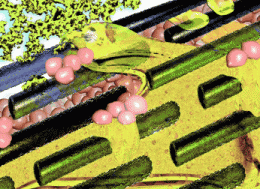
(PhysOrg.com) -- As well as organic structures, mineral structures also play an important role in living organisms. You dont even have to go as far as seashells or the artful silica scaffolds of diatoms; a glimpse into your own body will do. Our bones and teeth are made of the mineral hydroxyapatite. Scientists try to imitate the processes of biomineralization in order to better repair such things as bones and teeth. A team led by Franklin R. Tay at the Georgia Health Sciences University (USA) and Ji-hua Chen at the Fourth Military Medical University (China) has now introduced a new approach in the journal Angewandte Chemie: the biomineralization of a collagen/silica hybrid material.
Biomineralization is a very complicated process that is not so easy to mimic. The silicate precursors required for the synthesis of the cell walls of diatoms are in a stabilized form, which prevents their uncontrolled polymerization. Special proteins then control the polymerization to make the highly complex structures of the resulting scaffold. Researchers would also like to control biomineralization processes to repair damaged teeth or to make synthetic cartilage and bone tissue. In order to culture bones, scientists would like to seed osteoblasts (bone building cells) from the patients own body onto a substrate, where they would attach and multiply. This scaffolding would be implanted to help damaged bone, in cases of osteoporosis-induced or highly complicated fractures for example, to regenerate. Osteoblasts release collagen, calcium phosphate, and calcium carbonate as the basis for new bone material.
Collagen fibers would be an ideal substrate, but they are not solid enough for bone repair. The researchers once again turned to nature for inspiration: in glass sponges, a collagen matrix is one component of the silica scaffolding. Would it thus be possible to strengthen a collagen structure with silica (silicon dioxide)? Although many teams have previously failed in their attempts, the team led by Tay and Chen has now been successful.
They used collagen fibers as both a mold and a catalyst for the polymerization of the liquid phase of a silica precursor compound to make solid silica. The silica precursor is stabilized with choline to prevent an uncontrolled polymerization. This leaves enough time for the liquid precursor to fully infiltrate the space between the microfibrils of the collagen fibers before it polymerizes to form silicaone secret to the success of this new approach. After the polymerization the solid silica reflects the architecture determined by the collagen fibers. After drying, the original sponge-like, porous structure of the collagen fibers is maintained. In contrast to pure collagen, the scaffold of the hybrid compound is stable and could, the researchers hope, be used to repair bones.
More information: Franklin R. Tay, Infiltration of Silica Inside Fibrillar Collagen, Angewandte Chemie International Edition, http://dx.doi.org/ … ie.201105114
Journal reference:
Angewandte Chemie International Edition
Provided by
Wiley
-
From lemons to lemonade: Reaction uses carbon dioxide to make carbon-based semiconductor,
32 comments
-
Thioridazine kills cancer stem cells in human while avoiding toxic side-effects of conventional cancer treatments,
3 comments
-
SpaceX private rocket blasts off for space station (Update),
42 comments
-
Climate scientists say they have solved riddle of rising sea,
31 comments
-
SpaceX capsule has 'new car' smell, astronauts say (Update),
4 comments
-
Gibbs Free Energy Change/Entropy
9 hours ago
-
What's the rule to covalent character
10 hours ago
-
Schwartz reagent-- NMR/MS/IR
May 26, 2012
-
High school chemistry EEI
May 25, 2012
-
oxidation of I- by KMnO4
May 25, 2012
-
Inversion temp
May 25, 2012
- More from Physics Forums - Chemistry
More news stories
Computer model used to pinpoint prime materials for efficient carbon capture
When power plants begin capturing their carbon emissions to reduce greenhouse gases and to most in the electric power industry, it's a question of when, not if it will be an expensive undertaking.
2 hours ago |
not rated yet |
0
|
Scientists develop ultra-sensitive test that detects diseases in their earliest stages
Scientists have developed an ultra-sensitive test that should enable them to detect signs of a disease in its earliest stages, in research published today in the journal Nature Materials.
Chemistry / Analytical Chemistry
2 hours ago |
not rated yet |
0
|
New CO2-removing catalyst can take the heat
(Phys.org) -- The current method of removing the greenhouse gas carbon dioxide (CO2) from the flues of coal-fired power plants uses so much energy that no one bothers to use it. So says Roger Aines, principal ...
May 24, 2012 |
5 / 5 (9) |
10
|
High-speed method to aid search for solar energy storage catalysts
Eons ago, nature solved the problem of converting solar energy to fuels by inventing the process of photosynthesis.
May 25, 2012 |
5 / 5 (3) |
4
|
Researchers demonstrate possible primitive mechanism of chemical info self-replication
(Phys.org) -- When scientists think about the replication of information in chemistry, they usually have in mind something akin to what happens in living organisms when DNA gets copied: a double-stranded molecule ...
May 25, 2012 |
5 / 5 (4) |
2
|
Land and sea species differ in climate change response: study
(Phys.org) -- Marine and terrestrial species will likely differ in their responses to climate warming, new research by Simon Fraser University and Australia’s University of Tasmania has found.
Almost half of new vets seek disability
(AP) -- America's newest veterans are filing for disability benefits at a historic rate, claiming to be the most medically and mentally troubled generation of former troops the nation has ever seen.
'Unzipped' carbon nanotubes could help energize fuel cells, batteries
Multi-walled carbon nanotubes riddled with defects and impurities on the outside could replace some of the expensive platinum catalysts used in fuel cells and metal-air batteries, according to scientists at ...
T cells 'hunt' parasites like animal predators seek prey, study shows
By pairing an intimate knowledge of immune-system function with a deep understanding of statistical physics, a cross-disciplinary team at the University of Pennsylvania has arrived at a surprising finding: T cells use a movement ...
Change in developmental timing was crucial in the evolutionary shift from dinosaurs to birds: study
At first glance, it's hard to see how a common house sparrow and a Tyrannosaurus Rex might have anything in common. After all, one is a bird that weighs less than an ounce, and the other is a dinosaur that ...
Yale study concludes public apathy over climate change unrelated to science literacy
Are members of the public divided about climate change because they don't understand the science behind it? If Americans knew more basic science and were more proficient in technical reasoning, would public consensus match ...
Nov 14, 2011
Rank: not rated yet