Living cells say: Can you hear me now?
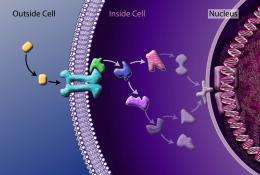
It has long been known that cells release chemical signals in response to outside conditions, triggering reactions inside the cell.
But it turns out that such communication is a two-way street: New research shows that cells’ signaling mechanisms can tell whether their signals are being received, and then adjust the volume of their messages as needed.
Cells use these chemical signaling systems to control many basic functions. For example, signaling can control how genes are turned on and off in response to external or internal cues, how cells grow and organize their internal structures, and even how and when cells trigger their own death, a process known as apoptosis.
The new finding could lead to new ways of finely controlling cells’ output of signal molecules, which could be useful for everything from synthetic biology to slowing the spread of cancer cells.
Researchers led by MIT’s Domitilla Del Vecchio, a Keck Career Development Associate Professor in Biomedical Engineering, first proposed three years ago that the signaling systems within cells might detect and respond to nearby receptors for their signals. Their new research now presents the first direct experimental evidence in support of this theory.
A paper on these results, which Del Vecchio and colleagues call “surprising” and “non-intuitive,” was published in October in the journal Science Signaling. In addition to Del Vecchio, the paper was co-authored by researchers at the University of Michigan, the University of Buenos Aires and Rutgers University.
Del Vecchio says the effect is similar to the way electrical or hydraulic systems interact with what is known as a load. For example, when you flush a toilet, the water pressure at a nearby faucet may drop because of the extra flow of water to refill the tank. Likewise, your lights may dim momentarily when a refrigerator motor kicks on, placing an extra burden on the household circuit.
Similarly, it turns out, when a cell is putting out signaling molecules in response to some variable stimulus, the time it takes to respond will change if there are “downstream targets” — that is, receptors within the cell that are receiving the signal. Because electrical and hydraulic systems are well understood, the comparison may help scientists figure out how to harness and apply the new knowledge about cell behavior.
These cell signaling systems are “building blocks used to transmit information from outside the cell, through the cell membrane, to the interior where processes occur to decide how the cell will react,” Del Vecchio says. This new finding, she says, gives scientists “another understanding of how real organisms parse the information coming from outside the membrane.”
This understanding might ultimately lead to new ways of controlling some disease processes. “A lot of recent papers talk about how cancer formation may be due to aberrant signaling,” Del Vecchio says. This finding may offer an example of a method that cells use to control which signals get transmitted and which ones don’t, which could help lead to new ways of deliberately manipulating these systems.
Del Vecchio says, “In principle, it gives us a way to tune the behavior of the system, which wasn’t known before. In addition, it gives us an idea of how we can build devices” to harness this mechanism.
Another possible application of such a system would be to engineer cells that can respond — perhaps by changing color — to certain disease-causing substances or toxins, thus producing very sensitive biologically based detectors.
“Signaling cascades are often portrayed as unidirectional,” says Stanislav Shvartsman, a professor of chemical and biological engineering at Princeton University who was not involved in this research. But, he adds, earlier work by Del Vecchio and colleagues “argued that this picture is far from truth, even in very simple cascades.” Now, in this new paper, he says they “provide a convincing proof of their earlier theory. The results of their beautifully designed and carefully executed experiments profoundly influence our understanding of signal transduction in cellular networks.”
This story is republished courtesy of MIT News (web.mit.edu/newsoffice/), a popular site that covers news about MIT research, innovation and teaching.
Provided by Massachusetts Institute of Technology


