Teeth study shows big dinosaurs trekked for food
October 26, 2011 By ALICIA CHANG , AP Science Writer

Teeth study shows big dinosaurs trekked for food (AP)

Enlarge

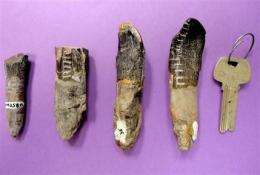
An undated photo released by Henry Fricke shows a sampling of dinosaur teeth from the Dinosaur National Monument in Utah. Scientists analyzing 32 teeth of plant-eating dinosaurs found that they migrated from the lowlands to highlands in search of food and water during the late Jurassic period. A new study suggests long-necked, plant-eating dinosaurs migrated hundreds of miles to find enough food for their gargantuan appetites. (AP Photo/ Henry Fricke,/Colorado College)

What did giant plant-munching dinosaurs do when they couldn't find enough to eat in the parched American West? They hit the road. An analysis of fossilized teeth adds further evidence that the long-necked dinosaurs called sauropods - the largest land creatures - went on road trips to fill their gargantuan appetites.

Scientists have long theorized that sauropods foraged for precious resources during because of their preserved tracks and long limbs that were "ideal moving machines" and allowed them to cover , said paleobiologist Matthew Bonnan of Western Illinois University.

The latest study is the best evidence yet that at least one kind of sauropod "took to the hills in search of food when times got tough in the lowlands," said paleontologist Kristi Curry Rogers at Macalester College in Minnesota.

The new work, published online Wednesday by the , was led by geologist Henry Fricke of Colorado College.

The researchers analyzed 32 sauropod teeth collected in Wyoming and Utah. The teeth came from massive plant-eaters that roamed a semi-arid basin in the American West during the late about 150 million years ago.

The largest sauropods weighed 100 tons and were 120 feet long. The type in the study was smaller - about 60 feet in length and weighing 25 tons.

Scientists can get a glimpse into the source of the dinosaurs' drinking water by comparing the oxygen preserved in the to that found in ancient sediment.

A chemical analysis showed differences in the teeth and the basin where the dinosaurs were buried, meaning they must have wandered hundreds of miles from the flood plains to the highlands for food and water.

Fricke said the movement appeared to be tied to changing seasons. Sauropods left the basin in the summer for higher elevations - a trek that took about five months - and returned in the winter.

In lush times, sauropods would have feasted on a diversity of plants including ferns, horsetails, conifers and moss, said John Foster, a curator at the Museum of Western Colorado, who had no part in the research.

More information: Journal: http:// www.nature.com/nature, DOI: 10.1038/nature10570

©2011 The Associated Press. All rights reserved. This material may not be published, broadcast, rewritten or redistributed.


Rank 5 /5 (2 votes)
Relevant PhysicsForums posts

More news stories

Change in developmental timing was crucial in the evolutionary shift from dinosaurs to birds: study

At first glance, it's hard to see how a common house sparrow and a Tyrannosaurus Rex might have anything in common. After all, one is a bird that weighs less than an ounce, and the other is a dinosaur that ...

Other Sciences / Archaeology & Fossils

created 1 hour ago | popularity 5 / 5 (2) | comments 0 | with audio podcast

Social welfare cuts ultimately come with heavy price, researchers say

(Phys.org) -- Slashing government funding for Medicaid, food stamps and other programs that serve the poor – while politically popular with some lawmakers and many conservatives – may do more harm ...

Other Sciences / Social Sciences

created May 24, 2012 | popularity 4.3 / 5 (16) | comments 151

Ancient Bethlehem seal unearthed in Jerusalem

Israeli archaeologists have discovered a 2,700-year-old seal that bears the inscription "Bethlehem," the Israel Antiquities Authority announced Wednesday, in what experts believe to be the oldest artifact ...

Other Sciences / Archaeology & Fossils

created May 23, 2012 | popularity 3.5 / 5 (14) | comments 23

Oldest Jewish archaeological evidence on the Iberian Peninsula

German archaeologists of the Friedrich Schiller University Jena found one of the oldest archaeological evidence so far of Jewish Culture on the Iberian Peninsula at an excavation site in the south of Portugal, ...

Other Sciences / Archaeology & Fossils

created May 25, 2012 | popularity 4.4 / 5 (5) | comments 12

Dollars and sense: Why are some people morally against tax?

As the U.S. presidential election campaigns heat up, the economic debate is dominated by bailouts, austerity and, inevitably, taxation. Now a new study published in Symbolic Interaction asks why tax is such an important issue ...

Other Sciences / Social Sciences

created May 23, 2012 | popularity 3 / 5 (2) | comments 12


'Unzipped' carbon nanotubes could help energize fuel cells, batteries

Multi-walled carbon nanotubes riddled with defects and impurities on the outside could replace some of the expensive platinum catalysts used in fuel cells and metal-air batteries, according to scientists at ...

T cells 'hunt' parasites like animal predators seek prey, study shows

By pairing an intimate knowledge of immune-system function with a deep understanding of statistical physics, a cross-disciplinary team at the University of Pennsylvania has arrived at a surprising finding: T cells use a movement ...

Computer model used to pinpoint prime materials for efficient carbon capture

When power plants begin capturing their carbon emissions to reduce greenhouse gases – and to most in the electric power industry, it's a question of when, not if – it will be an expensive undertaking.

Yale study concludes public apathy over climate change unrelated to science literacy

Are members of the public divided about climate change because they don't understand the science behind it? If Americans knew more basic science and were more proficient in technical reasoning, would public consensus match ...

Same gene that stunts infants' growth also makes them grow too big: research

UCLA geneticists have identified the mutation responsible for IMAGe* syndrome, a rare disorder that stunts infants' growth. The twist? The mutation occurs on the same gene that causes Beckwith-Wiedemann syndrome, which makes ...

Scientists develop ultra-sensitive test that detects diseases in their earliest stages

Scientists have developed an ultra-sensitive test that should enable them to detect signs of a disease in its earliest stages, in research published today in the journal Nature Materials.