The hazy history of Titan's air
October 13, 2011 by Shaun McCormack

The hazy history of Titan's air

Enlarge

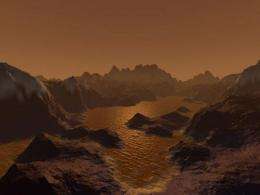
Artist concept of a hydrocarbon lake on Titan. Image credit: NASA

What rocky moon has a nitrogen-rich atmosphere, Earth-like weather patterns and geology, liquid hydrocarbon seas and a relatively good chance to support life? The answer is Titan, the fascinating moon of Saturn.

Titan's many similarities to Earth is why astrobiologists are so fascinated by this unusual . Its is often viewed as an analog to what the Earth's atmosphere may have been like billions of years ago. Despite the 800 million miles between the two worlds, both may have had their atmospheres created through the gravitational layering and processing of asteroids and comets.

"Titan provides an extraordinary environment to better understand some of the that led to the appearance of ,” says Josep M. Trigo-Rodriguez, of the Institute of Space Sciences (CSIC-IEEC) in Barcelona, Spain. “Titan’s atmosphere is a natural laboratory that, in many aspects, seems to have a strong similitude with our current picture of the pre-biotic atmosphere of Earth."

This is remarkable, because it was thought that Earth and Titan were made from a vastly different recipe of materials in drastically different temperatures, he says.

The research paper, "Clues on the importance of comets in the origin and evolution of the atmospheres of Titan," by Trigo-Rodriguez and F. Javier Martin-Torres (Center for Astrobiology, Madrid, Spain), recently published in the journal Planetary and Space Science, offers insight into the atmospheric affinities of Earth and Titan.

Building an Atmosphere From Scratch

Earth presumably formed from scorched, oxygen-poor rocks (planetesimals) located in the inner solar system, while Titan formed from rocks that were rich in oxygen and other volatile chemicals (cometesimals) in the outer solar system. Trigo-Rodriguez and Martin-Torres believe the vital organic ingredients in the early Earth's atmosphere were vaporized and swept away by solar winds. The ingredients for the air we breathe today returned about 4 billion years ago, during a cataclysmic rock storm known as the Late Heavy Bombardment (LHB). During this period, oxygen- and volatile-rich materials from the outer solar system were hurled en masse towards the inner .

Chris McKay, a planetary scientist at NASA's Ames Research Center, says comets may have made small contributions to the water, carbon dioxide, and nitrogen content of the Earth's early atmosphere, "but they were not the main source." This is known because the Deuterium/Hydrogen ratios of our oceans do not match the ratios found in comets. He says asteroids hurled our way during the LHB could be the main source of water on Earth.

The hazy history of Titan's air
Enlarge

NASA's Cassini spacecraft snapped this shot of sunlight reflecting off a lake on Titan. Image credit: NASA

Trigo-Rodriguez says he and McKay are basically on the same page. "We think that asteroids and comets were key sources for water and organics,” says Trigo-Rodriguez. Four billion years ago, some asteroids contained so much ice that they would have brought just as much water to our planet as comets did.

Trigo-Rodriguez and Martin Torres studied how hydrogen, carbon, nitrogen and oxygen isotopes reacted with their environments on Earth and Titan. They looked at data recorded by the Cassini-Huygens probe to better understand the isotopic ratios in Titan's dense, hazy atmosphere.

Different distances from the Sun, different sizes and different environmental conditions led to different chemical evolutions on the two worlds. Even so, both Earth and Titan were hit by similar water-rich bodies, which provided a volatile-rich source for both atmospheres during the late-heavy bombardment.

Outgassing and collisional processing on both worlds led to the production of molecular nitrogen-dominated atmospheres with similar isotopic ratios of hydrogen, carbon, and oxygen.

Life’s Origin and Other Questions

"We see Titan as a natural oasis of remarkable astrobiological significance to understand the environment in which origin of life took place on Earth," Trigo-Rodriguez says. "It seems that a plausible scenario to build life consists of a dense atmosphere, where small particles like organic haze and meteoric metals could act as catalysts for the formation of more complex organic compounds from simple precursors such as carbon monoxide and methane, thus promoting increasing complexity."

In fact, a 2007 experiment by chemistry professor Margaret Tolbert and graduate student Melissa Trainer at the University of Colorado in Boulder showed early Earth's atmosphere would have had the same organic haze that encourages formation of complex organic molecules on Titan.

Scientists are still wondering how Titan is able to maintain all of its atmospheric methane. According to McKay, "Earth's atmosphere is composed of compounds that persist over billions of years. However on Titan, all of the methane should have been destroyed by sunlight on a timescale of about 30 million years. There must be a source of methane re-supply."

The methane in the atmosphere may come mainly from Titan’s lakes of liquid hydrocarbon. But to really understand what is re-supplying the methane, Martin-Torres would like to see another probe sent to the moon’s surface. (The Cassini mission sent the Huygens probe to in January 2005, but the probe had limited instruments and could only transmit data from the surface for 90 minutes before the battery power ran out).

"We need a surface exploration with a lander-style mission,” says Martin-Torres. “We're still missing the most important data.” A ground probe could examine the composition of Titan's surface, the nature of its low-temperature chemistry, and search for signs of life.

Source: Astrobio.net search and more info website

4.9 /5 (8 votes)  

Filter


Move the slider to adjust rank threshold, so that you can hide some of the comments.


Display comments: newest first

kevinrtrs
Oct 13, 2011

Rank: 1.1 / 5 (33)
to better understand some of the chemical processes that led to the appearance of life on Earth
There is absolutely zero support for the assumption that life arose from purely chemical processes without outside intervention by some intelligent being. Right now most if not all credible scientists would acknowledge this fact. So the author needs to take a slight detour and state that it's his BELIEF that life arose in that fashion.
. Four billion years ago, some asteroids contained so much ice that they would have brought just as much water to our planet as comets did.
Where exactly did the author get this "fact" from since it's not documented anywhere? No one was there to record it for posterity. This is sheer speculation and needs to be treated as such. It also means that anything else that depends on the validity of it should be taken with a big dose of salt.
Currently scientist have no clue as to how the solar system came into being - they can only GUESS.
kevinrtrs
Oct 13, 2011

Rank: 1 / 5 (28)
However on Titan, all of the methane should have been destroyed by sunlight on a timescale of about 30 million years. There must be a source of methane re-supply.

So the jury is still out on this little conundrum. If some kind of mission ever gets to Titan and firmly establishes that no such source exists the scientists will have to invoke miracles to account for billions of years of existence. They do not even begin to countenance the possibility that maybe Titan is young, certainly far less than even 30 million years old. Think 10 000 years or less.
Goresh
Oct 13, 2011

Rank: 5 / 5 (14)
Think 10 000 years or less.


Sigh.

How do you explain being able to see stars more than 20,000 light years away?
barakn
Oct 13, 2011

Rank: 4.6 / 5 (16)
You must be new here. Kevin won't answer your question. He's not here for reasoned debate, he's here to instill doubt in the few readers that are not intelligent enough to see the sheer idiocy of his statements.
Anda
Oct 13, 2011

Rank: 5 / 5 (5)
Still here Kevin? ...
askantik
Oct 13, 2011

Rank: 5 / 5 (10)
I'm guessing Kevin hasn't heard of the Miller-Urey experiment, where amino acids formed from common compounds with only a little electricity... and this experiment has been repeated multiple times with the same result.
Nanobanano
Oct 13, 2011

Rank: 1.4 / 5 (12)
Think 10 000 years or less.


Sigh.

How do you explain being able to see stars more than 20,000 light years away?


From the photon's point of view, it got here instantaneously, even within the standard model.

When v equals c, delta t equals zero.

From the photon's point of view, it doesn't cross space at all, because the distance is actually zero due to length contraction.

Another way of seeing it is that from the photon's point of view, it "teleports" from it's point of creation to it's destination.

----

Askantik:

Amino acids are a very long way from a cell, nevermind a multi-cellular life form.

Even an entire DNA sequence is a very long way from a cell.

You can take your entire Genome and put it in a nutrient bath of water and every element and trace element of life and it will do next to nothing, and just die and break down on the spot.
Nanobanano
Oct 13, 2011

Rank: 1.4 / 5 (11)
Why?

Because without the machinery of the cell, the DNA is useless. Much like a computer program is useless without a computer, and moreover the program won't even run exactly right if it's on the wrong type of machine or wrong operating system.

Life systems work with other systems which they are specifically designed to work with.

Genetic engineering typically involves splicing one or two new genes into an organism, which is also very, very different from some random pile of goo allegedly spontaneously becoming a higher life form just because of "add enough time".
bewertow
Oct 13, 2011

Rank: 4.2 / 5 (5)
There is absolutely zero support for the assumption that life arose from purely chemical processes without outside intervention by some intelligent being. Right now most if not all credible scientists would acknowledge this fact. So the author needs to take a slight detour and state that it's his BELIEF that life arose in that fashion.


Credible scientists don't believe in god(s) and other crazy fairy tales. Faith is contrary to the scientific method.
ppnlppnl
Oct 13, 2011

Rank: 4.3 / 5 (3)

From the photon's point of view, it got here instantaneously, even within the standard model.

When v equals c, delta t equals zero.


Delta t is only zero for the photon. The rest of the universe still ages many tens of thousands of years. Tens of thousands of years that creationists do not believe existed.

If you freeze me to send me to the stars it would seem to me that I simply teleported since no time would pass for me. Everyone I knew would still be dead of old age.
ACW
Oct 13, 2011

Rank: 4.3 / 5 (6)
Scientists make estimates based upon empirical and rational deductions which are much more credible than the hocus-pocus theory of creation.
flicktheswitch
Oct 13, 2011

Rank: 5 / 5 (6)
The greatest failing of Kevinrtrs and his idiot brethren is the inability to describe, theorise or discuss in any way whatsoever the process aspect of creation vs the 'result'.

They take the resultant of life existing as evidence of some sort of God, but are completely ignore the process. Or proving/disproving aspects of it.

If science tried to do the same thing we'd be laughed out of a job.

Imagine saying the sun exists and is yellow therefore it must be the remaining end of a giant cosmic banana. How did it become that way? Oh can't discuss that sorry. It's ineffable. But that fact that it exists is enough evidence to 'prove' the theory.

If Science makes an assertion about something we don't get the luxury of also using it's existence as proof. We have to provide evidence and some theory of the process that made it that way which is then modeled and tested.

So come on Kevin. Let's see it: Mechanics of the process of creation by a God. Go.
Hint: No magic wands allowed.
LivaN
Oct 14, 2011

Rank: 4.7 / 5 (3)
How do you explain being able to see stars more than 20,000 light years away?
From the photon's point of view, it got here instantaneously, even within the standard model.
How is that relevant to the question?

Amino acids are a very long way from a cell, nevermind a multi-cellular life form.
Yet not so far away from basic RNA molecules that are capable of replication with modification.

some random pile of goo allegedly spontaneously becoming a higher life form just because of "add enough time".
Add as much time as you want and you will never go spontaneously from A to Z. Luckily, it is possible to go from A to Z non-spontaneously, via all the in-betweens.
Daleg
Oct 16, 2011

Rank: 4 / 5 (4)
As A creationist with scientific knowledge and pure enjoyment of the 13.7 billion year history of the Universe and what our human studies thereof have revealed, I take quite a bit of exception to your nonsense about God and fairy tales. There simply is no need to ascribe to God every single detail of the physical process that describes the functioning of the Universe. Even life could and I stress only could be an emergent phenomenon of the laws of physics as prescribed for the functioning of this reality we call our Universe. Unless or until someone somewhere actually "proves" beyond any doubt how life actually did arise, that will of course as with any other unknown, remain a mystery. I believe that this study of Titan's atmosphere should reveal quite a bit about the process, and that any knowledge we acquire from this is all to the good, and well worth the effort. It is a real shame when "some" let antagonism between science and religion degrade their civility into arrogance.
Daleg
Oct 16, 2011

Rank: 3 / 5 (2)
As for going anywhere spontanously or otherwise, we material beings cannot acquire infinite energy so will never be able to travel at light speed. As ppnlppnl pointed out even if you could, so what! Everybody and everything else around you would age at the normal rate, so it would be a cold comfort to accomplish a feat which would simply cut you off from the rest of humanity and reality.
kaasinees
Oct 16, 2011

Rank: 5 / 5 (2)
Ah i remember talking about Titan in a thread about Mars. Titan is where we need to explore more than Mars. Why did i get down-rated for that one, and now they are talking about here.
Callippo
Oct 16, 2011

Rank: not rated yet
The problem with Titan is, it's extremely cold - so that the speed of every possible evolution (even if it could emerge there) would be incredibly slow. And I don't believe, that the complexity of chemical reactions of carbon at the temperature -200deg could even allow the spontaneous formation of living structures. It doesn't mean, we shouldn't look at it from proximity, but I'm extremely skeptical, we could find some living forms there in any thinkable form.
Bonkers
Oct 17, 2011

Rank: 1 / 5 (1)
Titan, bloody cold, yes. However, look at life on Earth, it seems to have occurred pretty much at the moment conditions were suitable (i.e. cooler than lava). Not only that, but seems also to have crept into every environment from the very cold to the very hot. There is also some controversy over "goo" which seems to be below the currently accepted dawn of cellular life, though this might be a red herring. Point is, I would not be surprised if life of some sort is present on Titan. :-) maybe God put it there.
Rank 4.9 /5 (8 votes)
Relevant PhysicsForums posts
  • Distance of planets from stars and revolution
    created4 hours ago
  • revamping general concept and cosmological principle
    createdMay 25, 2012
  • Transiting Exoplanet Light Curve
    createdMay 25, 2012
  • Math behind Theoretical Physics
    createdMay 24, 2012
  • Do we know whats at the center of galaxies yet?
    createdMay 23, 2012
  • Structure of the Milky Way?
    createdMay 20, 2012
  • More from Physics Forums - General Astronomy

More news stories

Land and sea species differ in climate change response: study

(Phys.org) -- Marine and terrestrial species will likely differ in their responses to climate warming, new research by Simon Fraser University and Australia’s University of Tasmania has found.

Space & Earth / Environment

created 2 hours ago | popularity not rated yet | comments 1 | with audio podcast

Yale study concludes public apathy over climate change unrelated to science literacy

Are members of the public divided about climate change because they don't understand the science behind it? If Americans knew more basic science and were more proficient in technical reasoning, would public consensus match ...

Space & Earth / Environment

created 4 hours ago | popularity 4 / 5 (1) | comments 10 | with audio podcast

10 million years needed to recover from mass extinction

It took some 10 million years for Earth to recover from the greatest mass extinction of all time, latest research has revealed.

Space & Earth / Earth Sciences

created 4 hours ago | popularity not rated yet | comments 1 | with audio podcast

Sophisticated simulations predict future warming

The chances of our planet being hit by a global warming of 3 degrees Celsius by 2050 is as likely as it being hit by an increase of 1.4 degrees, new research shows. Presented in the journal Nature Geoscience, the British study ...

Space & Earth / Earth Sciences

created May 22, 2012 | popularity 4.4 / 5 (9) | comments 51

Aliens don't want to eat us, says former SETI director

Alien life probably isn’t interested in having us for dinner, enslaving us or laying eggs in our bellies, according to a recent statement by former SETI director Jill Tarter.

Space & Earth / Space Exploration

created May 25, 2012 | popularity 4.4 / 5 (14) | comments 40


'Unzipped' carbon nanotubes could help energize fuel cells, batteries

Multi-walled carbon nanotubes riddled with defects and impurities on the outside could replace some of the expensive platinum catalysts used in fuel cells and metal-air batteries, according to scientists at ...

T cells 'hunt' parasites like animal predators seek prey, study shows

By pairing an intimate knowledge of immune-system function with a deep understanding of statistical physics, a cross-disciplinary team at the University of Pennsylvania has arrived at a surprising finding: T cells use a movement ...

Computer model used to pinpoint prime materials for efficient carbon capture

When power plants begin capturing their carbon emissions to reduce greenhouse gases – and to most in the electric power industry, it's a question of when, not if – it will be an expensive undertaking.

Change in developmental timing was crucial in the evolutionary shift from dinosaurs to birds: study

At first glance, it's hard to see how a common house sparrow and a Tyrannosaurus Rex might have anything in common. After all, one is a bird that weighs less than an ounce, and the other is a dinosaur that ...

Nvidia trumpets Tegra 3 phone design wins for 2012

(Phys.org) -- Nvidia’s competitive war paint has a name, Tegra 3. On the heels of Nvidia announcements about lowering costs of its Tegra 3 processors and Nvidia-enabled tablets running Android Ice Cream ...

Scientist: Evolution debate will soon be history

(AP) -- Richard Leakey predicts skepticism over evolution will soon be history. Not that the avowed atheist has any doubts himself.