Self-cleaning cotton breaks down pesticides, bacteria
Sep 28, 2011
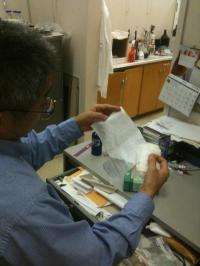
UC Davis Professor Gang Sun inspects a sample of his self-cleaning cotton. The fabric is chemically treated to remove stains and contaminants when exposed to light. Credit: Andy Fell/UC Davis

(PhysOrg.com) -- UC Davis scientists have developed a self-cleaning cotton fabric that can kill bacteria and break down toxic chemicals such as pesticide residues when exposed to light.

“The new fabric has potential applications in biological and chemical protective clothing for health care, food processing and farmworkers, as well as military personnel,” said Ning Liu, who conducted the work as a doctoral student in Professor Gang Sun’s group in the UC Davis Division of Textiles of Clothing.

A paper describing the work was published Sept. 1 in the Journal of Materials Chemistry.

Liu developed a method to incorporate a compound known as 2-anthraquinone carboxylic acid, or 2-AQC, into fabrics. This chemical bonds strongly to the cellulose in cotton, making it difficult to wash off, unlike current self-cleaning agents. Unlike some other experimental agents that have been applied to cotton, it does not affect the properties of the fabric.

When exposed to light, 2-AQC produces so-called reactive oxygen species, such as hydroxyl radicals and hydrogen peroxide, which kill and break down organic compounds such as pesticides and other toxins.

Although 2-AQC is more expensive than other compounds, the researchers say that cheaper equivalents are available.

Explore further: Unique method creates correct mirror image of molecule

Related Stories

Cotton's potential for padding nonwovens

Sep 09, 2011

U.S. Department of Agriculture (USDA) scientists have conducted studies to investigate the use of virgin cotton in nonwoven materials and products. The work was led by cotton technologist Paul Sawhney and his colleagues at ...

Killer Kevlar -- clothing that shields from germs

Jul 21, 2008

Protective clothing worn by firemen and other emergency workers may soon get a germ-fighting upgrade. Researchers in South Dakota report progress toward the first Kevlar fabrics that can kill a wide range ...

Recommended for you

Unique method creates correct mirror image of molecule

20 hours ago

Many molecules have a right and a left form, just like shoes. In pharmaceuticals, it is important that the correct form of the molecule is used. Researchers at the University of Gothenburg, Sweden, have been ...

New method for producing clean hydrogen

May 21, 2013

Duke University engineers have developed a novel method for producing clean hydrogen, which could prove essential to weaning society off of fossil fuels and their environmental implications.

Non-wetting fabric drains sweat

May 20, 2013

(Phys.org) —Waterproof fabrics that whisk away sweat could be the latest application of microfluidic technology developed by bioengineers at the University of California, Davis.

Beautiful 'flowers' self-assemble in a beaker

May 16, 2013

By simply manipulating chemical gradients in a beaker of fluid, materials scientists at Harvard have found that they can control the growth behavior of crystals to create precisely tailored structures—such ...

User comments : 0

More news stories

DNA damage: The dark side of respiration

(Phys.org) —Adventitious changes in cellular DNA can endanger the whole organism, as they may lead to life-threatening illnesses like cancer. Researchers at LMU now report how byproducts of respiration cause mispairing ...

Scientists announce Top 10 New Species from 2012

An amazing glow-in-the-dark cockroach, a harp-shaped carnivorous sponge and the smallest vertebrate on Earth are just three of the newly discovered top 10 species selected by the International Institute for ...