NASA satellite rainmap shows extent of Tropical Storm Lee's heavy rainfall
September 9, 2011

NASA satellite rainmap shows extent of Tropical Storm Lee's heavy rainfall

Enlarge

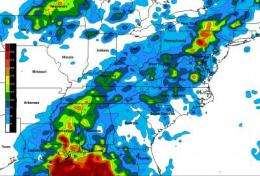
Map created from NASA's TRMM satellite shows rainfall from tropical storm Lee. Rainfall from the northern Gulf of Mexico across eastern La., Miss., northwestern Ala., and central Tenn. generally exceed 100 mm (~4 inches, shown in dark green) with some parts of Miss. and La. receiving upwards of 250 mm (~10 inches, shown in dark red). Totals of 125 mm (~5 inches, shown in bright green) to as much as 200 to 250 mm (~8 to 10 inches, shown in orange and red) extend from south central Pennsylvania. Elsewhere in the mid-Atlantic, rainfall ranged from 100 to 150 mm (~4 to 6 inches). Credit: SSAI/NASA, Hal Pierce

NASA has a rain gauge flying in space called TRMM, and data from that satellite has been used to create a map of the massive rainfall generated by landfalling Tropical Storm Lee.

After forming in the north central Gulf of Mexico, Lee came ashore over south central Louisiana on the morning of Sunday September 4th, 2011. Over the next two and a half days, the slow-moving storm worked its way across central Louisiana and central Mississippi and into northern Alabama, dumping heavy rains along the way. Tropical Storm Lee joined a frontal system to soak the eastern U.S.

The primary mission of the Measuring Mission or TRMM satellite is to measure rainfall over the global Tropics using a combination of passive microwave and active radar sensors. TRMM is a joint mission between NASA and the JAXA. For expanded coverage, TRMM can be used to calibrate rainfall estimates from other satellites. Rainfall estimates from the TRMM-based, near-real time Multi-satellite Precipitation Analysis (TMPA) at the NASA Goddard Space Flight Center in Greenbelt, Md. are shown here for the period August 31 to September 8, 2011 for the eastern half of the U.S.

TMPA shows heavy rains extending inland from the northern Gulf of Mexico across eastern Louisiana, Mississippi, northwestern Alabama, and into central Tennessee. Rainfall totals in this region generally exceed 100 mm (~4 inches) with some parts of Mississippi and Louisiana receiving upwards of 250 mm (~10 inches) Chattanooga, Tennessee broke their all time 24-hour rainfall total with 9.69 inches.

After coming ashore, Tropical Storm Lee began to merge with a slowing-moving frontal system advancing eastward out of the Mississippi valley. This frontal system was associated with a quasi-stationary upper-level low pressure center located over the Ohio valley. As a result, tropical moisture was drawn up the eastern seaboard, bringing heavy rains from the mid-Atlantic up into the northern Appalachians.

TMPA rainfall totals of 125 mm (~5 inches, shown in bright green) to as much as 200 to 250 mm (~8 to 10 inches, shown in orange and red) extend from south central Pennsylvania up into central New York, where the Susquehanna River reached record flood levels in downtown Binghamton. Elsewhere across the mid-Atlantic, where pockets of rain exceed anywhere from 100 to 150 mm (~4 to 6 inches), numerous roads and streets were closed due to widespread localized flooding.

On Sept. 9, 2011 at 5 a.m. EDT, heavy rains associated with Lee's remnants are slowly coming to an end across the Mid-Atlantic. The large-scale extra-tropical low pressure area that absorbed Lee's moisture and energy was centered over Indiana and will continue weakening. Meanwhile, The National Weather Service's Hydrometeorological Prediction Center (HPC) expects "tropical moisture to continue streaming up from the Atlantic Ocean leading to the potential for another round of across the region."

NASA satellite rainmap shows extent of Tropical Storm Lee's heavy rainfall
Enlarge

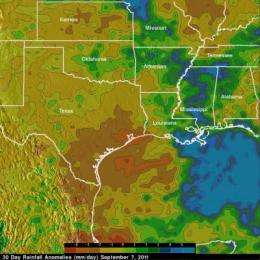
The TMPA rainfall analysis showed a stark contrast between Lee's rains and the drought to the west. Anomalies for the one-month period Aug. 7 to Sept. 7, 2011 (areas in green) to well-above normal rain (areas in blue) along and east of the Mississippi due to the passage of Lee, while nearly all of Texas and most of Kansas are either below (yellow areas) or well-below normal (brown areas). Credit: SSAI/NASA, Hal Pierce

For updated rain totals from Tropical Storm Lee, visit the HPC's webpage: http://www.nhc.noaa.gov/text/refresh/MIAHPCAT3+shtml/090857.shtml .

While much of the nation east of the Mississippi received too much rain, there was no relief for Texas and parts of the Central Plains, which remain locked in a drought. TRMM satellite data is also helpful in determining areas of drought.

At NASA Goddard, TMPA rainfall anomalies were created for the one-month period from August 7 to September 7, 2011 that showed a stark contrast between the drought-stricken, well-below normal areas (nearly all of Texas and most of Kansas) and those with well-above normal rain along and east of the Mississippi due to the passage of Lee. The anomalies were constructed by computing the average rate over the period and then subtracting the 10-year average rate for the same period.

Those drought-stricken areas are hoping that Tropical Storm Nate, currently in the southwestern Gulf of Mexico will bring them some wet relief.

Provided by NASA's Goddard Space Flight Center search and more info website


Rank not rated yet
Relevant PhysicsForums posts

More news stories

Land and sea species differ in climate change response: study

(Phys.org) -- Marine and terrestrial species will likely differ in their responses to climate warming, new research by Simon Fraser University and Australia’s University of Tasmania has found.

Space & Earth / Environment

created 25 minutes ago | popularity not rated yet | comments 1 | with audio podcast

Yale study concludes public apathy over climate change unrelated to science literacy

Are members of the public divided about climate change because they don't understand the science behind it? If Americans knew more basic science and were more proficient in technical reasoning, would public consensus match ...

Space & Earth / Environment

created 2 hours ago | popularity not rated yet | comments 10 | with audio podcast

10 million years needed to recover from mass extinction

It took some 10 million years for Earth to recover from the greatest mass extinction of all time, latest research has revealed.

Space & Earth / Earth Sciences

created 2 hours ago | popularity not rated yet | comments 1 | with audio podcast

Sophisticated simulations predict future warming

The chances of our planet being hit by a global warming of 3 degrees Celsius by 2050 is as likely as it being hit by an increase of 1.4 degrees, new research shows. Presented in the journal Nature Geoscience, the British study ...

Space & Earth / Earth Sciences

created May 22, 2012 | popularity 4.4 / 5 (9) | comments 51

Aliens don't want to eat us, says former SETI director

Alien life probably isn’t interested in having us for dinner, enslaving us or laying eggs in our bellies, according to a recent statement by former SETI director Jill Tarter.

Space & Earth / Space Exploration

created May 25, 2012 | popularity 4.4 / 5 (14) | comments 39


Almost half of new vets seek disability

(AP) -- America's newest veterans are filing for disability benefits at a historic rate, claiming to be the most medically and mentally troubled generation of former troops the nation has ever seen.

'Unzipped' carbon nanotubes could help energize fuel cells, batteries

Multi-walled carbon nanotubes riddled with defects and impurities on the outside could replace some of the expensive platinum catalysts used in fuel cells and metal-air batteries, according to scientists at ...

T cells 'hunt' parasites like animal predators seek prey, study shows

By pairing an intimate knowledge of immune-system function with a deep understanding of statistical physics, a cross-disciplinary team at the University of Pennsylvania has arrived at a surprising finding: T cells use a movement ...

Computer model used to pinpoint prime materials for efficient carbon capture

When power plants begin capturing their carbon emissions to reduce greenhouse gases – and to most in the electric power industry, it's a question of when, not if – it will be an expensive undertaking.

Change in developmental timing was crucial in the evolutionary shift from dinosaurs to birds: study

At first glance, it's hard to see how a common house sparrow and a Tyrannosaurus Rex might have anything in common. After all, one is a bird that weighs less than an ounce, and the other is a dinosaur that ...

Same gene that stunts infants' growth also makes them grow too big: research

UCLA geneticists have identified the mutation responsible for IMAGe* syndrome, a rare disorder that stunts infants' growth. The twist? The mutation occurs on the same gene that causes Beckwith-Wiedemann syndrome, which makes ...