Mobile shopping: More buzz than buy so far
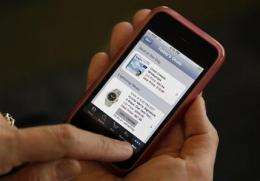
When it comes to mobile shopping, so far there's more buzz than buy.
As the number of people who use iPhones and other smartphones grows, companies selling everything from hardware to high fashion are touting all the new applications they're rolling out that enable shoppers to do anything from check a store's inventory while in the dressing room to order prescriptions.
Retailers are betting that selling their wares on a device that people carry around all day can encourage Americans to spend money during an economic downturn in which they're making fewer impulse buys in their bricks-and-mortar stores. But so far, consumers mostly are using their phones to look up locations and compare prices and stopping short of tapping the "buy" button. Why? In part because they find it hard to shop on the tiny screens and they don't quite think it's safe to input their credit card information into their phone.
To be sure, mobile purchases are growing faster than online sales, which are increasing at around 10 percent a year. But mobile commerce is expected to account for $6 billion, or just 2 percent of overall e-commerce sales this year, according to Forrester Research. By 2016, that figure could rise to $31 billion -- still a sliver of electronic sales.
"The transactions aren't anywhere close to a big number," says Siva Kumar, whose company, TheFind, offers mobile price-checking applications. "But the first stage of any revolution is that people start using the new tool."
The use of smartphones is indeed growing. There are 82 million smartphones in circulation today in the U.S. - one in every three people 13 and older owns one - and that figure is expected to double by 2015. And smartphone users are increasingly using mobile applications: The average user spends 81 minutes a day using mobile apps, more time than is spent Web browsing on a computer or other device, according to mobile analytics firm Flurry.
But smartphone users are spending most of their time playing games, checking social networks, taking video, accessing maps and getting sports scores, according to digital research firm comScore. Shopping, meanwhile, ranks at No. 13, with less than 7 percent of mobile users accessing online retail stores through their phones.
Retailers are partly to blame for shoppers' apathy. Less than a third of retailers polled by the National Retail Federation in May said they have a fully implemented mobile strategy, which might include an application available for download by iPhone, Droid and Blackberry users. It's far less pleasurable to hunt down a new pair of boots when it requires zooming in and out of a site that's not oriented to the mobile screen, shoppers say.
For instance, Sara Margulis, who runs an online wedding gift registry in Sonoma County, Calif., uses her iPhone to buy books and diapers on Amazon, but sticks to her home computer for the majority of her electronic purchases in part because she likes the larger screen.
"If I know what I want, and it's on Amazon, I'll do it on my phone," she says. "But not if it requires a lot of research."
Another big impediment is the payment process. Typing billing information into a phone can be tedious and time-consuming, and many shoppers aren't convinced that mobile sites are safe. In one Forrester poll, 44 percent of shoppers said they would use the mobile Web to make purchases if the payment services were more secure.
Sucharita Mulpuru, a Forrester analyst, says mobile payments are generally safe and this is a "perception issue" stemming from fear of the unknown. Overall, she says, it will take some time for Americans to fully embrace mobile shopping - just as they did with online shopping. After all, people were playing games of Solitaire on their computers before they were willing to shop on web sites.
"You have to walk before you run," she says. "You have to do things that are easy that don't require you to give up your money first."
A few retailers are far ahead in mobile shopping. Although she hasn't tested a lot of sites on her iPhone because her AT&T cellphone plan caps the amount of data she can use each month, Nancy Pelaia, who works at a Christian college in Beaver Falls, Pa., said she likes shopping on the app from QVC, which is more cutting edge than many other retailers' mobile apps. It syncs up with the sales-pitch TV network, showing shoppers the item currently being sold on-air. Additionally, users' payment info is stored, so they need only enter a four-digit passcode to complete the purchase.
A "I usually have my phone sitting right there, and they make it very easy," Pelaia says.
The most successful mobile shopping sites are eBay and Amazon, which together account for four out of every five mobile shopping transactions. Ebay reported nearly $2 billion in mobile sales last year - more than tripling its 2009 total -- and it expects to reach $4 billion this year. And last July, Amazon capped off a 12-month period of mobile sales exceeding $1 billion.
Both companies were early to invest in mobile, but just as importantly, they've been able to smooth the checkout process by accepting PayPal or storing payment information in users' accounts. They've also worked to make searching simpler. With Amazon's price-checking app, for instance, you can speak the name of an item and it will show the lowest price in its marketplace. And with Ebay, customers can receive a notification when they've been outbid or the bidding is ending for a particular item.
"You can be in a meeting and you can bid then and there," said eBay's spokeswoman Katherine Chui.
Their strategies seem to be working. In July, Amazon capped off a 12-month period of mobile sales exceeding $1 billion. And Ebay, which said its iPhone app has been downloaded 18 million times, reported nearly $2 billion in mobile sales last year - more than tripling its 2009 total - and it expects to reach $4 billion this year.
A But other companies say even if consumers aren't overwhelmingly using their apps to make purchases on their phones, the devices still are driving in-store purchases. Target, Best Buy, American Eagle Outfitters and others are boosting sales with a third-party mobile application called Shopkick that gives customers special offers anytime they step into their stores. And inside Home Depot, a shopper can launch the store's app and get more information about a lawn mower or other item without having to ask a salesperson.
Hal Lawton, Home Depot's president of online, says "that gives us opportunities to keep shoppers in our stores longer" even if the impact on the bottom line is hard to quantify.
©2011 The Associated Press. All rights reserved. This material may not be published, broadcast, rewritten or redistributed.


