New 'Koomey’s Law' of power efficiency parallels Moore'e Law
September 15, 2011 by Bob Yirka
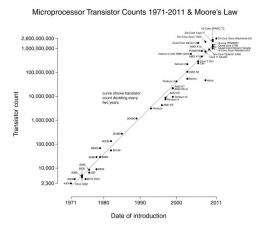
Transistor counts for integrated circuits plotted against their dates of introduction. The curve shows Moore's law - the doubling of transistor counts every two years. Image: Wikipedia.
(PhysOrg.com) -- For most of the computer age, the central theme in computer hardware architecture has been: create more computational power using the same amount of chip space. Intel founder Gordon Moore even came up with a law based on what hed seen up to that point to predict how things would go in the future; that computing power would double every year and a half. Now Jonathan Koomey, a consulting professor at Stanford has led a study that shows that the electrical energy efficiency of computers has been following roughly the same path. He and his colleagues from Microsoft and Intel have published the results of their study in EEE Annals of the History of Computing that shows that the energy efficiency of computers has doubled nearly every eighteen months (now called appropriately enough, Koomeys Law) going all the way back to the very first computers built in the 1950s.
This is not the first time Koomeys name has been in the news, just last month he was the lead author of a paper that showed that electricity consumed by data centers in the U.S. and around the world grew at a slower pace (from 2005 to 2010) than had been predicted by a 2007 U.S. EPA report. This time around, Koomey, in collaboration, with Intel and Microsoft has been studying how much electricity is used relative to processing power, by computers in a historical context. Way back in 1956, for example, ENIAC, one of the first true computers, used approximately 150 kilowatts of electricity to perform just a few hundred calculations per second.
Using historical data, the team created a graph comparing the amount of computing power of the average computer (from supercomputers to laptops) with the amount of electricity it needed and found that over time, energy efficiency improvements from the 1950s till now, have moved in virtual lockstep with increases in the amount of processing power: energy efficiency, they found effectively doubled every 1.57 year. Because of this, they predict that the trend is likely to continue into the foreseeable future.
This is important as computing platforms have become more mobile and end users increasingly tend to place more value in power efficiency (because it means longer battery life) than in how fast their Smartphone or tablet is able to produce results. Thus, its possible that Koomeys Law will become the rallying cry on into the future, much as Moores Law has been in the past. Though hopefully, new engineers wont start to fudge on Moores Law to get these results, as that could lead to small devices that last for weeks on batteries alone, but are sluggish.
More information: Implications of Historical Trends in the Electrical Efficiency of Computing, July-September 2011 (vol. 33 no. 3)
pp. 46-54. http://doi.ieeecom … MAHC.2010.28
Abstract
The electrical efficiency of computation has doubled roughly every year and a half for more than six decades, a pace of change comparable to that for computer performance and electrical efficiency in the microprocessor era. These efficiency improvements enabled the creation of laptops, smart phones, wireless sensors, and other mobile computing devices, with many more such innovations yet to come. The Web Extra appendix outlines the data and methods used in this study.
© 2011 PhysOrg.com
-
From lemons to lemonade: Reaction uses carbon dioxide to make carbon-based semiconductor,
32 comments
-
Thioridazine kills cancer stem cells in human while avoiding toxic side-effects of conventional cancer treatments,
3 comments
-
SpaceX private rocket blasts off for space station (Update),
42 comments
-
Climate scientists say they have solved riddle of rising sea,
31 comments
-
SpaceX capsule has 'new car' smell, astronauts say (Update),
4 comments
-
How to select a low-pass filter
1 hour ago
-
Diodes, supplies, and graphs.
10 hours ago
-
describing the voltage out of a rectifier
11 hours ago
-
Statistics of random processes passed through an LTI system
14 hours ago
-
Drawing energy band diagrams
22 hours ago
-
Using multiple 555 timers in astable
May 26, 2012
- More from Physics Forums - Electrical Engineering
More news stories
Browser wars flare in mobile space
The browser wars are heating up again, but this time the fight is for dominance of the mobile Internet.
10 hours ago |
5 / 5 (1) |
3
Probability of contamination from severe nuclear reactor accidents is higher than expected: study
Catastrophic nuclear accidents such as the core meltdowns in Chernobyl and Fukushima are more likely to happen than previously assumed. Based on the operating hours of all civil nuclear reactors and the number ...
Technology / Energy & Green Tech
May 22, 2012 |
3.6 / 5 (22) |
56
|
HyperSolar shows dirty water no barrier to power world
(Phys.org) -- The Santa Barbara, California, company, HyperSolar, is set to transparently share the ups and downs of its research experiences toward the companys ultimate vision, successfully producing ...
SpotterRF debuts Radar Backpack Kit (w/ Video)
(Phys.org) -- SpotterRF has announced a special radar backpack kit designed to enhance situational awareness for soldiers on the ground. The company says its special radar is designed for warfighters as part ...
Tesla to launch electric sedan in US on June 22
Tesla Motors said Tuesday it would begin deliveries of "the world's first premium electric sedan" on June 22, slightly ahead of schedule.
Technology / Energy & Green Tech
May 22, 2012 |
4.5 / 5 (12) |
18
Land and sea species differ in climate change response: study
(Phys.org) -- Marine and terrestrial species will likely differ in their responses to climate warming, new research by Simon Fraser University and Australia’s University of Tasmania has found.
'Unzipped' carbon nanotubes could help energize fuel cells, batteries
Multi-walled carbon nanotubes riddled with defects and impurities on the outside could replace some of the expensive platinum catalysts used in fuel cells and metal-air batteries, according to scientists at ...
T cells 'hunt' parasites like animal predators seek prey, study shows
By pairing an intimate knowledge of immune-system function with a deep understanding of statistical physics, a cross-disciplinary team at the University of Pennsylvania has arrived at a surprising finding: T cells use a movement ...
Computer model used to pinpoint prime materials for efficient carbon capture
When power plants begin capturing their carbon emissions to reduce greenhouse gases and to most in the electric power industry, it's a question of when, not if it will be an expensive undertaking.
Change in developmental timing was crucial in the evolutionary shift from dinosaurs to birds: study
At first glance, it's hard to see how a common house sparrow and a Tyrannosaurus Rex might have anything in common. After all, one is a bird that weighs less than an ounce, and the other is a dinosaur that ...
Almost half of new vets seek disability
(AP) -- America's newest veterans are filing for disability benefits at a historic rate, claiming to be the most medically and mentally troubled generation of former troops the nation has ever seen.
Sep 15, 2011
Rank: 4 / 5 (6)
He predicted that the number of transistors on an affordable chip would double. NOT computing power.
The number of transistors does not translate to computing power. Increasing the number of cores on a chip doesn't yield you linear increases in computing power, which is why supercomputers have to have hundreds of thousands of CPU cores to perform marginally better than the previous one.
Sep 15, 2011
Rank: 3.7 / 5 (3)
The power efficiency is therefore a requisite for increased transistor density. Without it, Moore's law wouldn't work.
Sep 15, 2011
Rank: 4.5 / 5 (2)
Multi-core really only helps if you are running applications or models that are multi-threaded.
Once you get beyond 1 processor core per thread, you really aren't going to see much benefit, if any, from adding additional cores.
Currently, weather models are limited by the resolution of data input, not computational power, nor even software limitations.
Some of the newer experimental models are actually run on massive arrays of video cards that they reprogram to do weather calculations, because video cards are usually cheaper than CPU processors, and they now have so much memory and hundreds or even thousands of stream processors.
But the weather is something that can be scaled almost indefinitely, and broken down into smaller packets in space and time almost indefinitely, so it's ideal for multi-core computing.
Sep 15, 2011
Rank: 5 / 5 (2)
You're right, the Koomey law can be derived from Moore's law easily in such way. Actually we can see, the power efficiency limits the power generated with processor long time - they all consume about 150 - 200 W a long time, because this is just a value, which allows their effective cooling per unit of chip area with passive heat transfer. The so-called green processors (mobile platform, etc..) are just smaller and less powerfull, but not actually more effective, than the energy hungry ones.
Sep 15, 2011
Rank: 5 / 5 (3)
Sep 15, 2011
Rank: 3 / 5 (6)
The doubling rate has actually been slowing down over time, but don't tell that to the singularity geeks. They'll just get mad at you.
Sep 15, 2011
Rank: 5 / 5 (1)
The graph at the top of this page is the objective reality concerning transistor density, and it is clearly not slowing down (although it did for a short while during the Pentium line, it has since caught up).
Sep 15, 2011
Rank: 5 / 5 (4)
Sep 15, 2011
Rank: 2.4 / 5 (5)
He originally stated it would double every year, and then revised his prediction in 1975.
The problem of the prediction is, that the industry has set a target on following it, so it doesn't really have any predictive power. I can make a prediction that I will walk to the corner shop to buy some beer in the next 30 minutes, and what do you know, it comes true!
As a side effect though, the capital cost of semiconductor factories is also following an exponential curve to keep pace with the Moore's law.
Sep 15, 2011
Rank: 2.3 / 5 (4)
That means, if the industry can't keep pushing the processors into exponentially more and more devices, Moore's law will grind to a halt very quickly.
Sep 15, 2011
Rank: 5 / 5 (1)
...and now your just making stuff up.
For the last five years intel's capital expenditures: (couldnt find it going back further)
http://www.fabtec...in_2011/
big jump in 2011 because they added a brand new fab which they haven't done in a while. but outside the jump for 2011, their capital expenditures were actually trending DOWN from 2006-2010.
Please quit making up stuff to sound smart.
Sep 15, 2011
Rank: 5 / 5 (2)
That said, OF COURSE Moore's law will grind to a halt. probably 5-6 years from now actually. beyond a certain limit quantum tunneling will render a transistor incapable of shutting off.
Intel isn't building better chips because they want to keep pace with Moore's law, they are building better chips because there is competition in the marketplace and if they stand still they might as well liquidate the company. Demand for better chips pushes moores law, not Intel's desire to be trendy.
Sep 15, 2011
Rank: 1 / 5 (1)
Nope.
http://en.wikiped...%27s_law
Sep 15, 2011
Rank: not rated yet
Sep 15, 2011
Rank: not rated yet
Nope. They are designed to be cheap.
Nobody builds a fab just to see how cheap they can make the chips, or to put bets on how many they can sell. Their intention all along is to make a certain number of chips at a cost that they belive can be sold. Without a very good reason to believe that they can sell N units at M price, nobody would fund the factory.
So, as the factories become more expensive with more advanced machinery to make more advanced chips, they can only be built if there's a market for the products. If there isn't enough potential buyers, then the price goes up, and if the price is unpalatable to the potential buyers then the factory won't go up.
If somebody builds the factory regardless, they risk going bankcrupt with a loss that rivals the GDP of a small nation because the products didn't sell.
Sep 15, 2011
Rank: not rated yet
exactly.
Read that again, really. The logic is so circular it hurts to think about. Intel isnt building new fabs just because they have preorders for chips in 2013. They are building fabs because the expect the market to exist, and yeah, if the market disappears then they go bankrupt. It is expensive and risky.
And yeah, they are designed to be cheap. Despite the mammoth costs of a chip fab, each chip is ridiculously cheap. The cost per transistor has fallen faster than transistor density has risen. That's the objective reality you are missing.
Sep 16, 2011
Rank: 1 / 5 (1)
chip failure due to heat damage could be controlled,but if they lasted longer,turnover rates would decrease profits.profits drive corporations, not dependability of their products.people usually work their computers until they fail, most will try repairs before replacement. some do buy because of advances in tech, and manufacturers know this.i have a tube stereo from the fifties that still works fine, and have killed many transistor based ones over the last thirty years. they don't build things to last anymore as that would cut profit. they (computer manufaturers) don't give away older tech, they sell ti in third world markets,and that proves they don't care about anything but profits.
Sep 16, 2011
Rank: 5 / 5 (2)
That's at least the third wrong thing you said, but I have a limited amount of time for trolls like you.
The vast majority of computers are thrown away working perfectly fine. The desire to keep up with the Jones's is what drives turnover. If your cpu fries, you either overclocked it without knowing what you were doing, blocked the air vents on your case, never opened the case to dust off stuff, or failed to use a decent surge protector. Computers get slow and die because users click on a million mall-ware links and their computer is too busy being part of a bot-net to run simple tasks.
I have had 7 home computers and 4 work computers. One of them died to a lightning strike, and another had a hard drive failure. The other 9 were discarded because something new and shiny came around the corner.
Sep 28, 2011
Rank: not rated yet
Oct 10, 2011
Rank: not rated yet
Eikka, please site your references, otherwise it is just gossip and of little value.
Oct 13, 2011
Rank: not rated yet
The cost per transistor has gone down because the process capacity has gone up faster than the investment costs, but the investment costs have still risen. That's the whole point.
That means each time you build a new fab, you need to sell more chips to offset the investment, and at some point you simply don't have the markets for such an ungodly number of chips that would pay for the new fabs, and the prices will start to increase and the demand for the new chips will vanish with the increasing price.
And that's where the upgrade cycle stops. It no longer makes sense to build the next better fab.