New 'FeTRAM' is promising computer memory technology
September 27, 2011 by Emil Venere

New 'FeTRAM' is promising computer memory technology

Enlarge

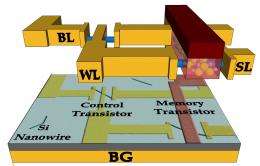
This diagram shows the layout for a new type of computer memory that could be faster than the existing commercial memory and use far less power than flash memory devices. The technology, called FeTRAM, combines silicon nanowires with a "ferroelectric" polymer, a material that switches polarity when electric fields are applied, making possible a new type of ferroelectric transistor. (Birck Nanotechnology Center, Purdue University)

(PhysOrg.com) -- Researchers are developing a new type of computer memory that could be faster than the existing commercial memory and use far less power than flash memory devices.

The technology combines silicon with a "ferroelectric" polymer, a material that switches polarity when electric fields are applied, making possible a new type of ferroelectric transistor.

"It's in a very nascent stage," said doctoral student Saptarshi Das, who is working with Joerg Appenzeller, a professor of electrical and computer engineering and scientific director of at Purdue's Birck Nanotechnology Center.

The ferroelectric transistor's changing polarity is read as 0 or 1, an operation needed for digital circuits to store information in binary code consisting of sequences of ones and zeroes.

The new technology is called FeTRAM, for ferroelectric transistor .

"We've developed the theory and done the experiment and also showed how it works in a circuit," he said.

Findings are detailed in a research paper that appeared this month in , published by the American Chemical Society.

The FeTRAM technology has nonvolatile storage, meaning it stays in memory after the computer is turned off. The devices have the potential to use 99 percent less energy than flash memory, a non-volatile chip and the predominant form of memory in the commercial market.

"However, our present device consumes more power because it is still not properly scaled," Das said. "For of FeTRAM technologies one of the main objectives will be to reduce the . They might also be much faster than another form of called SRAM."

The FeTRAM technology fulfills the three basic functions of computer memory: to write information, read the information and hold it for a long period of time.

"You want to hold memory as long as possible, 10 to 20 years, and you should be able to read and write as many times as possible," Das said. "It should also be low power to keep your laptop from getting too hot. And it needs to scale, meaning you can pack many devices into a very small area. The use of silicon nanowires along with this ferroelectric polymer has been motivated by these requirements."

The new technology also is compatible with industry manufacturing processes for complementary metal oxide semiconductors, or CMOS, used to produce computer chips. It has the potential to replace conventional memory systems.

A patent application has been filed for the concept.

The FeTRAMs are similar to state-of-the-art ferroelectric random access memories, FeRAMs, which are in commercial use but represent a relatively small part of the overall semiconductor market. Both use ferroelectric material to store information in a nonvolatile fashion, but unlike FeRAMS, the new technology allows for nondestructive readout, meaning information can be read without losing it.

This nondestructive readout is possible by storing information using a ferroelectric transistor instead of a capacitor, which is used in conventional FeRAMs.

More information: FETRAM. An Organic Ferroelectric Material Based Novel Random Access Memory Cell

ABSTRACT
Science and technology in the electronics area have always been driven by the development of materials with unique properties and their integration into novel device concepts with the ultimate goal to enable new functionalities in innovative circuit architectures. In particular, a shift in paradigm requires a synergistic approach that combines materials, devices and circuit aspects simultaneously. Here we report the experimental implementation of a novel nonvolatile memory cell that combines silicon nanowires with an organic ferroelectric polymer—PVDF-TrFE—into a new ferroelectric transistor architecture. Our new cell, the ferroelectric transistor random access memory (FeTRAM) exhibits similarities with state-of the-art ferroelectric random access memories (FeRAMs) in that it utilizes a ferroelectric material to store information in a nonvolatile (NV) fashion but with the added advantage of allowing for nondestructive readout. This nondestructive readout is a result of information being stored in our cell using a ferroelectric transistor instead of a capacitor—the scheme commonly employed in conventional FeRAMs.

Provided by Purdue University search and more info website

4.4 /5 (17 votes)  

Filter


Move the slider to adjust rank threshold, so that you can hide some of the comments.


Display comments: newest first

Bowler_4007
Sep 27, 2011

Rank: 5 / 5 (1)
One word "cooooool". i do hope that a few of the technologies being engineered around the world become widespread, i long for the day when computers operate at mind boggling speed with low power usage and low heat output
holoman
Sep 27, 2011

Rank: not rated yet
Not until the densities are there will this memory be
competive with flash. For 20 years ferroelectrics has been
advertised as low power and fast, but density has not broken the 512k mark which is obsolete for other memory.
CHollman82
Sep 27, 2011

Rank: 5 / 5 (1)
Not until the densities are there will this memory be
competive with flash. For 20 years ferroelectrics has been
advertised as low power and fast, but density has not broken the 512k mark which is obsolete for other memory.


512k is a near infinity when you work on embedded systems like I do, I can do more with half a meg of memory than you can imagine. Speed is FAR more important than capacity in the work I do, if we need more capacity we just use more than one chip, but speed is paramount as part of the work I do involves measuring light reflectance (backscatter) in an optical fiber as frequently as possible. We currently measure with 1/8 meter resolution, or about 2.4 billion times per second. Faster memory means higher resolution measurements.
holoman
Oct 02, 2011

Rank: not rated yet
I know all your market talk points. It still doesn't address the
single chip capacity issue. Flash is the heavy weight and cheap.

Ferroelectrics is like nuclear fusion, a someday technology.
CHollman82
Oct 04, 2011

Rank: not rated yet
I know all your market talk points. It still doesn't address the
single chip capacity issue.


The point is there are more uses for chips like this where capacity > 100's of kilobytes is irrelevant than there are uses where large capacity is important.

All you're thinking of is a thumb drive to store your porn videos on... nonvolatile memory does a lot more than that. 512k is PLENTY for most embedded applications, and the vast majority of all types or RAM manufactured in the world are used in such embedded applications, not by consumers for data storage.

This memory could be used in a refrigerator, or a child's toy, or a vehicle, or a hand held device, or an alarm clock, or a stereo, or blender, or a GPS, or whatever... most memory is used in this way, not to store home videos on a thumb drive.
Rank 4.4 /5 (17 votes)
Relevant PhysicsForums posts
  • How to calculate the repulsion force between a permanent and an electromagnet?
    created1 hour ago
  • Why does light allow us to see things?
    created1 hour ago
  • Room temperature superconductivity
    created1 hour ago
  • Water flow question
    created5 hours ago
  • [Drift velocity] Factors affecting velocity
    created7 hours ago
  • does cold gasoline have less energy
    created8 hours ago
  • More from Physics Forums - General Physics

More news stories

'Unzipped' carbon nanotubes could help energize fuel cells, batteries

Multi-walled carbon nanotubes riddled with defects and impurities on the outside could replace some of the expensive platinum catalysts used in fuel cells and metal-air batteries, according to scientists at ...

Nanotechnology / Nanomaterials

created 2 hours ago | popularity not rated yet | comments 0 | with audio podcast

In nanorod crystal growth, nanoparticles seen as artificial atoms

In the growth of crystals, do nanoparticles act as "artificial atoms" forming molecular-type building blocks that can assemble into complex structures? This is the contention of a major but controversial theory ...

Nanotechnology / Nanophysics

created May 24, 2012 | popularity 4.8 / 5 (6) | comments 0 | with audio podcast

Dopant gives graphene solar cells highest efficiency yet

(Phys.org) -- By taking advantage of graphene’s favorable electrical and optical properties, and then adding an organic dopant, researchers have achieved the highest power conversion efficiency yet for ...

Nanotechnology / Nanophysics

created May 21, 2012 | popularity 5 / 5 (10) | comments 14 | with audio podcast feature

First direct observation of oriented attachment in nanocrystal growth

Berkeley Lab researchers have reported the first direct observation of nanoparticles undergoing oriented attachment, the critical step in biomineralization and the growth of nanocrystals. A better understanding ...

Nanotechnology / Nanophysics

created May 24, 2012 | popularity 4.7 / 5 (3) | comments 0 | with audio podcast

Synthetic nano-waste does not disappear

(Phys.org) -- Tiny particles of cerium oxide do not burn or change in the heat of a waste incineration plant. They remain intact on combustion residues or in the incineration system, as a new study by Swiss ...

Nanotechnology / Bio & Medicine

created May 25, 2012 | popularity 5 / 5 (2) | comments 1 | with audio podcast


Land and sea species differ in climate change response: study

(Phys.org) -- Marine and terrestrial species will likely differ in their responses to climate warming, new research by Simon Fraser University and Australia’s University of Tasmania has found.

Almost half of new vets seek disability

(AP) -- America's newest veterans are filing for disability benefits at a historic rate, claiming to be the most medically and mentally troubled generation of former troops the nation has ever seen.

T cells 'hunt' parasites like animal predators seek prey, study shows

By pairing an intimate knowledge of immune-system function with a deep understanding of statistical physics, a cross-disciplinary team at the University of Pennsylvania has arrived at a surprising finding: T cells use a movement ...

Computer model used to pinpoint prime materials for efficient carbon capture

When power plants begin capturing their carbon emissions to reduce greenhouse gases – and to most in the electric power industry, it's a question of when, not if – it will be an expensive undertaking.

Change in developmental timing was crucial in the evolutionary shift from dinosaurs to birds: study

At first glance, it's hard to see how a common house sparrow and a Tyrannosaurus Rex might have anything in common. After all, one is a bird that weighs less than an ounce, and the other is a dinosaur that ...

Nvidia trumpets Tegra 3 phone design wins for 2012

(Phys.org) -- Nvidia’s competitive war paint has a name, Tegra 3. On the heels of Nvidia announcements about lowering costs of its Tegra 3 processors and Nvidia-enabled tablets running Android Ice Cream ...