Edible carbon dioxide sponge
September 23, 2011 By Megan Fellman

Edible carbon dioxide sponge

Enlarge

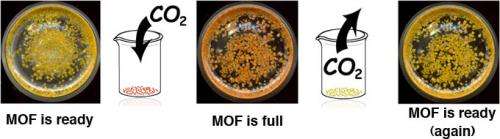
When a yellow dye, called pH indicator, is placed within the voids of the metal-organic frameworks (MOFs), the crystals turn yellow. However, upon exposure to carbon dioxide, the pH indicator switches to a red color, indicating that the MOF has both reacted and filled up with carbon dioxide. If the crystals are placed away from high concentrations of carbon dioxide, the gas leaves, and the crystals once again turn yellow.

(PhysOrg.com) -- A year ago Northwestern University chemists published their recipe for a new class of nanostructures made of sugar, salt and alcohol. Now, the same team has discovered the edible compounds can efficiently detect, capture and store carbon dioxide. And the compounds themselves are carbon-neutral.

The porous crystals -- known as metal-organic frameworks (MOFs) -- are made from all-natural ingredients and are simple to prepare, giving them a huge advantage over other MOFs. Conventional MOFs, which also are effective at adsorbing , are usually prepared from materials derived from crude oil and often incorporate toxic .

Other features of the Northwestern MOFs are they turn red when completely full of carbon dioxide, and the carbon capture process is reversible.

The findings, made by scientists working in the laboratory of Sir Fraser Stoddart, Board of Trustees Professor of Chemistry in the Weinberg College of Arts and Sciences, are published in the (JACS).

"We are able to take molecules that are themselves sourced from , through photosynthesis, and use them to capture even more carbon dioxide," said Ross S. Forgan, a co-author of the study and a postdoctoral fellow in Stoddart's laboratory. "By preparing our MOFs from naturally derived ingredients, we are not only making materials that are entirely nontoxic, but we are also cutting down on the associated with their manufacture."

The main component, gamma-cyclodextrin, is a naturally occurring biorenewable sugar molecule that is derived from .

The are held in place by metals taken from salts such as potassium benzoate or rubidium hydroxide, and it is the precise arrangement of the sugars in the crystals that is vital to their successful capture of carbon dioxide.

"It turns out that a fairly unexpected event occurs when you put that many sugars next to each other in an alkaline environment -- they start reacting with carbon dioxide in a process akin to carbon fixation, which is how sugars are made in the first place," said Jeremiah J. Gassensmith, lead author of the paper and also a postdoctoral fellow in Stoddart's laboratory. "The reaction leads to the carbon dioxide being tightly bound inside the crystals, but we can still recover it at a later date very simply."

The fact that the carbon dioxide reacts with the MOF, an unusual occurrence, led to a simple method of detecting when the crystals have reached full capacity. The researchers place an indicator molecule, which detects changes in pH by changing its color, inside each crystal. When the yellow crystals of the MOFs are full of carbon dioxide they turn red.

The simplicity of the new MOFs, allied with their low cost and green credentials, have marked them as candidates for further commercialization. Ronald A. Smaldone, also a postdoctoral fellow in Stoddart's group and a co-author of the paper, added, "I think this is a remarkable demonstration of how simple chemistry can be successfully applied to relevant problems like carbon capture and sensor technology."

More information: http://pubs.acs.or … 21/ja206525x

Provided by Northwestern University search and more info website


Rank 3 /5 (3 votes)
Relevant PhysicsForums posts
  • Gibbs Free Energy Change/Entropy
    created5 hours ago
  • What's the rule to covalent character
    created6 hours ago
  • Schwartz reagent-- NMR/MS/IR
    createdMay 26, 2012
  • High school chemistry EEI
    createdMay 25, 2012
  • oxidation of I- by KMnO4
    createdMay 25, 2012
  • Inversion temp
    createdMay 25, 2012
  • More from Physics Forums - Chemistry

More news stories

New CO2-removing catalyst can take the heat

(Phys.org) -- The current method of removing the greenhouse gas carbon dioxide (CO2) from the flues of coal-fired power plants uses so much energy that no one bothers to use it. So says Roger Aines, principal ...

Chemistry / Materials Science

created May 24, 2012 | popularity 5 / 5 (9) | comments 9 | with audio podcast

High-speed method to aid search for solar energy storage catalysts

Eons ago, nature solved the problem of converting solar energy to fuels by inventing the process of photosynthesis.

Chemistry / Materials Science

created May 25, 2012 | popularity 5 / 5 (3) | comments 4 | with audio podcast

Researchers demonstrate possible primitive mechanism of chemical info self-replication

(Phys.org) -- When scientists think about the replication of information in chemistry, they usually have in mind something akin to what happens in living organisms when DNA gets copied: a double-stranded molecule ...

Chemistry / Materials Science

created May 25, 2012 | popularity 5 / 5 (4) | comments 2 | with audio podcast

Building a better solar panel -- one molecule at a time

(Phys.org) -- One of the fundamental building blocks in modern chemistry, an organometallic chemical compound called ferrocene, has never been structurally defined - until now.

Chemistry / Materials Science

created May 25, 2012 | popularity 5 / 5 (3) | comments 0 | with audio podcast

Discarded data may hold the key to a sharper view of molecules

(Phys.org) -- There's nothing like a new pair of eyeglasses to bring fine details into sharp relief. For scientists who study the large molecules of life from proteins to DNA, the equivalent of new lenses have come in the ...

Chemistry / Biochemistry

created May 24, 2012 | popularity 4.7 / 5 (3) | comments 0 | with audio podcast


Nvidia trumpets Tegra 3 phone design wins for 2012

(Phys.org) -- Nvidia’s competitive war paint has a name, Tegra 3. On the heels of Nvidia announcements about lowering costs of its Tegra 3 processors and Nvidia-enabled tablets running Android Ice Cream ...

Browser wars flare in mobile space

The browser wars are heating up again, but this time the fight is for dominance of the mobile Internet.

Scientist: Evolution debate will soon be history

(AP) -- Richard Leakey predicts skepticism over evolution will soon be history. Not that the avowed atheist has any doubts himself.

Dell tablet leak: 10.1-inch display, two-battery choice

(Phys.org) -- Headline after headline talks about vendors’ tablets in the wings as likely number-one contenders for the iPad. Such claims have justifiably been taken with a grain of salt, considering ...

Keep food safety in mind this memorial day weekend

(HealthDay) -- Picnics, parades and cookouts are as much a part of Memorial Day weekend as tributes to the United States' war veterans.

Social welfare cuts ultimately come with heavy price, researchers say

(Phys.org) -- Slashing government funding for Medicaid, food stamps and other programs that serve the poor – while politically popular with some lawmakers and many conservatives – may do more harm ...