Coral rehab finding offers hope for Great Barrier Reef
September 5, 2011

Coral rehab finding offers hope for Great Barrier Reef

Enlarge

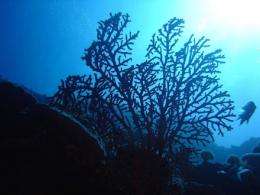
Even small scale, patchy reef restoration efforts can go a long way to repair coral ecosystems, new research has found. Flickr/gruntzooki

Coral ecosystems cope much better than was first thought when the reef habitat is fragmented, a new study has found, meaning that efforts to restore even small parts of the damaged Great Barrier Reef could reap great rewards.

Like other around the world, the has suffered from coral bleaching and habitat die-off brought on by , , and pollution by .

Such disturbances often cause and patchiness in the way the coral is distributed but until now it has been hard to know which factor — habitat loss or fragmentation — was causing the most damage to fish populations.

Now researchers from James Cook University have discovered that while overall habitat loss is indeed a disaster for fish, the fact that the remaining reef is spread patchily over the original area may not be such a problem after all.

“There’s a perception problem that habitat patchiness is a bad thing when, in fact, our results suggest it doesn’t matter if it’s patchy as long as the total amount of habitat is not changed,” said Dr Mary Bonin of the ARC Centre of Excellence for Coral Reef Studies and James Cook University.

The researchers think a patchy reef may actually create more nooks and crannies for fish to hide in, whereas a large continuous reef may be guarded by territorial alpha fish that chase competitors away.

“I want to be clear that we are not saying we should (deliberately) fragment reefs but our results are showing habitat loss is the real problem and patchy restoration is still beneficial,” said Dr Bonin.

The finding could fuel a policy shift in the way reef restoration is viewed. Large-scale, complex and expensive reef-wide restorations may still be worthwhile, but the research shows that reef rehab experts could also reap great benefits from small scale efforts, such as deployment of reef balls.

“It means we don’t necessarily have to restore the entire reef back to 100%. Actually, just going in an providing small patches of habitat would could be beneficial,” said Dr Bonin.

“You can’t probably get it back to a pristine state (after a major disturbance). But even to go in and deploy reef balls in a patchy way can still do a lot to help.”

The study was published in Ecology, the journal of the Ecological Society of America.


This story is published courtesy of the The Conversation (under Creative Commons-Attribution/No derivatives).

Source: The Conversation


Rank 5 /5 (2 votes)
Relevant PhysicsForums posts

More news stories

Sophisticated simulations predict future warming

The chances of our planet being hit by a global warming of 3 degrees Celsius by 2050 is as likely as it being hit by an increase of 1.4 degrees, new research shows. Presented in the journal Nature Geoscience, the British study ...

Space & Earth / Earth Sciences

created May 22, 2012 | popularity 4.4 / 5 (9) | comments 51

Kyoto Protocol architect 'frustrated' by climate dialogue

UN climate talks are going nowhere, as politicians dither or bicker while the pace of warming dangerously speeds up, one of the architects of the Kyoto Protocol told AFP.

Space & Earth / Environment

created May 23, 2012 | popularity 3.7 / 5 (7) | comments 39

Aliens don't want to eat us, says former SETI director

Alien life probably isn’t interested in having us for dinner, enslaving us or laying eggs in our bellies, according to a recent statement by former SETI director Jill Tarter.

Space & Earth / Space Exploration

created May 25, 2012 | popularity 4.4 / 5 (13) | comments 37

Dragon arrives at space station in historic 1st (Update 2)

The privately bankrolled Dragon capsule made a historic arrival at the International Space Station on Friday, triumphantly captured by astronauts wielding a giant robot arm.

Space & Earth / Space Exploration

created May 25, 2012 | popularity 5 / 5 (10) | comments 19

What's the big deal about private space launches?

(AP) -- The first private spaceship is headed to the International Space Station. Some questions and answers about the cargo mission by Space Exploration Technologies, known as SpaceX:

Space & Earth / Space Exploration

created May 22, 2012 | popularity 5 / 5 (6) | comments 32


Nvidia trumpets Tegra 3 phone design wins for 2012

(Phys.org) -- Nvidia’s competitive war paint has a name, Tegra 3. On the heels of Nvidia announcements about lowering costs of its Tegra 3 processors and Nvidia-enabled tablets running Android Ice Cream ...

Browser wars flare in mobile space

The browser wars are heating up again, but this time the fight is for dominance of the mobile Internet.

Scientist: Evolution debate will soon be history

(AP) -- Richard Leakey predicts skepticism over evolution will soon be history. Not that the avowed atheist has any doubts himself.

Dell tablet leak: 10.1-inch display, two-battery choice

(Phys.org) -- Headline after headline talks about vendors’ tablets in the wings as likely number-one contenders for the iPad. Such claims have justifiably been taken with a grain of salt, considering ...

Keep food safety in mind this memorial day weekend

(HealthDay) -- Picnics, parades and cookouts are as much a part of Memorial Day weekend as tributes to the United States' war veterans.

Social welfare cuts ultimately come with heavy price, researchers say

(Phys.org) -- Slashing government funding for Medicaid, food stamps and other programs that serve the poor – while politically popular with some lawmakers and many conservatives – may do more harm ...