A model could guide the design of artificial composites
September 19, 2011 By Lee Swee Heng

Demystifying natural hierarchy

Enlarge

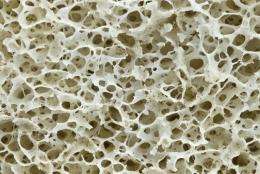
Macro cross-sectionn of human hip bone. Credit: Patrick Siemer

Many biomaterials such as bone, shell and mineralized tendon have a hierarchical structure that provides the material with exceptional mechanical and load-bearing properties, even though the building blocks of such structures may themselves have very poor mechanical properties. One type of structural hierarchy known as ‘self-similarity’ is ubiquitous in nature and is based on the repetition of units that are composed of biominerals and proteins, creating multi-level structures that provide enhanced strength and durability.

The number of hierarchical levels in such structures is dependent on the mineral content. Bone, for example, combines soft organic collagen material and hard crystal phases in an organized seven-level structure (see image), whereas shell is typically organized into two- or three-level structures. Little has been known, however, about what determines the number of levels in natural systems. Zuoqi Zhang at the A*STAR Institute of High Performance Computing and co-workers have now developed a theoretical, quasi-self-similar model to demonstrate why these natural biomaterials typically exhibit two to seven levels of structural hierarchy.

Previous experiments at different size scales have shown that the cooperative deformation of load-bearing biomaterials depends on their underlying hierarchical structures. The model developed by Zhang’s team, however, is the first to match these measurements of mineral and collagen deformation in bone and mineralized tendon. In the new model, each hierarchical level consists of hard, slender inclusions that form a staggered pattern within a soft matrix. These staggered microstructures then serve as inclusions in the next level. “The aspect ratio of the inclusions varies from level to level,” says Zhang.

The model showed that depending on mineral concentration, maximum toughness is obtained at a certain number of hierarchical levels and a certain . Zhang notes that within the optimal structure, characteristic sizes range from tens of nanometers to hundreds of micrometers. The model also confirmed the predicted trend that the number of hierarchical levels would be highest for bone, lower for mineralized tendon, and lowest for shell. “These predictions are in agreement with experimental observations,” says Zhang.

The researchers are currently planning to use their to guide the design and fabrication of artificial hierarchical composites in the laboratory. In addition, they are investigating the ability of hierarchical biomaterials to resist impact load. “We are trying to reveal the underlying mechanisms that may lead to acoustic cloaking composites—materials with the ability to make an object ‘invisible’ to sound,” says Zhang.

More information: Zhang, Z., et al. On optimal hierarchy of load-bearing biological materials. Proceedings of the Royal Society B 278, 519–525 (2011). http://rspb.royals … 278/1705/519

Provided by Agency for Science, Technology and Research (A*STAR)

Filter


Move the slider to adjust rank threshold, so that you can hide some of the comments.


Display comments: newest first

Isaacsname
Sep 19, 2011

Rank: not rated yet
" We are trying to reveal the underlying mechanisms that may lead to acoustic cloaking compositesmaterials with the ability to make an object invisible to sound "

I imagine when they can produce metal nanomaterials with foam-like structures is when that will start to happen.

http://en.wikiped...tal_foam
antialias_physorg
Sep 19, 2011

Rank: not rated yet
The number of hierarchical levels in such structures is dependent on the mineral content.

Actually, for biologiocal structures that is not true. The minimum size of trabeculae is determined by the size of the remodeling cells (osteoclasts and osteoblasts). This is why the individual structures in a rat's knee and a human knee on the finest level are of the same size (because osteoclasts and osteoblasts are of the same size in rats and humans)

The human knee has more hierarchical levels because it is bigger. The rat knee may have a dozen trabeculae but no real hierarchical structure because the next hierarchy is already the size of the respective bone (femur/tibia)

Mineral content, therefore, does not define the hierarchical structure in bone - it merely defines the density of each level of hierarchy (and to some extent the morphology: rodlike or platelike)
Isaacsname
Sep 19, 2011

Rank: not rated yet
I think it's an interesting observation that the inclusions( read: defects ) in one level of structure are the base for the next level up in structural stability. It means that each level of hierarchical structure has a different bulk modulus, right ? It's self-correction in biological structures. The inclusions ( shearing, fracturing, etc ) represent everything about the structure at that scale that's insufficient, that forms the basis for the next level up ?
Rank not rated yet
Relevant PhysicsForums posts
  • Gibbs Free Energy Change/Entropy
    created6 hours ago
  • What's the rule to covalent character
    created7 hours ago
  • Schwartz reagent-- NMR/MS/IR
    createdMay 26, 2012
  • High school chemistry EEI
    createdMay 25, 2012
  • oxidation of I- by KMnO4
    createdMay 25, 2012
  • Inversion temp
    createdMay 25, 2012
  • More from Physics Forums - Chemistry

More news stories

New CO2-removing catalyst can take the heat

(Phys.org) -- The current method of removing the greenhouse gas carbon dioxide (CO2) from the flues of coal-fired power plants uses so much energy that no one bothers to use it. So says Roger Aines, principal ...

Chemistry / Materials Science

created May 24, 2012 | popularity 5 / 5 (9) | comments 10 | with audio podcast

High-speed method to aid search for solar energy storage catalysts

Eons ago, nature solved the problem of converting solar energy to fuels by inventing the process of photosynthesis.

Chemistry / Materials Science

created May 25, 2012 | popularity 5 / 5 (3) | comments 4 | with audio podcast

Researchers demonstrate possible primitive mechanism of chemical info self-replication

(Phys.org) -- When scientists think about the replication of information in chemistry, they usually have in mind something akin to what happens in living organisms when DNA gets copied: a double-stranded molecule ...

Chemistry / Materials Science

created May 25, 2012 | popularity 5 / 5 (4) | comments 2 | with audio podcast

Building a better solar panel -- one molecule at a time

(Phys.org) -- One of the fundamental building blocks in modern chemistry, an organometallic chemical compound called ferrocene, has never been structurally defined - until now.

Chemistry / Materials Science

created May 25, 2012 | popularity 5 / 5 (3) | comments 0 | with audio podcast

Discarded data may hold the key to a sharper view of molecules

(Phys.org) -- There's nothing like a new pair of eyeglasses to bring fine details into sharp relief. For scientists who study the large molecules of life from proteins to DNA, the equivalent of new lenses have come in the ...

Chemistry / Biochemistry

created May 24, 2012 | popularity 4.7 / 5 (3) | comments 0 | with audio podcast


Browser wars flare in mobile space

The browser wars are heating up again, but this time the fight is for dominance of the mobile Internet.

Nvidia trumpets Tegra 3 phone design wins for 2012

(Phys.org) -- Nvidia’s competitive war paint has a name, Tegra 3. On the heels of Nvidia announcements about lowering costs of its Tegra 3 processors and Nvidia-enabled tablets running Android Ice Cream ...

Scientist: Evolution debate will soon be history

(AP) -- Richard Leakey predicts skepticism over evolution will soon be history. Not that the avowed atheist has any doubts himself.

Dell tablet leak: 10.1-inch display, two-battery choice

(Phys.org) -- Headline after headline talks about vendors’ tablets in the wings as likely number-one contenders for the iPad. Such claims have justifiably been taken with a grain of salt, considering ...

Keep food safety in mind this memorial day weekend

(HealthDay) -- Picnics, parades and cookouts are as much a part of Memorial Day weekend as tributes to the United States' war veterans.

Social welfare cuts ultimately come with heavy price, researchers say

(Phys.org) -- Slashing government funding for Medicaid, food stamps and other programs that serve the poor – while politically popular with some lawmakers and many conservatives – may do more harm ...