Detecting an unexpected delay at ultrafast speed
August 5, 2011

Detecting an unexpected delay at ultrafast speed

Enlarge

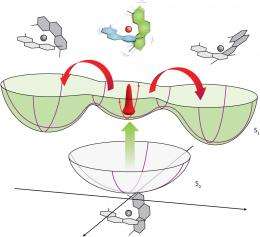
When copper dimethylphenanthroline absorbs a photon (bottom), it transitions from a ground state (S0) to an electronically excited (S1) state that causes the molecular structure to flatten. Ultrafast laser spectroscopy has revealed that the molecule coherently vibrates for a short time (upper center) before distorting. Credit: 2011 American Chemical Society

Molecules that suddenly transform into new structures when stimulated by photons or electrons play key roles in many chemical and biological processes. Recently, chemists have discovered that adding transition metals such as copper to photo-responsive organic ligands produces materials with high solar conversion efficiencies, owing to the metal’s ready supply of light-activated electrons. But despite the interest in these substances for opto-electronic devices, their inner workings remain mostly inscrutable because the charge-transfer dynamics happen too quickly for detection by typical instruments.

Tahei Tahara and colleagues from the RIKEN Advanced Science Institute, Wako, have spearheaded development of ultrafast laser spectroscopy that can capture these high-speed reactions by taking ‘snapshots’ of photochemical transformations with quadrillionths-of-a-second (10-15 s) accuracy. Now, an unprecedented finding by the research team—a picosecond (10-12 s) time delay during a theoretically instantaneous distortion—is set to overturn current thinking about light-driven rearrangements in transition metal complexes1. 

Copper dimethylphenanthroline (Fig. 1) is a compound containing two propeller-shaped wings, made out of thin aromatic sheets. Chemists regularly use it to explore photo-induced structural changes. In its unexcited state, the complex’s wings are oriented perpendicular to each other. But when illuminated at a specific wavelength, the copper ion absorbs a photon and transfers an electron to the sheets—an action that flattens the structure by disrupting critical copper—phenanthroline bonds. 

The exact flattening mechanism, however, has been controversial because electrons can be photo-excited in two different ways: through an easily accessible high-energy state called S2, or a harder-to-spot, low-energy transition called the S1 state. Tahara and colleagues tracked the extremely fast relaxation process from both states and found that S1 electrons provoked the flattening. This finding will allow researchers to eventually squeeze as much efficiency as possible from these devices. 

When the team examined how the molecule behaved in the S1 excited state, they saw unexpected oscillations in the absorption signals during its picosecond-long lifetime.  According to Tahara, these signals are unmistakable evidence that the excited complex vibrates coherently in place and waits a short while before distorting. 

Because this result contradicts traditional understandings of transition metal processes—atomic movements were theorized to immediately follow excitation to S1-type electronic states—it may spark revolutionary changes in how chemists conceive and control photo-initiated reactions. “This is a fundamental and deep issue,” says Tahara.

By expanding this technique to other poorly understood metal complexes, the team hopes to produce ‘textbook-type’ results that can guide future development of these remarkable materials.

More information: Iwamura, M., et al. Coherent nuclear dynamics in ultrafast photoinduced structural change of bis(diimine)copper(I) complex. Journal of the American Chemical Society 133, 7728–7736 (2011).  http://www.riken.j … o/index.html

Provided by RIKEN search and more info website

4.3 /5 (3 votes)  

Filter


Move the slider to adjust rank threshold, so that you can hide some of the comments.


Display comments: newest first

TomSullivan
Aug 05, 2011

Rank: not rated yet
Yee Haa! great work, great finding!
TomSullivan
Aug 05, 2011

Rank: not rated yet
Congrats to RIKEN Advanced Science Institute, Wako. With this technology the workings of life and matter are unraveled even further! these "vibrations" may be found to be the process by which DNA directs the building of organics and organisms.
hush1
Aug 05, 2011

Rank: not rated yet
Yes. Kudos and congratulations. Impressive research.
I see this adding insight to biochemical molecular structures of the brain. Premonitions along a direction of thought coinciding with the words of sentiment written above by TS.

I like the concept that a complex has distinct final (inevitable?)'distortions' modes to 'resort' to, ending any ongoing transitions.
SemiNerd
Aug 05, 2011

Rank: not rated yet
I did a lot of work in college with a very similar group of compounds (they were Cu and Ni with 2 ring 'wings' instead of 3). The major problem we had was that the compounds were pretty unstable in the presence of water vapor.

I am curious what is the stability of these compounds in the presence of water, and/or air.

Anyway, kudos's to the research. All we were doing was studying the way their optical properties varied according to the 'wing' orientations.
Rank 4.3 /5 (3 votes)
Relevant PhysicsForums posts
  • Water flow question
    created2 hours ago
  • [Drift velocity] Factors affecting velocity
    created5 hours ago
  • does cold gasoline have less energy
    created5 hours ago
  • distribution of molecules throughout the atmosphere
    created7 hours ago
  • The Global Positioning System !
    created8 hours ago
  • A Question relating Power
    created9 hours ago
  • More from Physics Forums - General Physics

More news stories

Is a classical electrodynamics law incompatible with special relativity?

(Phys.org) -- The laws of classical electromagnetism that were developed in the 19th century are the same laws that scientists use today. They include Maxwell’s four equations along with the Lorentz la ...

Physics / General Physics

created May 24, 2012 | popularity 4.7 / 5 (17) | comments 43 | with audio podcast feature

Landmark calculation clears the way to answering how matter is formed

(Phys.org) -- An international collaboration of scientists, including Thomas Blum, associate professor of physics, is reporting in landmark detail the decay process of a subatomic particle called a kaon – ...

Physics / General Physics

created May 25, 2012 | popularity 4.3 / 5 (22) | comments 50 | with audio podcast

Lying in wait for WIMPs: Researchers seek to dramatically increase sensitivity of Large Underground Xenon detector

Although it's invisible, dark matter accounts for at least 80 percent of the matter in the universe. No one knows what it is, but most scientists would bet on weakly interacting massive particles, or WIMPs.

Physics / General Physics

created May 23, 2012 | popularity 4 / 5 (7) | comments 15 | with audio podcast

Hawaii lab turns laser-powered bubbles into microrobots

(Phys.org) -- A team of scientists from the University of Hawaii are working on microrobots created from bubbles of air in a saline solution. The bubbles take on their title of “robots” as a laser ...

Physics / General Physics

created May 23, 2012 | popularity 5 / 5 (4) | comments 2 | with audio podcast weblog

Sound increases the efficiency of boiling

Scientists at the Georgia Institute of Technology achieved a 17-percent increase in boiling efficiency by using an acoustic field to enhance heat transfer. The acoustic field does this by efficiently removing vapor bubbles ...

Physics / Soft Matter

created May 24, 2012 | popularity 5 / 5 (2) | comments 2


Change in developmental timing was crucial in the evolutionary shift from dinosaurs to birds: study

At first glance, it's hard to see how a common house sparrow and a Tyrannosaurus Rex might have anything in common. After all, one is a bird that weighs less than an ounce, and the other is a dinosaur that ...

Computer model used to pinpoint prime materials for efficient carbon capture

When power plants begin capturing their carbon emissions to reduce greenhouse gases – and to most in the electric power industry, it's a question of when, not if – it will be an expensive undertaking.

'Unzipped' carbon nanotubes could help energize fuel cells, batteries

Multi-walled carbon nanotubes riddled with defects and impurities on the outside could replace some of the expensive platinum catalysts used in fuel cells and metal-air batteries, according to scientists at ...

T cells 'hunt' parasites like animal predators seek prey, study shows

By pairing an intimate knowledge of immune-system function with a deep understanding of statistical physics, a cross-disciplinary team at the University of Pennsylvania has arrived at a surprising finding: T cells use a movement ...

Manufacturing genes to attack flu virus

An international research team has manufactured a new protein that can combat deadly flu epidemics.

Yale study concludes public apathy over climate change unrelated to science literacy

Are members of the public divided about climate change because they don't understand the science behind it? If Americans knew more basic science and were more proficient in technical reasoning, would public consensus match ...