Chemist contributes to development of novel method for recovering old fingerprints
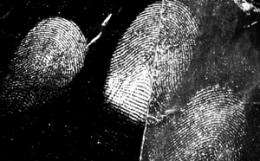
A Northern Illinois University chemist is part of an international team of scientists whose work might someday crack open cold-case files.
The scientists are developing a new fingerprinting method that could make it possible to recover previously unusable or undetected prints from old evidence and from surfaces long considered too difficult by crime scene investigators.
Results of a preliminary study on the development of the novel immunogenic method were published this past spring in Chemical Communications, a journal of the Royal Society of Chemistry.
Despite fingerprinting being a foundational technique of modern forensic science, only a fraction of all the fingermarks at a crime scene are actually detected.
The new method uses unique antibodies developed by NIU Chemistry and Biochemistry Professor Oliver Hofstetter. The antibodies are immobilized onto gold nanoparticles and applied to a surface, where they bind to amino acids contained in any fingerprints that are present. A fluorescent dye is then used to improve the visualization and capture of the fingerprint.
While not seen as a replacement for current techniques of recovering fresh prints, the new method is particularly effective for enhancing aged or dried fingermarks on non-porous surfaces.
“Our new fingerprint detection method enables the visualization of weak fingerprints that are difficult to develop with other current techniques,” Hofstetter said. “This is the first antibody-based technique that specifically targets amino acids, which are ubiquitous components of human sweat and are present in invisible fingerprints on non-porous surfaces, such as glass and ceramics.”
Hofstetter is working to develop the fingerprinting method with a team of researchers led by Xanthe Spindler, a forensic science researcher at the University of Technology Sydney (UTS) in Australia. Chief investigators and key personnel also include Director of the UTS Center for Forensic Science Professor Claude Roux, Professor Chris Lennard from the University of Canberra in Australia and Andrew McDonagh from UTS.
“The targeting of amino acids in fingerprint detection has been around since the mid-’50s, but its use has been limited largely to porous surfaces like paper because of the fragility of amino acid secretions on non-porous surfaces,” Spindler said.
“We’ve been able to successfully target amino acids on non-porous surfaces for the first time, with promising results in enhancing aged and degraded fingermarks that typically give poor results with traditional powdering and cyanoacrylate fuming,” Spindler said. “The potential is there to go back to old cases to see what might now be recovered.”
Hofstetter said the researchers have tested fingerprints that have been stored for as long as a year. Unlike conventional techniques, the effectiveness of the antibody-based system did not decrease with fingerprint age. Because amino acids are relatively stable, there is the potential to detect even much older fingerprints, the scientists said.
The research is also a step in pursuit of what Spindler calls the “Holy Grail”—a reliable method for recovering fingerprints from human skin.
“The work we have done so far enables us to pursue several intriguing research directions and to test the method under a variety of experimental conditions,” Hofstetter said. “It’s possible to work on fingerprints of any age or composition and to expand this work further to include other surfaces, possibly even skin.”
Hofstetter’s research expertise is in the production, characterization and application of antibodies that recognize small molecules.
“The Australian team originally contacted me,” he said. “They had the idea of trying to detect amino acids in fingerprints using an immunological approach and knew that I had antibodies directed against amino acids. After discussing their planned approach with them, I selected a batch of antibodies I thought might work and advised them on how to apply them and use them in their test.”
Provided by Northern Illinois University


