Controlling cells' environments: A step toward building much-needed tissues and organs
With stem cells so fickle and indecisive that they make Shakespeare’s Hamlet pale by comparison, scientists today described an advance in encouraging stem cells to make decisions about their fate. The technology for doing so, reported here at the 242nd National Meeting & Exposition of the American Chemical Society (ACS), is an advance toward using stem cells in “regenerative medicine” -- to grow from scratch organs for transplants and tissues for treating diseases.
“Stem cells have great potential in regenerative medicine, in developing new drugs and in advancing biomedical research,” said Laura L. Kiessling, Ph.D., who presented the report. “To exploit that potential, we need two things: first, reproducible methods to grow human stem cells in the laboratory, and second, the ability to make stem cells grow into heart cells, brain cells or whatever kind of cell. Our technology takes a different approach to both of these problems, and the results are very encouraging.”
Biologically, so-called pluripotent human embryonic stem cells have not made up their minds about what to become. That’s essential because these cells, which are derived from embryos, have the agility to develop into the hundreds of different kinds of cells in a fully-formed human body. But controlling their differentiation has also stood as a major barrier to making the stem cell dream come true and using these all-purpose cells in medicine.
Past approaches to growing and scripting the fate of stem cells have involved adding growth-regulating and other substances to cultures of stem cells growing in the laboratory. These conditions left scientists guessing about exactly what wound up in the stem cells. Kiessling and colleagues are pioneering a new approach that involves using chemically controlled surfaces.
Kiessling previously developed chemically modified plastic and glass surfaces that take much of the guess work out of growing stem cells in laboratory cultures. In the past, scientists grew stem cells on surfaces that contained mouse cells. That left scientists with nagging questions about possible contamination of stem cells with disease-causing animal viruses — a stumbling block for using stem cells in potential medical applications. And that growth system was what scientists term “undefined.” There were variations from batch to batch of mouse cells, and scientists never really knew what the stem cells were coming into contact with and how it might be changing them. The synthetic, chemically-defined, surfaces ended that uncertainty. The approach was inexpensive, simple and a much-needed advance in producing stem cells, Kiessling explained.
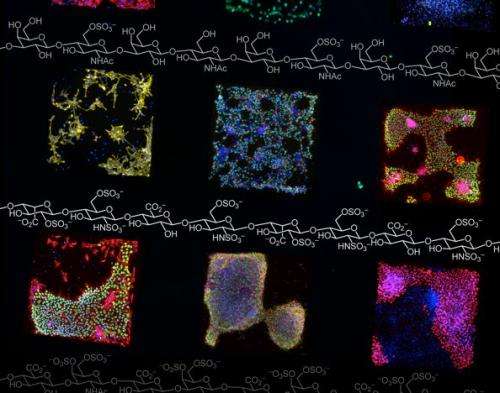
With the ability to grow stem cells on the synthetic surfaces under chemically defined, or known, conditions, Kiessling’s group took an additional step in their latest research. It found that chemically defined surfaces can exert control over signaling pathways. “Signaling” is how molecules talk to one another and get things done inside a cell. It’s how an immune cell knows to fight an infection or how a pancreatic cell determines that more insulin is needed in the bloodstream, for example. By controlling how molecules inside a stem cell communicate, researchers could someday in the future nudge them to become one type of cell or tissue over another.
To see whether a new chemically defined surface could change signaling in a pilot experiment, Kiessling tested cancer cells. The research involved use of a signaling substance, transforming growth factor-beta (TGF-beta), which controls a range of activities, from cell growth to self-destruction.
“The new surfaces give scientists much more control over cells, opening up a wide range of possible future applications,” Kiessling explained. Building directly on the results of the pilot study, the surfaces could have applications in wound healing. TGF- beta can help wounds heal, but if it touches healthy skin, inflammation or even a cancerous tumor could develop. “We haven’t done this, but you could imagine a bandage that has a localized concentration of the special peptide surface that would recruit TGF-beta just to the wound site,” said Kiessling.
The surfaces also could make it easier to manufacture organs and tissues in the laboratory someday. “We think that this strategy, with different sets of peptides (building blocks of proteins) bound to the surface, could direct certain human embryonic stem cells on the surface to become one type of cell and other stem cells to become a second cell type, right next to each other. For the tissue engineering involved in growing replacement organs, you need to organize specialized cells in particular ways like this.”
Provided by American Chemical Society


