Cape Cod Bay holds hidden risk for dining North Atlantic right whales
Tracking their dinner may be the best way to help North Atlantic right whales in Cape Cod Bay avoid being hit by recreational and commercial boats, according to a team of researchers who studied the whales for two years.
"Auto-detection buoys are making a remarkable attempt at recording the whale sounds to show when whales are in the area," said Susan Parks, assistant professor of acoustics and ecology and senior research associate, Penn State Applied Research Laboratory. "But North Atlantic right whales don't make call sounds when they are eating, so they don't show the whales when they are feeding."
North Atlantic right whales, like Southern and North Pacific right whales, are an endangered species. The researchers report in today's (Aug 3) issue of Biology Letters that "North Atlantic right whales have the largest per capita record of vessel strikes of any large whale population in the world."
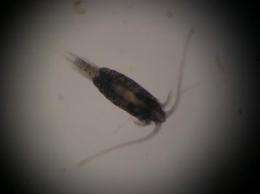
These whales are susceptible to being struck by boat propellers when they are in Cape Cod Bay because the whales feast on copepods -- tiny crustaceans the size of sesame seeds -- that school in very large masses just below the water's surface. The whales eat for about 18 hours. consuming between 125 to 400 pounds of copepods an hour with their mouths open like large scoops.
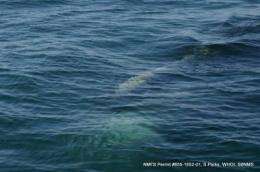
After two years of study, the research team determined that during the day when they feed, the North Atlantic right whales spend most of their time between the surface and 13 feet below. When the whales are below the surface, but still in the reach of boat propellers, they are invisible to people on the boats and consequently may be hit unintentionally.
"We found that every whale spent a lot of time just below the surface, where they can't be seen while feeding," said Parks. "It is a good thing that the whales are in Cape Cod Bay in April when it is pretty cold and not a lot of recreational boating is going on, because any boat, even small recreational boats, could bump into them."
The researchers have been studying the whales in Cape Cod Bay by placing suction cup tags -- digital acoustic recording tags developed by the Woods Hole Oceanographic Institution -- on the whales and recording their depth through the day.
The researchers also investigated the whale's preferred prey, the copepods, using acoustics and physical sampling methods. Using an echosounder -- a device like a depth sounder -- that could produce multiple sound frequencies, the researchers tested a variety of depths from about 1.5 to 90 feet below the surface looking for the copepods. Because sound waves bounce off objects, the scientists were able to locate tiny objects that could be copepods and eliminate large fish and crustaceans because of their large size. However, sound waves can locate objects of the proper size to be copepods, but cannot not detect whether these objects are copepods or inanimate debris of the same size.
To ensure that what the ecosounder recorded was actual prey, the researchers also looked at netted and pumped samples. Using very fine mesh nets less than 1640 feet from a tagged whale, they retrieved samples of the water and preserved any wildlife in formalin for identification. They also pumped samples from the water and preserved the samples in the same way.
The physical samples matched the acoustic data and showed that "there was a strong relationship between the depth of the center of a feeding whale's mouth and the mean depth of the top 5 percent concentration of their prey in the water column," the researchers reported.
The researchers suggest that the development of moored devices that can remotely detect the copepods may provide a way to remotely monitor where unseen and unheard right whales may be and provide a warning to avert ship collisions.
"The daytime and nighttime behavior may be different, but we don't know the nighttime behavior because every whale we tagged with a suction cup recorder slipped out of it before evening," said Parks.
Provided by Pennsylvania State University


