The atomic clock with the world's best long-term accuracy is revealed after evlauation
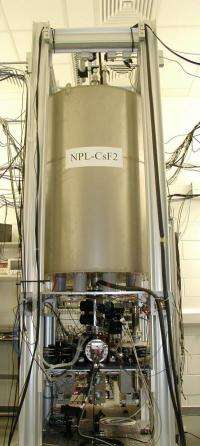
A caesium fountain clock that keeps the United Kingdom's atomic time is now the most accurate long-term timekeeper in the world, according to a new evaluation of the clock that will be published in the October 2011 issue of the international scientific journal Metrologia by a team of physicists at the National Physical Laboratory (NPL) in the United Kingdom and Penn State University in the United States. An early posting of the paper on the journal's online site will occur on 26 August 2011.
The clock is one of an elite group of caesium fountain clocks that have been built by the timing labs in Europe, the United States, and Japan as their national "primary frequency standard" for the measurement of time. These national standards are averaged to produce International Atomic Time and Universal Coordinated Time, which are used as time scales worldwide for such critical processes as global communications, satellite navigation and surveying, and time stamping for the computerized transactions of financial and stock markets. The methods used to improve the U.K. clock also can be used to evaluate the caesium fountain clocks of other countries, substantially improving the world's most accurate methods of keeping time.
"The improvements that we report in our paper have reduced significantly the caesium fountain clock's two largest sources of measurement uncertainties -- Doppler shifts and the microwave-lensing frequency shift," said NPL Project Leader Krzysztof Szymaniec. Other authors of the paper are Ruoxin Li and Professor of Physics Kurt Gibble at Penn State. The physicists evaluated the recently upgraded caesium fountain clock with physical measurements at NPL and mathematical models developed at Penn State.
"Kurt Gibble, at Penn State, made major contributions to the field of primary frequency standards by developing models for the systematic effects within caesium fountain clocks," Szymaniec said. "The uncertainties of those effects, now reduced several fold with the new models and numerical calculations provided by Gibble's group, have been verified at the National Physical Laboratory and also by the fountain clock group in Paris. Together with other improvements of the caesium fountain, these models and numerical calculations have improved the accuracy of the UK's caesium fountain clock , NPL-CsF2, by reducing the uncertainty to 2.3 × 10⁻¹⁶ -- the lowest value for any primary national standard so far."
Scientists estimate the accuracy of a caesium fountain clock by evaluating the uncertainties of all the physical effects known to cause frequency shifts in the clock's operation, including atomic interactions with external fields, collisions between atoms, and the construction of the atomic clock's subsystems, such as its microwave cavity. The two largest sources of these measurement uncertainties are frequency shifts caused by the Doppler effect and microwave-lensing. "One of the improvements that our model contributed is an improved understanding of the extremely small Doppler shifts that occur in caesium fountain clocks," Gibble said. While the acoustic Doppler shift of a car horn is well known in everyday lift, he explained that Doppler shifts for light are too small for people to notice. "If you are walking down the sidewalk while looking at a red traffic light, your eyes cannot perceive the small Doppler shifts resulting from your movement that shift the light toward the blue end of the spectrum," Gibble said. "This change in color is just 1/100 millionth of the difference between red and blue. In the NPL-CSF2 clock, our model now shows that these Doppler shifts are even 100 million times smaller than that."
The other major source of measurement uncertainties -- microwave lensing -- results from the forces that microwaves in the clock exert on the atoms used to measure the length of a second. "An international agreement on the definition of the second is of fundamental importance in timekeeping," Szymaniec said. He explained that the length of a second, by international agreement, is the "transition frequency between two ground-state sublevels of a caesium 133 atom." To measure this frequency, caesium fountain clocks probe laser-cooled caesium atoms twice as they travel through the clock's microwave cavity -- once on their way up and again on their way down. To achieve an accurate assessment of the clock's frequency, the physicists had to include in their models an understanding of how microwaves push on the quantum-mechanical atoms. As a result, Gibble said, "We now know that the NPL clock is so precise that it has to be considered as an atom interferometer."
"The first atomic clock was demonstrated at NPL and we have lead research into providing ever more accurate time keeping," Szymaniec said. "Combining our own measurement expertise with that of our colleagues at Penn State, we have shown that timekeeping at NPL continues to be some of the most advanced in the world."
Provided by Pennsylvania State University


