Inspired by teflon, researchers create super durable proteins
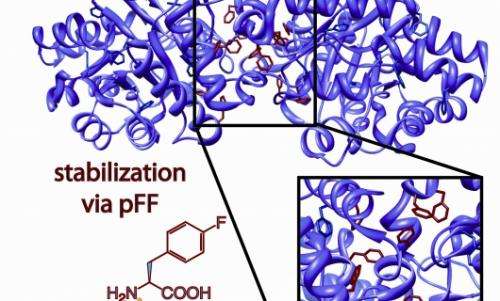
Fluorinated amino acids (p-fluorophenylalnine highlighted in the interface) help stabilize Teflon-like proteins against heat inactivation, allowing them to function more robustly, even at elevated temperatures.
(PhysOrg.com) -- More than 50 years ago, NYU-Poly alumni John Gilbert was asked to evaluate a newly- developed material called Teflon. His experiments using the fluorinated polymer as a surface coating for pots and pans helped usher in a revolution in non-stick cookware. Today, NYU-Poly Assistant Professor of Chemical and Biological Sciences Jin Montclare is taking the research theme in a new direction, investigating fluorinated proteins -- a unique class of proteins that may have a wide range of applications from industrial detergents to medical therapeutics.
In a paper published in the current issue of ChemBioChem, Montclare and Peter Baker, who just received his doctoral degree from NYU-Poly, detail their success in creating proteins that are considerably more stable and less prone to denaturation than their natural counterparts. These qualities enable them to retain both their structure and function under high temperatures in which other proteins would simply break down.
Inspired by the ability of fluorinated polymers like Teflon to stabilize surfaces, Montclare and Baker set their sights on developing a process that would allow them to reinforce the interface of proteins, rendering them more resistant to degradation.
One of the main challenges of proteinswhether theyre in the body or in the labis that they are naturally created to function under specific conditions, and to break down under others, Montclare explained. A stable protein that was still active and functional under a variety of conditions would open up an extraordinary range of potential for scientists and product developers.
Through a trick of genetic engineering, the scientists were able to coax a strain of bacteria into taking up amino acidsthe building blocks of proteinthat were chemically altered by the addition of fluorine. Nature doesnt make fluorinated amino acids, but these experiments show that we can create them, said Montclare. The result was a "fluorinated" protein that can withstand temperatures up to 140 degrees Fahrenheit with no compromise in activity or function.
Next up for Montclare and Baker are experiments to test the limits of their success in creating fluorinated or Teflon-like proteins. Theyre hoping that this type of effect can be achieved with a wide range of proteins, especially those used in medicine including some therapeutic cancer drugs. The stable proteins may also some day act as prophylactics to combat exposure to neurotoxic agents (including warfare agents)something that is of interest to the Department of Defense. The scientists hope to improve the proteinsdurability and decrease the need for precise storage conditions, which often include refrigeration to prevent breakdown.
More information: Paper online: http://dx.doi.org/ … ic.201100221
Provided by Polytechnic Institute of New York University
-
From lemons to lemonade: Reaction uses carbon dioxide to make carbon-based semiconductor,
32 comments
-
Thioridazine kills cancer stem cells in human while avoiding toxic side-effects of conventional cancer treatments,
3 comments
-
SpaceX private rocket blasts off for space station (Update),
42 comments
-
Climate scientists say they have solved riddle of rising sea,
31 comments
-
SpaceX capsule has 'new car' smell, astronauts say (Update),
2 comments
-
Gibbs Free Energy Change/Entropy
7 hours ago
-
What's the rule to covalent character
9 hours ago
-
Schwartz reagent-- NMR/MS/IR
May 26, 2012
-
High school chemistry EEI
May 25, 2012
-
oxidation of I- by KMnO4
May 25, 2012
-
Inversion temp
May 25, 2012
- More from Physics Forums - Chemistry
More news stories
Computer model used to pinpoint prime materials for efficient carbon capture
When power plants begin capturing their carbon emissions to reduce greenhouse gases and to most in the electric power industry, it's a question of when, not if it will be an expensive undertaking.
43 minutes ago |
not rated yet |
0
|
Scientists develop ultra-sensitive test that detects diseases in their earliest stages
Scientists have developed an ultra-sensitive test that should enable them to detect signs of a disease in its earliest stages, in research published today in the journal Nature Materials.
Chemistry / Analytical Chemistry
43 minutes ago |
not rated yet |
0
|
New CO2-removing catalyst can take the heat
(Phys.org) -- The current method of removing the greenhouse gas carbon dioxide (CO2) from the flues of coal-fired power plants uses so much energy that no one bothers to use it. So says Roger Aines, principal ...
May 24, 2012 |
5 / 5 (9) |
10
|
High-speed method to aid search for solar energy storage catalysts
Eons ago, nature solved the problem of converting solar energy to fuels by inventing the process of photosynthesis.
May 25, 2012 |
5 / 5 (3) |
4
|
Researchers demonstrate possible primitive mechanism of chemical info self-replication
(Phys.org) -- When scientists think about the replication of information in chemistry, they usually have in mind something akin to what happens in living organisms when DNA gets copied: a double-stranded molecule ...
May 25, 2012 |
5 / 5 (4) |
2
|
Change in developmental timing was crucial in the evolutionary shift from dinosaurs to birds: study
At first glance, it's hard to see how a common house sparrow and a Tyrannosaurus Rex might have anything in common. After all, one is a bird that weighs less than an ounce, and the other is a dinosaur that ...
'Unzipped' carbon nanotubes could help energize fuel cells, batteries
Multi-walled carbon nanotubes riddled with defects and impurities on the outside could replace some of the expensive platinum catalysts used in fuel cells and metal-air batteries, according to scientists at ...
T cells 'hunt' parasites like animal predators seek prey, study shows
By pairing an intimate knowledge of immune-system function with a deep understanding of statistical physics, a cross-disciplinary team at the University of Pennsylvania has arrived at a surprising finding: T cells use a movement ...
Manufacturing genes to attack flu virus
An international research team has manufactured a new protein that can combat deadly flu epidemics.
Yale study concludes public apathy over climate change unrelated to science literacy
Are members of the public divided about climate change because they don't understand the science behind it? If Americans knew more basic science and were more proficient in technical reasoning, would public consensus match ...
Same gene that stunts infants' growth also makes them grow too big: research
UCLA geneticists have identified the mutation responsible for IMAGe* syndrome, a rare disorder that stunts infants' growth. The twist? The mutation occurs on the same gene that causes Beckwith-Wiedemann syndrome, which makes ...
Jul 04, 2011
Rank: 3.3 / 5 (3)
The horror in my mind is that if this technology is not properly guarded; bacteria which can create protein polymers that withstand up to 140 degrees F.
If a protein is created that can infect humans; while the bacteria may die, the new proteins will not be destroyed by a fever and what does that mean for humans or other life forms?
I am not a scientist do please don't give berating comments if you are; please use your comments to educate a lay person who has a question vs making a declaration.
Jul 04, 2011
Rank: 5 / 5 (1)